


Five times classical composers made rockstars look tame

The rockstar is practically synonymous with debauchery. Whether it’s Jimmy Page covering his naked body in whipped cream, Tony Iommi setting his bandmate Bill Ward on fire, or Keith Richards burning down the Playboy mansion, the golden age of guitar music is overflowing with stories of sex, drugs and occult activity.
But don’t for a minute assume that rockstars invented debauchery. Some of the most sordid and scandalous activity, I’ll have you know, was enacted by gentlemen in powdered wigs and tights – and I’m not talking about Rod Stewart. Orchestral music might seem rather staid, but in its heyday, composers like Mozart, Beethoven, Stravinsky and Paganini stood at the vanguard of innovation. This meant wealth, fame and (in the case of Franz Lizst, at least) lots of sex.
It also usually meant rather a lot of booze. Liszt supposedly drank a bottle of cognac a day, Brahms drank himself to death at 32, and Finnish composer Jean Sibelius liked nothing more than overeating and getting hammered with his friends.
In this time-travelling list, we’ll be heading to the gilded concert halls of Vienna, the musty chambers of 18th-century Italy and the theatres of early 20th-century Paris to examine some of the most bizarre, dramatic and outrageous moments in orchestral music.
Five times classical composers made rockstars look tame:
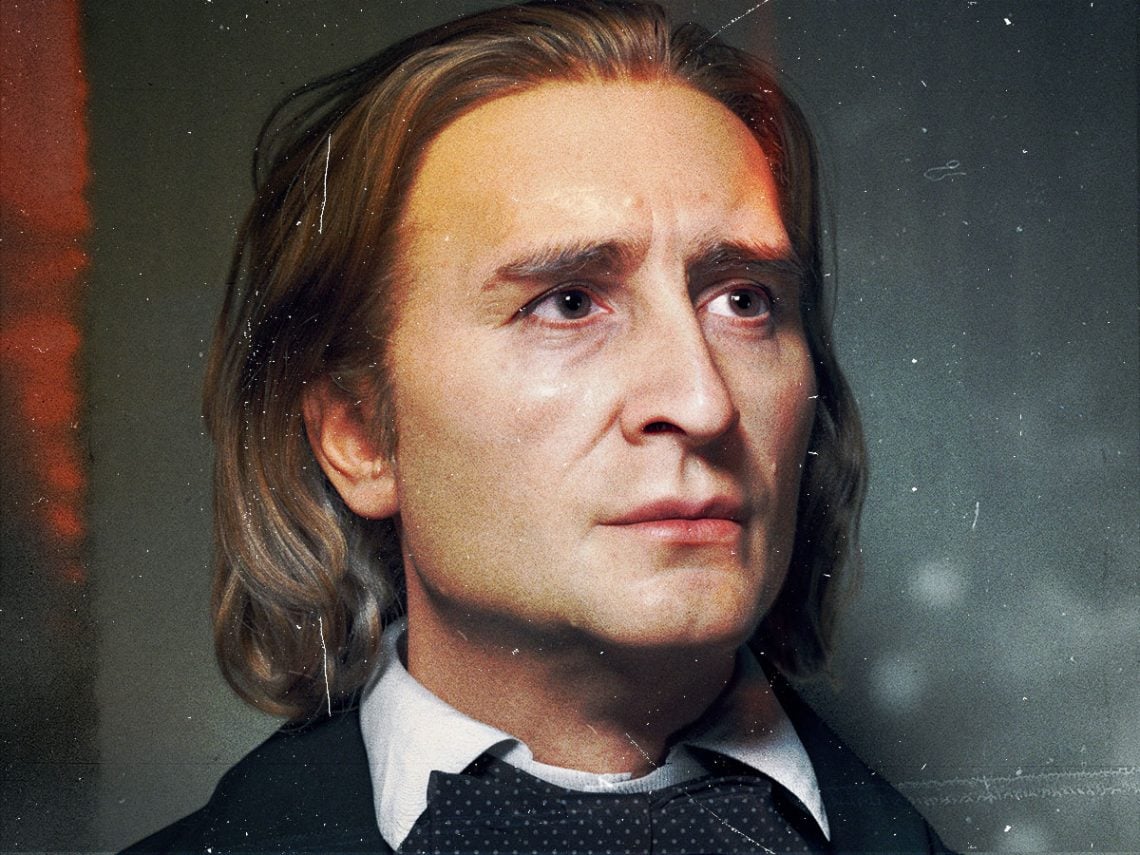
Lisztomania hits Europe
You’ll undoubtedly have heard of Beatlemania. You might even have heard of its ’50s forerunner – Presleymania. But how many of you have heard of “Lisztomonia” – the music craze that swept across mid-19th century Europe in response to charismatic Hungarian pianist Franz Liszt?
In 1839, the young virtuoso pianist and composer embarked on his first concert tour of Europe. As well as countless honours and awards, Liszt’s performances won him enormous fame, with polite ladies literally throwing themselves at the composer’s feet, fighting over broken piano strings (his performance style really was that frenzied) and cutting off locks of his hair. It’s believed that some women even salvaged his discarded cigar butts and placed them in their cleavage.
Liszt was a very dynamic personality, seducing countless women with his charisma and talent. In fact, the Lisztomania phenomenon was so intense in its effects that some considered it a genuine medical condition. In The Virtuoso Liszt, Dana Gooley quotes an 1843 clipping from a Munich newspaper which reads: “Liszt fever, a contagion that breaks out in every city our artist visits, and which neither age nor wisdom can protect, seems to appear here only sporadically, and asphyxiating cases such as appeared so often in northern capitals need not be feared by our residents, with their strong constitutions.” Blimey.
Mozart writes shit music
On November 5th, 1777, Wolfgang Amadeus Mozart wrote the following letter to his cousin Maria: “Well, I wish you good night, but first / Shit in your bed and make it burst / Sleep soundly, my love / Into your mouth your arse you’ll shove”.
The rhymed verse is just one example of the composer’s bewildering obsession with scatological humour. That’s right: Mozart had a potty mouth. He famously composed a party piece titled Leck mich im Arsch, or “lick me in the arse”, before his death in 1791. The canon includes the following lyric: “Leck mich im A[rsch] g’schwindi, g’schwindi”, which, in English, roughly translates to: “lick me in the arse, quickly, quickly!”
The composer’s scatological letters have been a source of discomfort for classical music scholars and fans alike. When Margaret Thatcher went to see Peter Shaffer’s play Amadeus, the British Prime Minister scolded the director for portraying the composer as a lover of faeces, unable to come to terms with the fact that Mozart had an incredibly childish sense of humour.
Paganini makes a deal with the Devil
Paganini’s skill was unmatched. As one of the first violinists to perform live without sheet music, he had to memorise incredibly complex pieces such as his ’24 Caprices for Solo Violin’ by heart. Then there were the techniques and articulations he pioneered: showy bow bounces (spiccato), left-hand pizzicato and harmonics. He is believed to have been able to play 12 notes per second, something we now think he was able to achieve due to his unusual finger length, which allowed him to play three octaves in one hand span.
Today, we might call that Marfan syndrome. In the 19th century, they called it the Devil’s work. Italy had already produced many virtuosos, but none like Paganini. His talent, the general public felt, was beyond the earthly realm, and rumours quickly spread that his mother had sold his soul to the Devil.
Paganini was also accused of some pretty nefarious pastimes. The violinist’s fame made him a heavy drinker, gambler and serial womaniser. A notorious rake, he was accused of butchering the women who fell under his spell, using their intestines as violin strings and then imprisoning their souls in the body of his Stradivarius. Some claimed that the screams of these unfortunate souls could be heard from his instrument during live performances.
Stravinsky starts a riot
Igor Stravinsky was virtually unknown when he was hired by Diaghilev’s Ballets Russes to compose the music for The Rite of Spring (Le Sacre du Printemps). At its notorious 1913 premiere, the now-established Russian composer’s work was so provocative it sparked a full-blown riot in the Theatre du Champs-Élysées in Paris.
With The Rite of Spring, Stravinsky broke every rule in the composer’s rulebook, surprising an audience expecting something like “Scheherazade or Cleopatra” with an unflinchingly modernist subversion of timbre, tonality and tempo. The principal bassoon player had barely made his way through the score’s opening bars when the house erupted in a cacophony of jeers. “The curtain opened on a group of knock-kneed and long-braided lolitas jumping up and down. The storm broke,” the composer said of the uproar. “I went out; I said ‘go to hell’… they were very naïve and stupid people.”
The adverse reaction of the Parisian Boergoise only affirmed Stravinsky’s belief that his piece was a landmark. “From all indications, I can see that this piece is bound to ’emerge’ in a way that rarely happens,” he wrote in a letter to his colleague Nicholas Roerich. He was right. That premiere is regarded as marking the birth of modernist music.
Schoenberg predicts his own death
Marc Bolan, Bob Marley, John Lennon: countless famous musicians are believed to have predicted their deaths. More often than not, such claims are pretty tenuous. If you want an example of a musician who successfully predicted their death to the day, look no further than Austrian composer and theorist Arnold Schoenberg.
Schoenberg developed the twelve-tone technique, an era-defining method of manipulating an ordered series of all 12 notes in the chromatic scale to create dissonant yet highly logical musical works. Given his contribution to music, it’s only fitting that he should have had triskaidekaphobia: the irrational fear of the number 13. The composer did everything in his power to avoid the dreaded digit, going so far as to deliberately misspell the name of his opera Moses und Aron, as the correct spelling would have resulted in the title being 13 letters long.
The strangeness of Schoenberg’s obsession is nothing compared to the strangeness of his death. Towards the end of his life, he predicted that his death would occur on Friday, the 13th on July 1951. When that day eventually came, he couldn’t move for anxiety: “About a quarter to twelve, I looked at the clock and said to myself: another quarter of an hour and then the worst is over,” his wife Gertrude recalled. “Then the doctor called me. Arnold’s throat rattled twice, his heart gave a powerful beat, and that was the end”. But the spookiest detail is still yet to come. Schoenberg died at the age of 76. If you isolate those numbers and add them together, what are you left with? 13, of course.
