


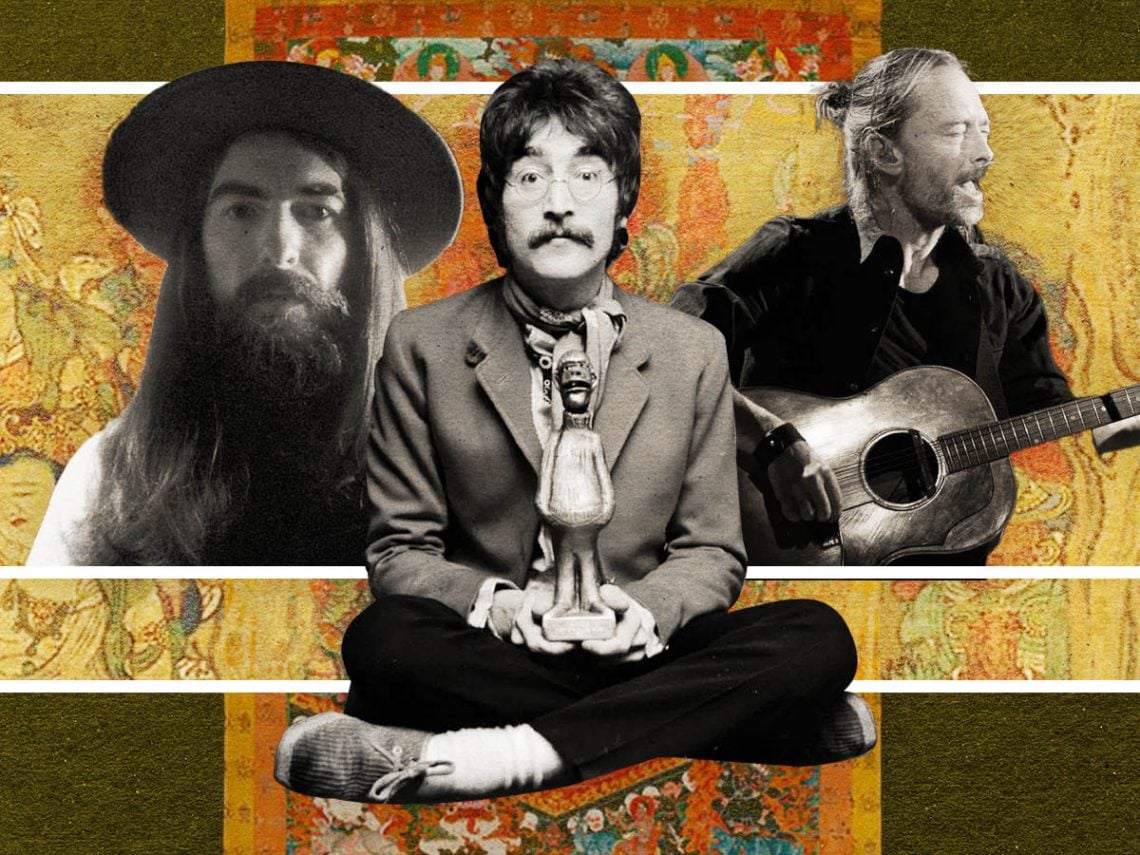
Five artists inspired by ‘The Tibetan Book of the Dead’

Bardo Thodol, commonly known in the west as The Tibetan Book of the Dead, is a comprehensive guide to living and dying. It’s a sacred text that proclaims: “May all sentient beings be endowed with happiness! May they all be separated from suffering and its causes! May they be endowed with joy, free from suffering! May they abide in equanimity, free from attachment or aversion.” And who can’t get behind that sentiment?
Its unburdened spiritualism has provided a crutch for many artists to delve into. It is quite simply, a guide to living well and facing up to mortality while you’re at it. As Graham Coleman’s translation cites: “The Tibetan Book of the Dead contains exquisitely written guidance and practices related to transforming our experience in daily life, on the processes of dying and the after-death state, and on how to help those who are dying. As originally intended this is as much a work for the living, as it is for those who wish to think beyond a mere conventional lifetime to a vastly greater and grander cycle.”
When new-age thinking came to the fore in the 1960s, many rockers sought the ultimate liberation as described thousands of years ago. Spiritualism was the crux of making art more expansive and littering pop with pertinent points to live by. Thus, many of the great and good were drawn to this eastern world of old for inspiration. Below we have looked at how The Tibetan Book of the Dead shaped the output of some of the greatest artists of all time.
Five artists inspired by The Tibetan Book of the Dead:
John Lennon
“The final track on Revolver, ‘Tomorrow Never Knows’, was definitely John’s,” Paul McCartney recalled. “Round about this time people were starting to experiment with drugs, including LSD. John had got hold of Timothy Leary’s adaptation of The Tibetan Book of the Dead, which is a pretty interesting book. For the first time we got the idea that, as with ancient Egyptian practice, when you die you lie in state for a few days, and then some of your handmaidens come and prepare you for a huge voyage. Rather than the British version, in which you just pop your clogs. With LSD, this theme was all the more interesting.”
The book itself contains the classic line, “Whenever in doubt, turn off your mind, relax, float downstream,” which Lennon later transposed into the lyrics of his “first psychedelic anthem”. Lennon, however, learnt early that spiritualism in music was best tempered with a sprinkling of sugar. As he said: “That’s me in my Tibetan Book of the Dead period. I took one of Ringo’s malapropisms as the title, to sort of take the edge off the heavy philosophical lyrics.”

Leonard Cohen
For some reason, it is quite a comical motif to picture Leonard Cohen playing tennis, but when he absconded to a Buddhist Monastery that is exactly what the monks sent him to do. Their goal was to get him to take life a little less serious. He had been informed that he “knew how to work but not how to play.” This all led Cohen to celebrate the mantra which he continued to extol long after he hung up his racket: “Lighten up! That’s what enlightenment means, to lighten up.”
This notion of separating yourself from work was pivotal for him. Much of his later work was inspired by the liberated notion of finding peace. Thus, he decided to repay the faith and the inspiration it had given him by narrating a two-part documentary series on The Tibetan Book of the Dead.

Laurie Anderson
Laurie Anderson and her husband Lou Reed met at a point when they were reconciling their lives in the arts up until that point. Spiritualism was at the centre of the relationship. In fact, they even came up with their own three succinct rules to live by. I’m just going to tell you what they are because they come in really handy,” Anderson once revealed. “Because things happen so fast, it’s always good to have a few, like, watchwords to fall back on.”
The rules are as follows: “And the first one is: One. Don’t be afraid of anyone. Now, can you imagine living your life afraid of no one? Two. Get a really good bullshit detector. And three. Three is be really, really tender. And with those three things, you don’t need anything else.” A fourth may well be to assimilate the wisdom around you so that you can come up with your own rules. For Anderson part of that was reading The Tibetan Book of the Dead, and she went on to construct an album based on readings from it.

Thom Yorke
In the 1990s, spiritualism seemed to have been swapped out for beer swilling. However, Radiohead upheld the old-school end of the arts. Thom Yorke was hoping to capture transcendence in his songs. One of which was ‘I Might Be Wrong’ which dealt with going beyond the physical world. As he said of the track: “’I used to think there was nothing left at all.’ It’s a document of a complete crisis point, basically. I live on a beach and one night I went out on my own and looked back at the house and even though I knew there was nobody there, I could see a figure walking about inside. Then I went back to the house and recorded that track with this presence still there.”
During this manic time in his life, Yorke sought peace and solitude in separating himself from the chaos of circumstance. As Yorke added: “I spent a lot of time watching things die. Walking a lot in vast landscapes, watching the seasons change, ancient rocks, rotting carcasses, flowers blossoming, rivers gurgling. I was reading The Tibetan Book of the Dead as well.”

Patty Waters
It is often the case in cultural history that a lesser-known name helped to launch an entire movement by inspiring the right people at the right time with something fresh that they could feed on and make their own. Jazz singer Patty Waters is one of those people. She directly transposed The Tibetan Book of the Dead notion of letting things flow by opening up a swirling sound and filling it with a maelstrom of wandering emotions.
This unfixed style directly influenced the likes of Yoko Ono and Diamanda Galas. In the domino effect of influence, these names would impact The Beatles, George Harrison’s solo work and so on. In a fateful way, this cycle is the tenet of the book itself. As it states in print: “Our past thinking has determined our present status, and our present thinking will determine our future status; for man us what man thinks.”

