


What is the first sound ever recorded by a machine?

Many believe that Edouard-Leon Scott de Martinville recorded the first sound to be put to a machine in Paris in the late 1850s. This was some two decades before Alexander Graham Bell made the world’s first telephone call in 1876, and Thomas Edison invented the phonograph in 1877.
However, the answer is not as straightforward as it may seem. Scott did indeed record the sound but did not believe anyone would actually listen to what he recorded. Instead, he thought that people would read the tracings. This meant that while the first sound recorded was by Scott, a sound wouldn’t be played back until Edison’s phonograph.
Discussing the topic, Audio historian David Giovannoni said: “The idea of somehow putting those signals back into the air never occurred to [him], nor did it occur to any human being on the planet until 1877.” Giovanni works with the First Sounds collaboration, where you can now listen back to Scott’s first recordings.
Patrick Feaster of the same collaborative project argues that just because Scott wasn’t able to play back the sound shouldn’t mean that he does not get the credit deserved for recording it in the first place. He said: “This was a full-fledged record of sound, no question about that, just as a seismograph records earthquakes. No one faults seismographs for not playing back earthquakes.”
Scott had not been a professional inventor, but he long desired to have a lasting impact on the world of technology. He thought that if a camera is attempting to imitate the eye by capturing an image on paper, then perhaps something to replicate an ear could capture sound.
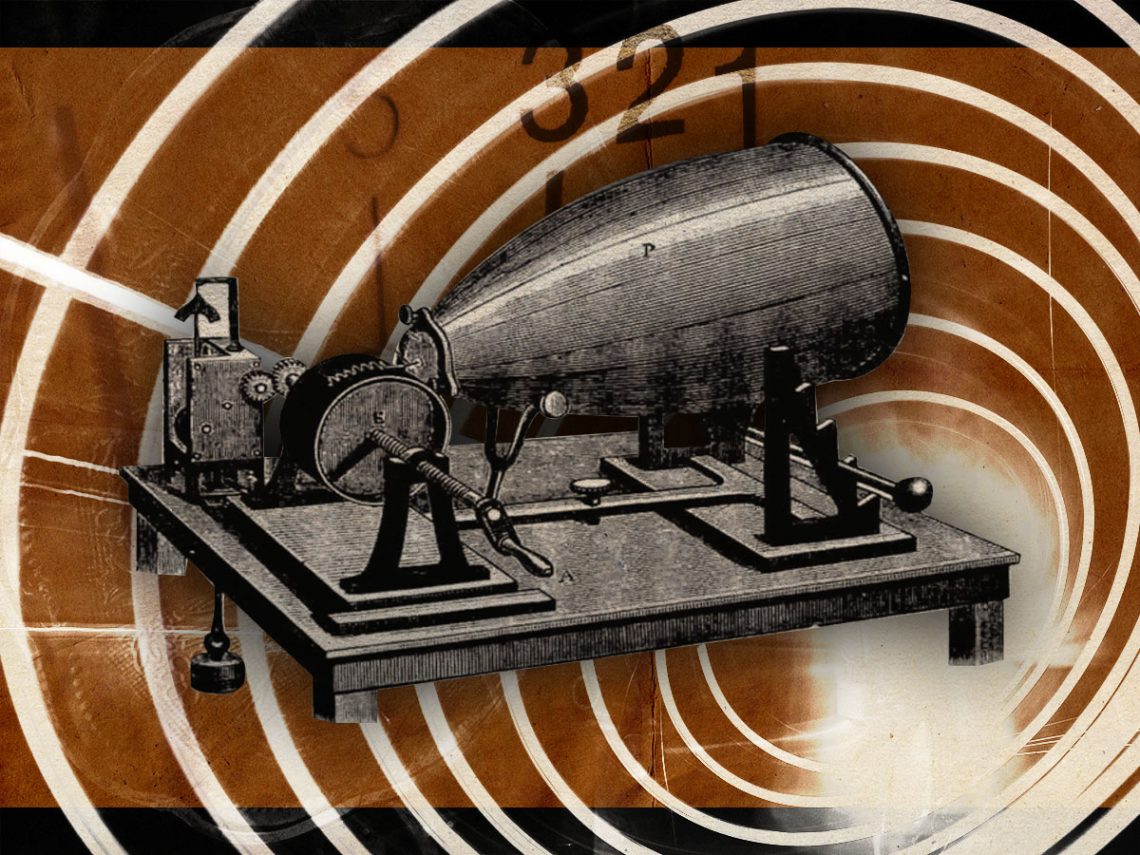
He created a vibrating membrane and attached it to a thin stylus that would mark out how the membrane moved on a sheet of paper covered in soot. This look like a primitive version of what we today know as a soundwave. Ultimately, those initial recordings were rather crude and difficult to interpret.
After improving his technological invention, he would record the sound of a tuning fork on a cylindrically wrapped piece of paper (this allowed for longer recordings) before recording a part of the folk song ‘Au Clair de la Lune’.
However, the recordings were still difficult to interpret. Giovannoni said, “In [one] sense, he failed [but] in another sense, he succeeded wildly. The phonautograph was really the first machine to record sensory data in real time over time.”
