


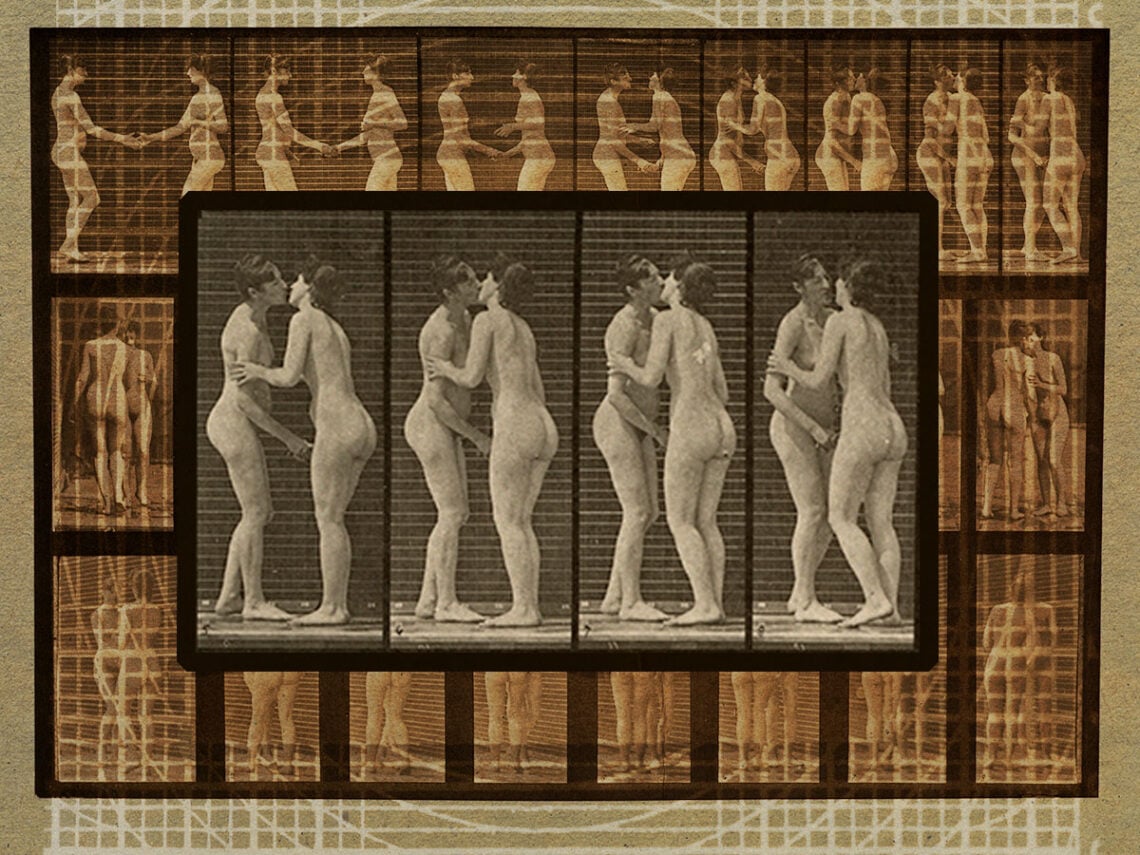
A pioneer of the moving image: The first ever on-screen movie kiss

In contemporary cinema, you can barely move for the amount of smooches, snogs and kisses on the silver screen. While suggestive flirting exists in everything from Top Gun: Maverick to Pixar’s The Incredibles, heavy petting can also be found in softcore form in the Fifty Shades of Grey series as well as in the hardcore variety throughout the movies of cinematic provocateurs Lars von Trier and Gaspar Noé.
Nudity and intimacy, indeed, get punters through the doors of the cinema, but it wasn’t until the late 20th century that such explicit images became the norm, thanks to the sexual revolution of the time. Between the 1960s and 1980s, eroticism was celebrated, not repressed, with sexual liberation movements blossoming thanks to the hippie culture that simultaneously flourished, in part thanks to the creation of the birth control pill.
Yet, before the 1960s, sexual scenes were highly censored in the movie industry, with one of the most popular pieces of film trivia relating to the fact that Alfred Hitchcock’s iconic 1960 horror flick Psycho was the first ever to feature a flushing toilet. Such was done by the British director as a form of protest against the stringent Hays Code, which prevented filmmakers from overstepping the mark of morals.
Enforced back in 1934, the Hays Code introduced a number of rules that felt archaic even during the time, with morally questionable characters being banned, as well as any suggestion towards being sexually active or being curious about gender norms. Hitchcock and many others found ways to bend these rules, with much of their debauchery happening off-screen as well as symbolised by other sneaky means.
But, long before these rules were introduced, filmmaking was largely an experimental space where nudity was explored as an artistic expression. Some of the earliest films to explore sex, nudity, and the very basic expressions of love came in the form of A Woman Undressing and Thomas Edison’s The Kiss, both released in 1896, yet both these popular historical films were predated by Eadweard Muybridge, who captured two women kissing back in 1887.
A pioneer of cinema, Muybridge was as important in fostering the future of the moving image as Georges Méliès, Fritz Lang and the Lumière brothers. Better known for his work creating The Horse in Motion in 1878, a zoetrope animation that would become recognised as the first-ever moving image, Muybridge released The Kiss less than a decade later, with the film created as part of his studies into the movement of humans and animals.
For a long while, a simple kiss was all you could capture in terms of on-screen ‘sexual’ activity, too, with Muybridge, no doubt, being integral to the normalisation of such a human act in cinema.
