


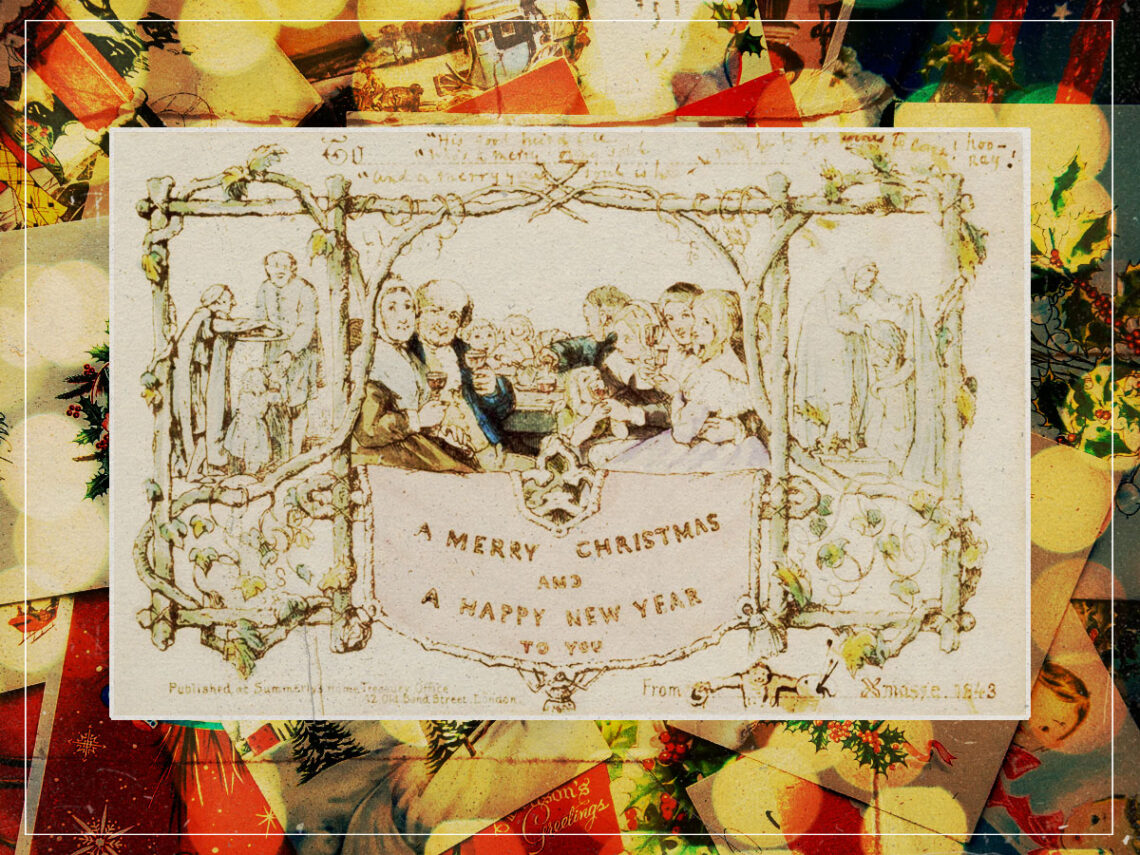
What was the first-ever Christmas card?

There are two things you should know about Henry Cole. One, he was an enthusiastic supporter of the postal system. Two, he had far too many friends. Come Christmas time in Victorian England, his stacked social calendar caused so much anxiety he wound up inventing the first-ever Christmas card. Michael Maier might have beat him on a technicality in 1611, having sent James I of England and his son Henry Frederick what’s considered the very first card. However, Cole pioneered their commercial ubiquity, much to the delight of Moonpig employees to this day.
In 1843, Cole found himself in the unique position of being so popular it was a burden. The social sway he didn’t mind, but it was all the letters that got to him. His plight wasn’t helped by the advent of the penny post, which allowed well-wishers to send letters anywhere in Britain with a penny stamp. Cole, the Victorian answer to Elvis at this point, fretted as letters piled up. Per the conventions of the Victorian letter-writing guides, which were indeed a thing back then, he had to respond.
But the guides also demanded responses be from the heart, written with absolute emotional honesty. He’d stare at the ever-growing pile of wax-sealed letters in despair. There was no way he could reply to them all, so he invented a loophole. He approached John Callcott Horsley with only a husk of an idea and a dream: not to reply to these letters individually.
Horsley was an artist, and Cole asked him to illustrate a scene he’d been mentally brewing, a festive scene involving a family at a table, and – his social standing in mind – drawings of people helping the poor. A pink banner read: “A Merry Christmas and a Happy New Year to you”.
Half the genius was that Horsley’s illustration dominated the page, conveniently meaning Cole had no room to write long-winded missives. But with centimetres to spare on the top and bottom, Horsley had written “to” and “from”, effectively birthing the modern card writing format in one fell swoop.
Cole had 1,000 copies printed. It’s unknown if he used up all of them, but so much is said about his popularity it wouldn’t be a surprise if he had. It was a somewhat controversial move, flouting Victorian letter-writing protocol and doling out an illustration that included children drinking wine. But far from being scandalised, almost everyone was relieved. They could put down the quill pen sooner if they only wrote their names on the cards.
Almost instantly, cards became commonplace. People bought Horsley’s design for a shilling, and soon, more artists were creating their own versions. It took the US a little longer to catch up, but by the 1900s, Christmas cards were everywhere.
