


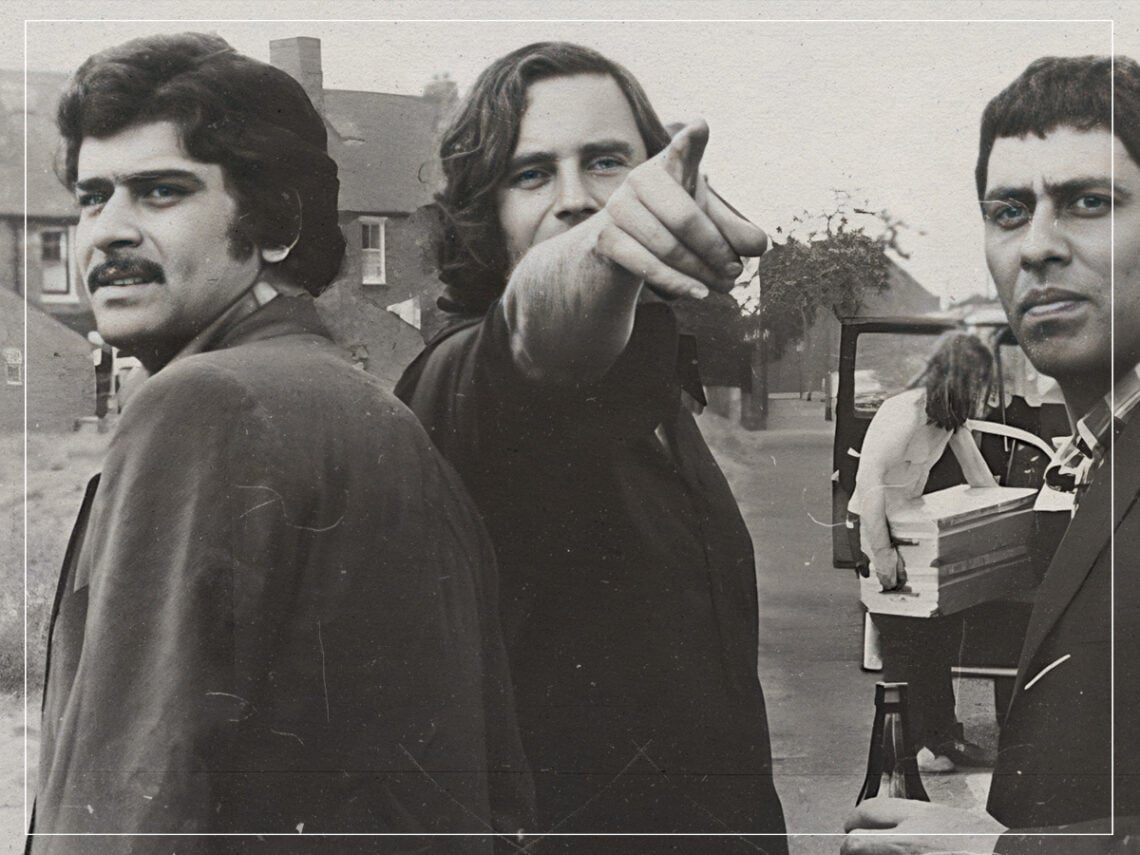
‘A Private Enterprise’: the first British-Asian movie ever made

Amid the tumultuous political landscape of the 1970s, a cultural change was afoot. While far-right hate groups like The National Front marched in the streets, British music and cinema were finally starting to take notice of the country’s increasingly diverse population. One of the most promising results of this was the 1974 film A Private Enterprise, the first British movie to centre around a South Asian cast.
South Asians have had a presence in the UK, in some form, going back hundreds of years, but levels of immigration rose steeply in the 20th century as the result of the post-war labour shortage in 1945. The next few decades saw many people travel over from Pakistan, Sri Lanka, and India to find work, many settling in industrial cities like Birmingham, Glasgow and Bradford.
Much like the Windrush Generation of people who had come to the UK from the Caribbean, South Asian immigrants faced a great deal of animosity in the country, both from the government and the general public. Groups like the BNP and National Front encouraged many young white men, particularly skinheads, to respond to this influx of immigrants with a wave of violence. South Asians bore the brunt of this terror, often becoming victims of the encouraged “P*** bashing” by National Front skinheads.
It is clear to see, therefore, why A Private Enterprise was such an important film. Not only did it provide a sense of representation for this new generation of British Asians, it exposed the struggles that many members of that community faced. Shot on a shoestring budget, the movie focuses on the life of Shiv Verma, a young Indian immigrant in Birmingham who dreams of starting his own business. The narrative is driven by this desire to open up a factory making plastic trinkets, but along the way, the audience is exposed to the difficulties of living in Britain as an immigrant.
Shiv, played expertly by Salmaan Peer, must grapple with these strange new surroundings of England while also appeasing the traditional Indian values of his uncle Ramji. The character doesn’t seem to fit in anywhere, equally ostracised by both English and Indian cultures, as is symbolised by his romantic exploits in the film. Meeting an English girl, Shiv soon discovers that he is viewed as an exotic object of curiosity rather than a legitimate romantic candidate. Likewise, when his uncle Ramji attempts to organise an arranged marriage, the young man is put off by the girl’s materialism.
Throughout the movie, Shiv is portrayed as an individual determined to do things his own way, who often becomes frustrated with the expectations placed on him as an Indian immigrant. He seeks genuine connections rather than skin-colour-based alliances and continues to chase his entrepreneurial dreams.
In addition to painting an often bleak image of the position of British Asians in the 1970s, A Private Enterprise is characterised by its warmth and love for the culture it is based around. Although the low budget is often painfully evident, and many of the acting performances leave much to be desired, there is no doubt that this pioneering work acted as an inspiration for future generations of British-Asian filmmakers. In that sense, A Private Enterprise is so much more important than just another social realist project. It is a manifesto for the expression of British-Asian voices in the popular culture of the UK. In spite of its importance, the movie has been largely forgotten by mainstream audiences, with the only clip available online being a TikTok of somebody restoring an original 35mm print of the film.
