


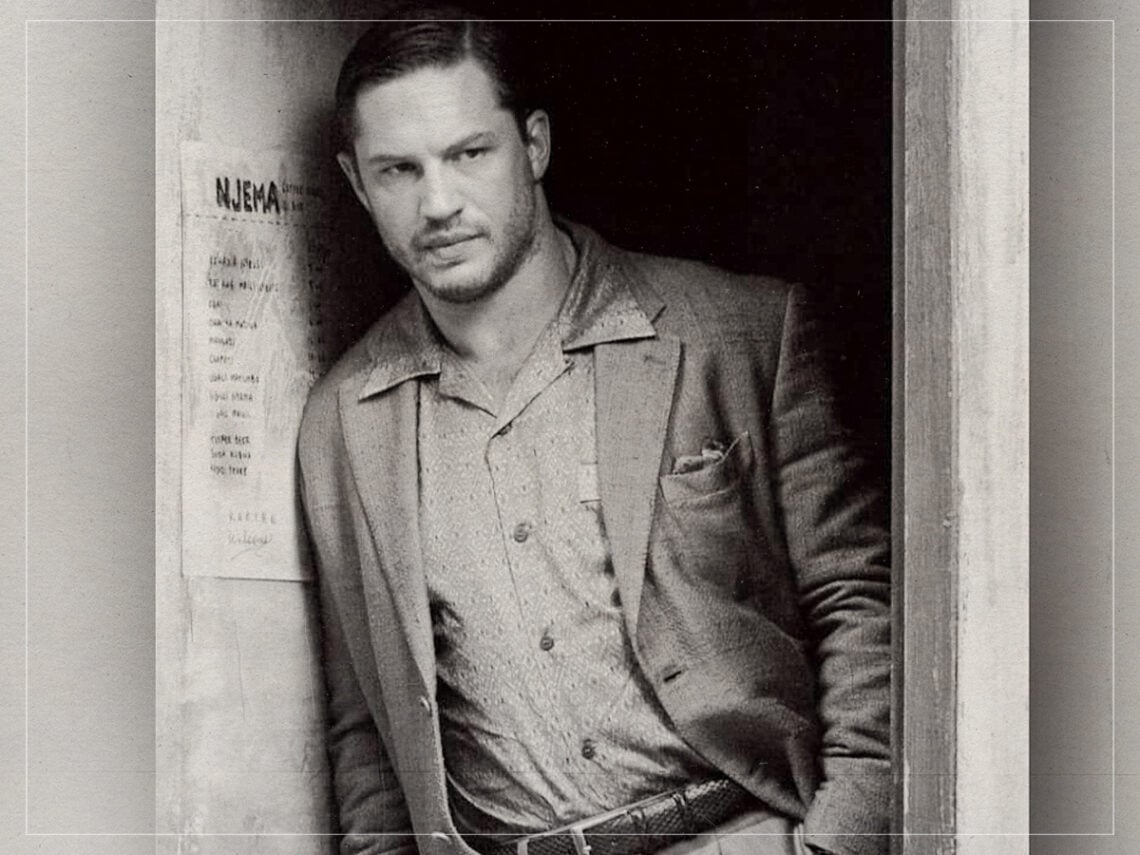
The filmmaker banned from looking at Tom Hardy: “They made me hide behind a tree”

In late 2022, a legendary 80-year-old photographer and filmmaker who had spent nearly six decades immersed in the lives of various fascinating and often dangerous subjects found himself in a strange situation. As he hid behind a tree in downtown Cincinnati on the set of a movie based on a pioneering book he published in 1968, he couldn’t help thinking how silly the whole situation was. You see, he was secreted behind the tree because Tom Hardy, the film’s star, didn’t want anyone to look him in the eye.
In truth, rumours of Hardy’s, shall we say, difficult and aloof nature have been doing the rounds for years at this point. He is one of the few stars in this day and age who still has a mystique that surrounds him – an aura that carries through to interviews, where journalists often don’t quite know what to make of him. Indeed, when stories of his odd behaviour on-set mingle with his intense, often terrifying, performances on-screen, it can make him a slightly intimidating prospect to interact with.
It’s well-known at this point that Hardy and co-star Charlize Theron almost came to blows while making Mad Max: Fury Road, something both of which have apologised for in later years. However, Hardy’s tales of moviemaking unapproachability are usually much less explosive, if no less odd. For instance, in his memoir Making It So, Patrick Stewart wrote about working with a young Hardy on 2002’s Star Trek: Nemesis. He tagged him “an odd, solitary young man from London.”
“Tom wouldn’t engage with any of us on a social level,” Stewart claimed. “Never said, ‘Good morning,’ never said, ‘Goodnight,’ and spent the hours he wasn’t needed on set in his trailer with his girlfriend.” Stewart clarified that Hardy wasn’t overtly rude or confrontational, but the fact he kept himself so removed from all his co-workers was strange. “On the evening Tom wrapped his role, he characteristically left without ceremony or niceties, simply walking out of the door,” Stewart wrote. “As it closed, I said quietly, “And there goes someone I think we shall never hear of again.”
Naturally, Stewart was wrong, and Hardy went on to become one of the biggest British stars of his generation. But his antisocial behaviour on movie sets clearly never went away, much to the chagrin of Danny Lyon on the set of Jeff Nichols’ The Bikeriders.
“I just want to meet Tom Hardy. He gets [in position], and they say, ‘You can’t look at him.’ I said, ‘What do you mean? Why can’t I look at him?’ They say, ‘Oh, he doesn’t like it.'”
Danny Lyon
Nichols’ film tells the story of Vandals Motorcycle Club, a Chicago-based club formed in the 1950s by leader Johnny Davis (Hardy) after he watched Marlon Brando’s rebellious turn in The Wild One. The movie was a fictionalised version of a real-life club, though – the Outlaws Motorcycle Club – who were documented in a bestselling book by Lyon.
Lyon embedded himself with the club for four years between 1963 and 1967, photographing them extensively and learning everything he could about their outlaw lifestyle. By the end of his time with the outfit, though, Lyon admitted, “I was kind of horrified…I remember I had a big disagreement with this guy who rolled out a huge Nazi flag as a picnic rug to put our beers on. By then, I had realised that some of these guys were not so romantic after all.”
In subsequent years, Lyon completed more works of ‘New Journalism’, documenting the lives of inmates in Texas prisons, and moved into non-fiction filmmaking with titles like Los Niños Abandonados, Born to Film, Willie, and Murderers.
By the time Lyon found himself cowering behind a tree at 80 to avoid a major movie star catching his gaze, though, it all felt more than a little absurd. “They tried to keep me away, but I finally get there,” Lyon explained to The Telegraph. “And it’s fucking freezing.”
A despondent Lyon then sighed and referred to the whole debacle as “bullshit.” Oh dear.
