


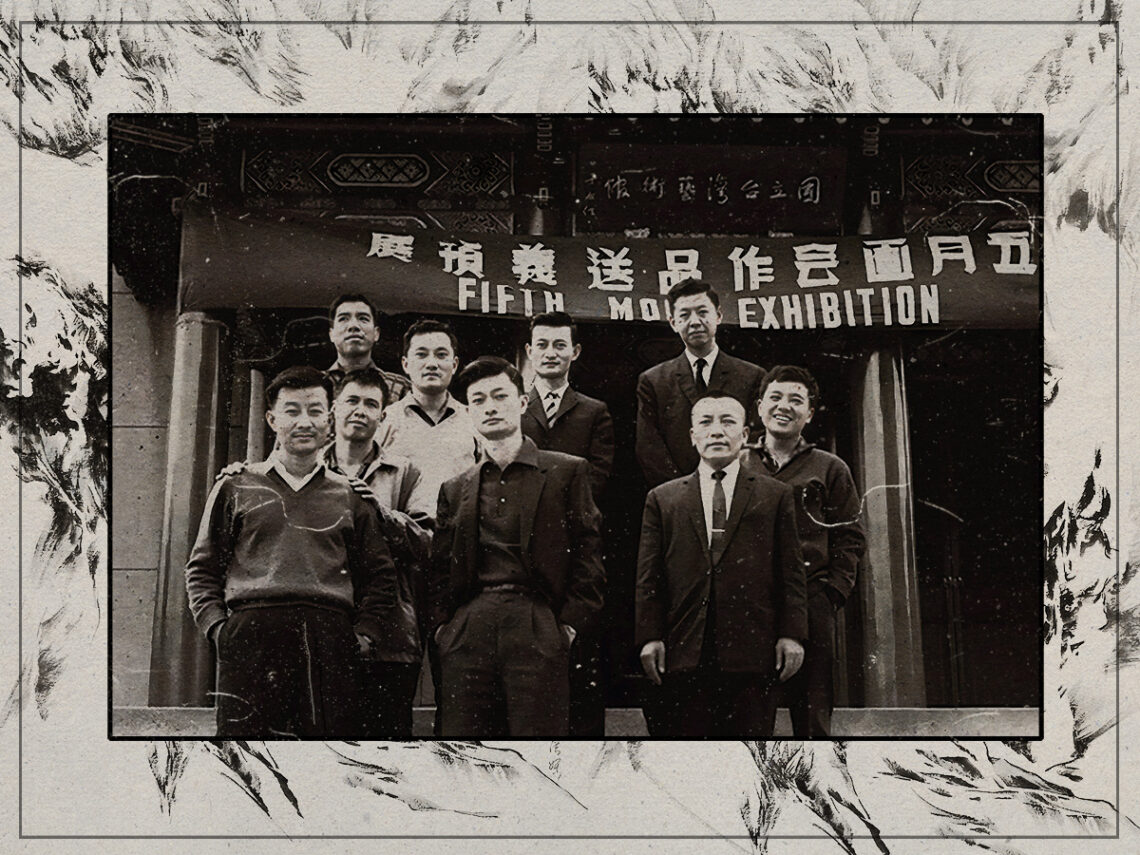
How the Fifth Moon Group modernised Chinese art

In the 1950s, a collection of artists revitalised Taiwan’s art scene by combining traditional features of Chinese art with American expressionism. The Fifth Moon Group’s peak coincided with Mao Zedong’s “Great Proletarian Cultural Revolution”, which aimed to use art as a political service to elevate the Communist Party. The overarching goal was that art should reflect the positive elements of living under Communism. Traditional Chinese traditional arts were often publicly attacked, but the Fifth Moon Group chose to pay homage to them.
All of the group’s members went to the National Taiwan Normal University, which sent its students on a yearly trip to the Taiwan Provincial Fine Arts Exhibition. On the fourth year of the trip, four of the Fifth Moon Group members decided to enter the exhibition, growing tired of the lack of diversity they saw in the artworks on display.
“Three of us failed,” recalled Liu Kuo-Sung, one of the founding members of the group. “It was apparent that only those who presented the most conservative artwork had been selected. Someone even told us we were never going to be chosen since the winning participants were students of the jury themselves.”
He decided if they couldn’t properly showcase their work because of conservative art ideals, they should just organise their own. “This is how the Fifth Moon Group began,” he told BlouinArtInfo. What followed was a series of works that seemed to blend Western and Eastern traditions. Initially, their work adopted a Western look completely, almost as a small rebellion.
“But on reconsideration,” said Kuo-Sung, “We realized that Abstract Expressionism in America was inspired by the West’s impression of Chinese calligraphy, so why don’t we advocate our own traditional heritage?” That decision saw them forge a new kind of style, not limited to the confines of abstract expression as pioneered by American artists like Mark Rothko and Lee Krasner, but fusing their own cultural traditions with them to create something entirely new.
Kuo-Sung was trained in traditional Chinese painting in Wuchang of Hubei Province and is considered one of the forefathers of modern ink painting. It was his opinion that the American art he had come across in magazines kept at the United States embassy borrowed from Chinese calligraphy as it was. The thought that followed was: “Why can’t we advocate our culture by ourselves?”
As the Fifth Moon Group started to integrate ink painting within their work, other artists began to follow suit, which broke a lot of creatives out of the bounds of social realism. Their emergence heralded a new era, which nodded to traditional Eastern brush strokes while also retaining a sense of modernity with their colour choices. By the early 1960s, Taiwan was seeing a wave of new ink paintings being created.
As Kuo-Sung mused on his website, as he saw it: “Imitating the new cannot replace imitating the old; copying Western art cannot replace copying Chinese art.”
