


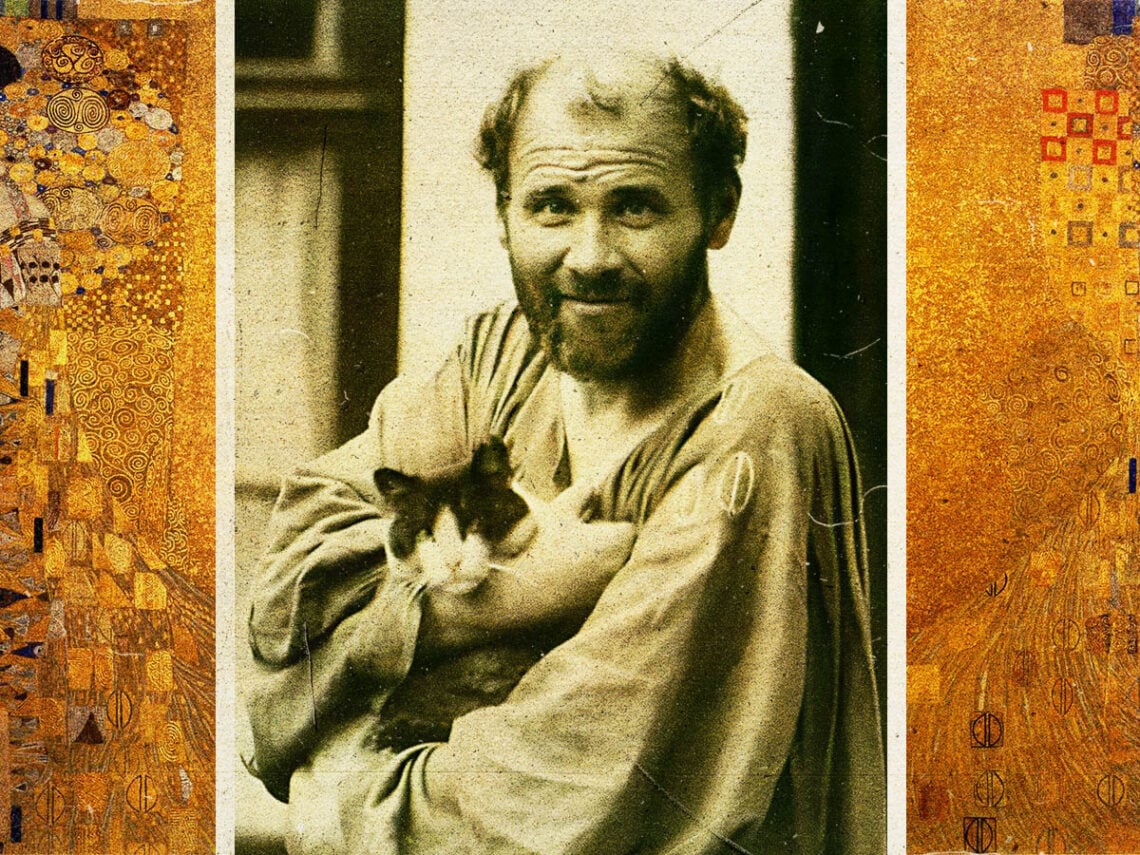
Feline frenzy: Gustav Klimt’s obsession with cats

Gustav Klimt’s paintings are honeycombed with a universal theme of golden eroticism and sexuality. The theory of a dominant and sensual woman instigated many of his paintings, with Klimt stating: “I have never painted a self-portrait. I am less interested in myself as a subject for a painting than I am in other people, above all women… There is nothing special about me”.
While his commissioned ceiling paintings at the University of Vienna were criticised as pornographic, Klimt remained the leader of the Vienna Secession movement.
His portrayal of female sexuality was an instrument in breaking taboos in Viennese society. Klimt’s nude painting ‘Nudas Veritas’ in 1899 caused a wave of controversy when he represented a woman’s pubic hair in a nude painting. Until this moment, women only appeared hairless in nude art. His authenticity and visual truthfulness transgressed the prude 19th-century boundaries at the time. He was also a famed womanizer, engaging in affairs with his muses.
However, it is unknown if his reputation as a womanizer had anything to do with his obsession with the urine of his cats. Reportedly, Klimt cohabited with numerous cats in his studio and had a favourite, which was appropriately called Katze. Klimt and Katz posed in the iconic photograph, where he cradles the cat in his arms, wearing his baggy painter’s smock adorned with a caring expression.
When art critic Arthur Roessler visited the painter’s studio, he was taken aback by the conditions in which Klimt worked. In his shock, he recalls his conversation with Klimt: “As I sat with Klimt and rummaged around in a heap of papers, surrounded by eight or ten meowing, purring cats, play fighting with each other, so much so that the rustling study sheets just went flying, I asked him, puzzled, why he tolerated such antics spoiling hundreds of the most beautiful drawings.’
Klimt remained unstirred by the chaos around him and replied: “No, my friend, even if they crumple and tear one or the other pieces of paper,” he said. “It doesn’t matter; they only pee on the others, and, you know, it makes the best fixing agent”. Before you reach out for the litter tray, this claim has been debunked. Cat urine has effectively ruined some of Klimt’s drawings and probably his sense of smell. In fact, if you try to search for ‘cat urine fixing agent painting’, the most helpful article you’ll get is a tutorial on how to remove it.
Klimt’s feline eccentricity is unsurprising and probably the least controversial fact about a male artist from the 20th century. His humble roots in the suburbs of Vienna meant that he was often caricatured and described as a ‘country bumpkin’ among the upper classes. His dialect, mannerisms and brash vernacular halted his integration into the circle of his wealthy audience. Subsequently, Klimt became emblematic of the reclusive and shy artist, contrasting his polemical paintings. His cats were likely a substitute for the unaccepting higher ranks of society that his fame propelled him into.
