


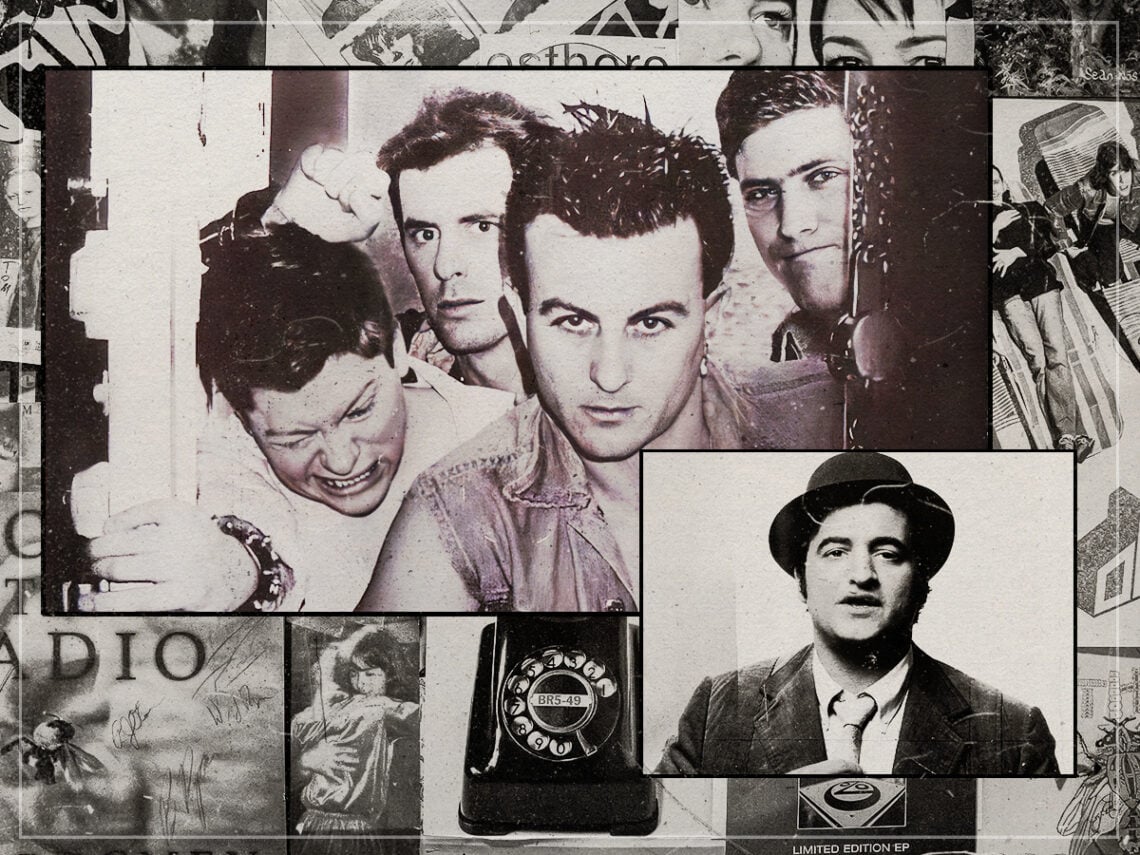
Fear: the remarkable tale of John Belushi’s favourite band

Originating from Los Angeles in 1977, Fear is often recognised as a trailblazer in the California hardcore and punk movement that gained prominence throughout the late 1970s, supplanting the prevailing soft rock music that had held sway over the airwaves. Lee Ving, the group’s unyielding frontman and the sole consistent member, epitomised the punk ethos, exuding a defiant, aggressive, and unwavering persona that directed the chaos accompanying the band’s performances at every venue they graced.
During the 1980s, the Goleta Valley Community Theatre played host to an unforgettable spectacle that unfolded both in the audience and on the stage. While three homegrown punk bands unleashed their raw energy throughout the night, the audience engaged in furious slam-dancing, pounding each other in the head just in front of the stage. However, upon the headliners’ entrance, instead of applause, the unruly crowd began to spit.
In a matter of moments, the lead singer found himself drenched. Following an hour-long performance, the singer retreated backstage, dried himself off, donned a fresh shirt, and departed the venue with his date. The band in question was, as the name may already suggest, Fear. Afterwards, they were deemed “the most notorious band in America”.
Not long after the band first formed, Ving and drummer Spit Stix crossed paths with film director Penelope Spheeris when they were plastering handbills on telephone poles along Laurel Canyon Boulevard in Los Angeles. During a brief conversation, she proposed that they participate in a documentary focused on the Los Angeles punk scene, The Decline of Western Civilization.
In the documentary, Fear delivered a performance that involved provoking the audience with personal insults, sexist and homophobic comments, and unconventional humour. Their antics even led some audience members to confront them on stage. Interestingly, at the time, Spheeris was married to Bob Biggs, the president of Slash Records, who later that year signed Fear to a recording contract.
Spheeris’s documentary also brought the band to the attention of John Belushi, the comedian and actor who became a staple of Saturday Night Live (SNL), sparking their journey to fame. Fear quickly became Belushi’s favourite band, who even went out of his way to see the group perform live multiple times in different dive bars infatuated with their style. Soon enough, Belushi offered Fear a bizarre opportunity to appear in front of a mainstream audience with a slot on SNL.
When he first became familiar with the band, Belushi was involved in the production of John G. Avildsen’s dark comedy film Neighbors. This film, adapted from Thomas Berger’s novel, featured stars like Dan Aykroyd, Cathy Moriarty, and Kathryn Walker, and it ultimately became a commercial hit for Columbia Pictures. Surprisingly, Fear was almost part of this cinematic venture.
Following a subsequent conversation with the band, Belushi arranged for them to visit Cherokee Studios to record songs for the movie. He hoped to feature the punk rockers in the film’s closing credits; however, things turned unexpectedly when the production team, increasingly frustrated by Belushi’s erratic behaviour, decided to scrap Fear’s involvement.
Cherokee Studios’ decision to remove Fear from the movie left Belushi embarrassed and frustrated, straining their friendship. To make amends, Belushi offered to use his connections to get the band a slot on Saturday Night Live. Fear eventually appeared on a special Halloween episode with a mission to create a memorable and slightly frightening experience for the studio audience.
Fear’s involvement in Saturday Night Live was marked by controversy and chaos. During their performance, Fear brought their own crowd of punk fans, including Ian MacKaye, Harley Flanagan, and John Joseph. The show’s director initially opposed the mosh pit but was convinced to allow it by Belushi, who also featured as a guest to boost the show’s ratings.
Fear’s opening line, “It’s great to be in New Jersey“, received a negative response, but the band charged on, playing three songs, but when a mosh pit member shouted, “New York Sucks!“ the band was quickly covered up, and their fourth song, ‘Let’s Have a War’, was pulled from the broadcast. The event left a mark as a tumultuous and anarchic foray into mainstream television.
A later report in the New York Post alleged that Fear had caused around $200,000 in damage to the studio that evening. They reportedly damaged the green room, a mini-cam camera, two monitors, and a viewing room. Understandably, the band was never invited back to the programme, but their performance remains a legendary moment in punk history.
“They said we caused half a million dollars worth of damage, but nothing much really happened,” Ving told LA Times. “Some piece of equipment worth 50 bucks got broken. Then someone from the audience said a four-letter word over the microphone that they couldn’t bleep out. We didn’t have anything to do with that. We were just trying to give a good performance. I guess it was a historical event. It’s never been on again, or so I’ve heard. One guy in New York was selling grainy bootleg copies for 40 bucks.”
Although some venues subsequently opted not to book Fear, in 1981, the band made a cameo in the rotoscope animated film American Pop, directed by Ralph Bakshi, and Ving performed under the alias Lee James Jude. During that same year, Josie Cotton released the hit song ‘Johnny Are You Queer?’, which was adapted from Fear’s track ‘Fetch Me One More Beer’, initially composed by Philo Cramer and John Clancy.
Then, In 1982, Fear released their debut album, The Record. Following their album tour, Ving had several bassists briefly step in, including Eric Feldman, Flea from Red Hot Chili Peppers, and Lorenzo Buhne. The band then famously participated in the Rock Against Reagan protest concert at the Lincoln Memorial in Washington, D.C. in 1983. The event featured punk and hardcore bands and aimed to protest against the Reagan administration, with Fear’s performance delivered in line with their confrontational style.
Although the later years were filled with periods of inactivity and hiatus, Fear made a comeback in the 2000s and continue to tour and perform sporadically over the years. Although their anarchist and overtly problematic attitude wouldn’t hold up in today’s environment, Fear carried a significant portion of the punk movement and became one of the most influential figures in the notorious scene.
