


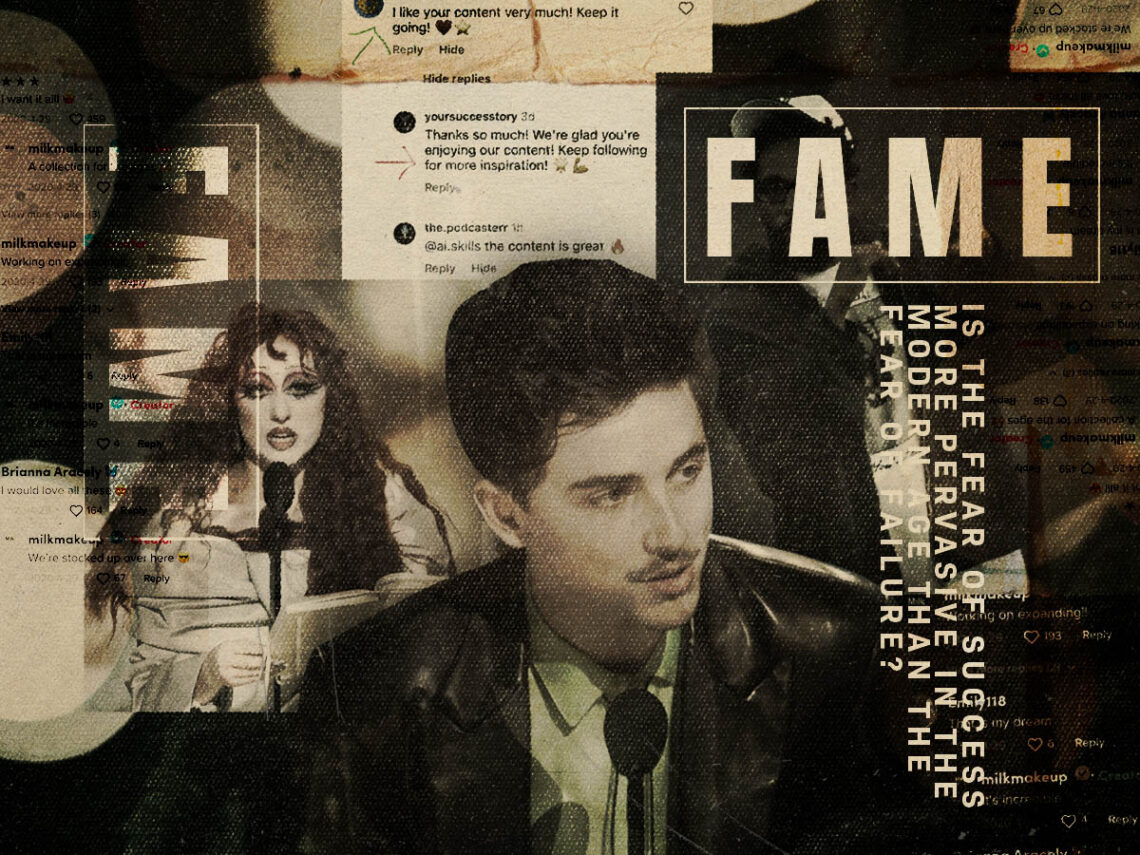
Is the fear of success more pervasive in the modern age than the fear of failure?

Recently, Timothée Chalamet took to the stage at the SAG Awards after receiving his commendation for his portrayal of Bob Dylan in A Complete Unknown. When he gave his acceptance speech, the actor surprised many people. While there was clear gratitude in his acceptance of the award, he also eluded to the fact that it wasn’t enough for him and that he wanted to progress and achieve much more.
“Thank you. I was not expecting this at all, truly,” he said. “I know the classiest thing would be to downplay the effort that went into this role and how much this means to me, but the truth is this was five and a half years of my life […] I poured everything I had into playing this incomparable artist. Mr Bob Dylan. A true American hero. It was the honour of a lifetime playing him.”
Chalamet continued to highlight his intentions in the world of acting, stating he wanted to be one of the best out there. “The truth is, I’m really in pursuit of greatness. I know people don’t usually talk like that. But I want to be one of the greats. I’m inspired by the greats. I’m inspired by the greats here tonight,” he said. “I’m as inspired by Daniel Day-Lewis, Marlon Brando, and Viola Davis as I am by Michael Jordan and Michael Phelps. And I wanna be up there.”
His comments echo those of Kendrick Lamar, whom Chalamet had interviewed a few weeks before his Super Bowl halftime show. When Lamar was asked about his recent beef with Drake, the rapper made it clear that he views music in the same way he views sport and subsequently wants to be considered one of the very best at it.
“My intent was to always keep, I think from day one, was to always keep the nature of it as a sport,” he said. “I don’t care how mother fuckers look at it as a collaborative effort, you know, that’s cool too, but I love when artists grit their teeth. Like, I still watch battle raps […] This has always been the core definition of who I am, and it’s been that way since day one.”
It shouldn’t be considered a surprise that comments like those made by Chalamet and Lamar exist; what’s surprising is that they exist in such a vacuum. It used to be the case that people within creative industries, whether that was writing, music, acting or something else, wanted to be the best at it. Now, that doesn’t seem to be the case, so much so that seeing a young actor say they want to be one of the greats feels alien. Why?

You can only build small homes in multiple fields
I believe a couple of things are at play, and the first is complacency. In an example of some of the worst journalism you’ve ever seen, I’m going to cite an interview with a comic. I don’t remember who the comedian was, I can’t find the interview anywhere online, and I can’t quote it directly, so you’re just going to have to trust me on this.
The comedian was asked how he wants to progress in his career and what’s next for him; he was honest in his answer, as he said that the huge gulf he has had to overcome is that between doing comedy as a hobby and doing it as a living. For him, he said that this was his biggest achievement. He continued to explain that the gap between being someone making a living off comedy and being the best comedian in the world is much smaller than that which he has already overcome. In other words, so long as he can be a comedian for a living, he doesn’t care how successful he is beyond that.
This seems to be the attitude adopted by many people, myself included. I am incredibly grateful because I always wanted to be a writer, and now that’s my job. Granted, six-figure book deals would be nice, but if the rest of my life is writing about the arts in the way that I do now, I’ll consider myself a happy man. Why are we more complacent in the modern age than people were previously?
The fact is that getting a creative job is much more broad these days. Mainstream media doesn’t exist anymore. The movies that get nominated for and win Oscars, for the most part, are small pictures that not many people see. Equally, music has so many styles and genres now that the headliner of one festival wouldn’t even fit the bottom of the bill at another. Subsequently, working in something creative doesn’t feel like a league; rather, it feels more like the game is trying to find your niche and developing in it enough so that you can then call it your job. Once that’s been achieved, the real battle is over.
When you consider trying to build a career for yourself in your chosen field, the mainstream media has now been sliced into multiple other fragments. What was once a large area is now hundreds of smaller ones. With such limited space in these fields, so long as you manage to build a home for yourself, you don’t care how big or small it is.
Fame is layered and intimidating
Pair this idea with the ramifications of being a superstar in the modern age. Being an A-lister and one of the most famous people in the world has never been a walk in the park; bands like The Beatles can attest to that, as when Beatlemania was happening, it was impossible for them to leave a hotel room without being bombarded by fans. However, at least when The Beatles were at the height of their powers, there was a cut-off point. They released music, did press when they chose to, and, apart from run-ins with obsessed fans and paparazzi, were able to seek some form of personal life. This is no longer the case.
Thanks to Chappell Roan, we have recently seen how difficult the transition from minor to major celebrity is. She has been making music for years and, in the past 18 months or so, has gone from being a relatively well-known artist to one of the most famous musicians on the planet. While she is no doubt happy that her work is being recognised, the additional stress that comes with being so firmly in the public eye has taken its toll to the extent that she had to address her fans on social media and ask them not to speak to her if they see her in public.
“If you saw a random woman on the street, would you yell at her from the car window?” asked Roan. “Would you go up to a random lady and say, ‘Can I get a photo with you?’” Roan then went on to say that the way people treat famous people in the street is harassment and that just because it has seemingly become normalised “Does not make it OK”.
Being famous comes with so many more layers than just those surrounding the thing you create. People need to think about how they want to be perceived online, which means having an active social media account and letting fans into their private life (or at least a version of their private life). Fans become more entitled as a result, as they believe they have a connection with artists beyond just a connection with their work. Of course, examples of this kind of behaviour existed before smartphones, but it will certainly have gone up in recent years.
Meeting famous people is no longer a personal experience, either. We live in a world that champions the visual medium, and therefore, meeting a fan no longer involves exchanging words or talking about your work; instead, it just means having a phone shoved in your face and being told to smile. If you’re caught on a bad day, stories circulate about how rude you are and how little you care about your fans.
Additionally, because of the readymade access you have to your fans and the world at large through these various strands of technology, you are expected to actively engage in everything that is happening. Political problems and international ordeals, your voice is expected, and assumptions are made about you if it’s not heard. Your life is forever held under a microscope, and its gaze is unrelenting.

Is there a middle ground?
When you combine the added pressure that comes with being famous and the difficulty of making a liveable wage in the creative world, it can hardly be seen as a surprise that so many people are content in mediocrity rather than pushing to be one of the best. The fear of success and the pressure that comes with it is much more crippling in the modern age than the fear of failure could ever be.
Of course, there are examples of people who manage to have some form of private life and still be considered huge in their field. For instance, both celebrities mentioned at the beginning of this piece, Kendrick Lamar and Timothée Chalamet, are relatively quiet in their personal lives. The issue is that this only works if you build a sense of mystery into your brand, and for a lot of up-and-coming creatives who are trying to make a name for themselves in the age of social media, not having a more personal and private presence is an immediate roadblock.
There is certainly a middle ground somewhere, but there is truth in the idea that many creative people in the modern age are more concerned about becoming superstars than they are about fading into obscurity. There is a lot of added pressure with modern stardom that many people would rather leave behind.
