


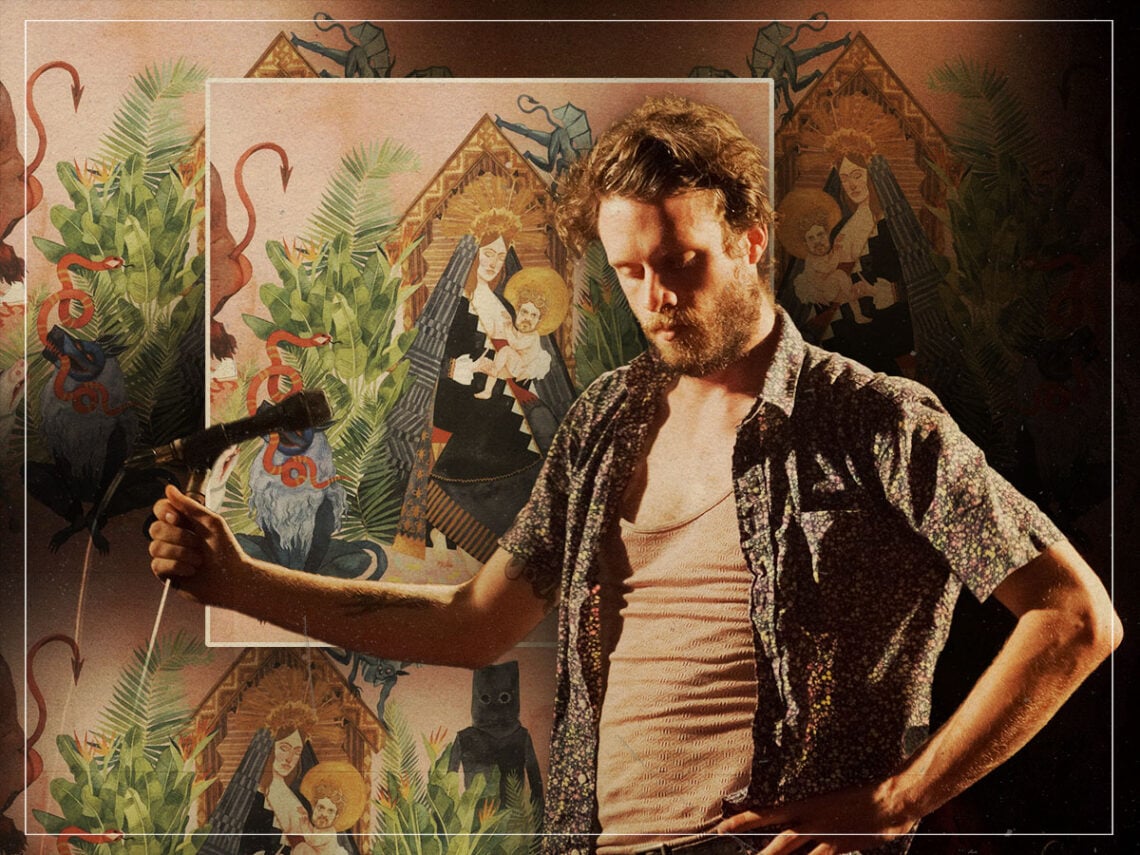
‘I Love You, Honeybear’: how Father John Misty established himself as one of music’s most divisive lyricists

Father John Misty is the kind of artist you either absolutely love or simply can’t stand. Regardless of your opinion on the man – whose stage presence is powerful enough to tempt even the most strong-willed of thinkers to consider cults and blind worship – the singer has garnered considerable acclaim since the early 2010s. After the musician, real-name Josh Tillman, released extensive solo records as J Tillman in the 2000s, he rose to further prominence as the drummer of Fleet Foxes before leaving the band in 2011.
Since then, Tillman has used the name Father John Misty to release six studio albums to date, beginning with 2012’s Fear Fun. It was largely praised, with the record containing some truly defining tracks from the early 2010s, like ‘Hollywood Forever Cemetery Sings’ and ‘Nancy From Now On’. Tillman, with his long beard and sardonic sense of humour, soon became the smart and self-mocking symbol of the modern hipster.
It’s a label that he has never been able to fully shake, what with his penchant for micro-dosing on acid, his former frequent use of Tumblr, and his love for trolling. He loves a good shitpost, and he doesn’t always take himself seriously – yet at the same time, wrapped up in his jokes and droll humour, both in interviews and his lyrics, is an incredible amount of truth. His explorations of politics, love, substances, sex, and creativity are all astute, even if some of his lyrics are totally ridiculous.
He often wraps up heavy themes and uncomfortable truths with a knowing wink, leaving some people amused and others rolling their eyes. Tillman has become a divisive figure in the industry, not because he’s done anything bad, but rather because his lyrics are so honest – often too honest, some may argue – and he is unafraid to reveal the kinds of feelings and behaviours that many of us would be too scared to admit to. I’d argue that it’s his second album, I Love You, Honeybear (now turning ten), which truly highlights the moment that Tillman established himself as one of the industry’s most unique figures.
Yes, his lyrics were even more brazen this time around, but they were also incredibly romantic and thoughtful, while the instrumentation was varied and, quite simply, addictive. From the thrashing backdrop of ‘The Ideal Husband’ with its siren-like wail that creates the perfect setting for the lyrical chaos to the gentle guitars and mandolin that accompany the intimate musings of ‘I Went to the Store One Day’, the album is beautifully considered and orchestrated. While Fear Fun is a great record, ILYHB is much more expansive and experimental, with Tillman further stepping into the limelight with a bold and unashamed approach.

Described by Tillman as a concept album about himself, it’s interesting to decide which parts of the record are entirely real and which the musician has exaggerated and moulded to fit the nihilistic-yet-romantic-yet-painfully-self-aware persona he leans into. It opens with the title track, a sprawling satirical look at relationships that is graphic and bleak but also strangely romantic. “My love, you’re the one I wanna watch the ship go down with,” he sings, before chiming in with “You’re bent over the altar and the neighbors are complaining/ That the misanthropes next door are probably conceiving a Damien.” Existentialism meets romanticism here, with gorgeous melodies and piano accompanying Tillman’s assertions that true love makes everything that little bit better.
The multi-faceted nature of romance and the vast range of feelings it can provoke are explored on ILYHB, with the singer drawing from his relationship with his wife, Emma Elizabeth Tillman. He name drops her in the next song, ‘Chateau Lobby #4 (in C for Two Virgins)’, in which the musician sings about marriage with frankness: “I wanna take you in the kitchen/ Lift up your wedding dress someone was probably murdered in.”
Tillman’s storytelling ability and wordplay, paired with his use of instrumentation that just perfectly fits the themes he explores in each song (like the cheerful mariachi in ‘Chateau Lobby’), is undeniable. In ‘The Night Josh Tillman Came to Our Apt’, he misuses the term “malaprop” to make fun of his partner, singing the lines “She says, like, literally, music is the air she breathes/ And the malaprops make me want to fucking scream/ I wonder if she even knows what that word means/ Well, it’s literally not that.” To some, these lyrics might come across as horribly sarcastic and pretentious, but Tillman is deliberately poking fun at himself, using the song’s attack against everything he hates about the subject as a way to actually attack the worst parts of himself.
Other songs on the album also expose some of his worst traits, like ‘The Ideal Husband’, where he sings, “Didn’t call when grandma died/ I spend my money getting drunk and high/ I’ve done things unprotected/ And proceeded to drive home wasted.” He ends the song on a humorous note with the correct use of a malapropism this time, suggesting to his lover that they should “put a baby in the oven.” It’s this self-awareness that makes his lyrics so full of wit – whether you’re a fan of this approach is down to how much of it you have the stomach for, but it can’t be argued that Tillman doesn’t have a knack for crafting vivid and descriptive songs that evoke a strong reaction in the listener.
The album is not only a messy love letter to love itself, but it’s also a letter – an email, perhaps – to the state of modern America, as demonstrated by tracks like ‘Bored in the USA’ and ‘Holy Shit’. Commenting on the country with a strong dose of satire laced with the truth, he sings in the former, “Oh, they gave me a useless education/ And a subprime loan on a craftsman home/ Keep my prescriptions filled/ And now I can’t get off/ But I can kind of deal/ Oh, with being/ Bored in the USA/ Oh, just a little bored in the USA/ Save me, President Jesus.”
America is full of internal conflict, increasing rates of depression, disillusionment, boredom, and unemployment, and Tillman’s exploration of the country highlights the reliance on various antidotes that people cling to – capitalism, religion, drugs, and love. “Love is just an institution based on human frailty,” he sings in ‘Holy Shit’, before adding a few lines later, “What I fail to see is what that’s gotta do/ With you and me.” At the end of the day, love might just be the purest thing we have – the only true and honest thing to get us through right-wing presidents, consumerist wastelands, and our fears of the world’s eventual demise.
ILYHB is an album that blends satire and sincerity in a way that few have done in such an accomplished way. While some of Tillman’s lyrics might come off as a little pretentious and too clever for their own good, he certainly has the poetic and vocal talent to pull it all off. The album has rightfully found itself considered one of the 2010s’ most defining records, but it has also helped to truly cement Father John Misty as an unavoidable musical heavyweight – his pen a powerful weapon and his voice its beautiful conduit.

