


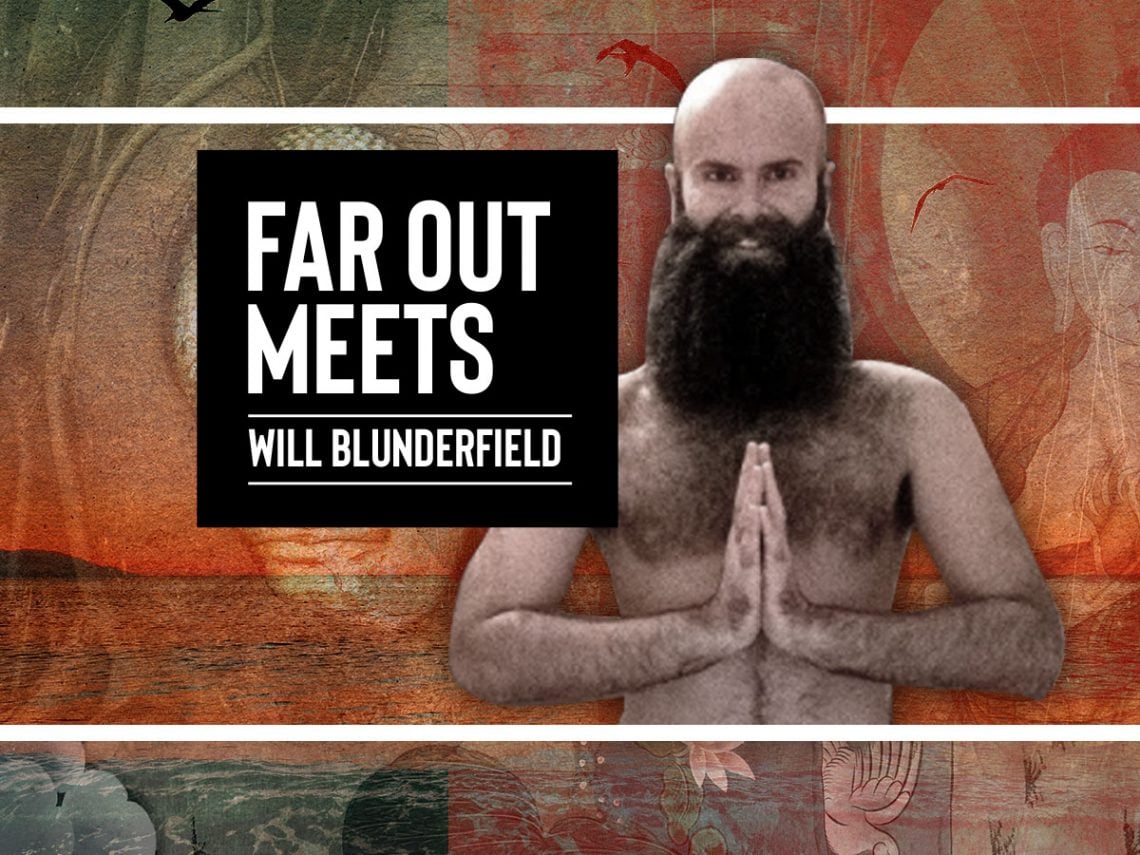
Far Out Meets: Will Blunderfield – Finding Sex Kung Fu spiritualism in the wake of ‘Canadian Idol’ shame

Will Blunderfield knows his stuff. I’ve never been more wowed by a shirtless (possibly naked) man on a zoom call at 7pm before, as he regales me with ancient Celtic wisdom regarding how “cock touching” in a forest can cause a re-wilding that transubstantiates a man into a “wild stag or a minotaur”. The mythic transformation he speaks of, caused by clasping a bros spam javelin by some shrubbery, might purely be figurative, but Blunderfield is certainly a man who has evolved.
When he was coming of age in Vancouver, BC, in the early 2000s, there was a survey done among schoolchildren about what they wanted to be when they were older. The most common answer to an overwhelming degree was ‘famous’—not a singer, actor or even a TV chef, just simply famous. In some ways, this is nothing new; even Alexander the Great craved glory, and in another era, he might have pined to make it to the judge’s houses. Fame offered the chance of escape for the disenfranchised.
Thus, talent shows like Canadian Idol exploded onto our screens and transformed culture. Despite all the bullying and exploitation, they were also, in fairness, great engines of social mobility in the stifled capitalist age. Sadly, they didn’t do much for individualism, and conformity to a fixed character ideal was the best shot at fame. “The Simon Cowell-type judge, I think his name was Zach Warner,” sadly told Blunderfield, “You’re too theatrical; get out.” Despite passing a few early audition phases, his dreams of grandeur were suddenly reduced to a delusion.
Now, he has surpassed that vapid complex of fame. He pursues his own path devoid of conformity and is certainly reclaiming his individualism. Thankfully, for the future of manhood, he’s taking it easy for all of us sinners, and his search for individualism has collective kindness at its core. He is – and I caveat this by saying that my interaction has been minimal in the grand scheme of things – a truly lovely man, compassionately trying to preach spiritual development.
That’s all well and good for us, but it’s the Canadian music industry’s loss because “at that time”, Blunderfield tells me, “There was only really Nickelback and Avril Lavigne. There wasn’t really room for a more theatrical pop singer. I was dying my hair black, and I had black nail polish, and I was doing more of a punk rock kind of thing. I don’t think that was really what the Canadian music industry was looking for at the time.”
So, this dismissive Simon Cowell-type character told him to ship off to New York City, where maybe Broadway would appreciate his theatricality. For Blunderfield, this moment would change everything as though his meeting with this dismissive Zach Warner fellow had been woven into place by mystic figures of fate. “Around the same time I was on Idol, I actually won a scholarship to go to New York and study for two years at a conservatory called the American Musical and Dramatic Academy,” he says. “That was where I first discovered spirituality because one of our acting teachers was a yoga teacher too.”
In time, Blunderfield would go on to prefer yoga over acting. “I didn’t like all the cattle-call auditions in New York,” he says. “I’d make it to, like the top three out of 400 dudes in a cattle-call, multiday audition for, like the role of Gaston on the Disney Cruise Line. And then I would get booted for ‘Oh, you’re you don’t have enough weight on you, or you’re too fat, or you’re too this or that,’ and I just didn’t like having my fate being in the hands of these casting directors in New York.”
Thus, over the course of a year, Blunderfield traded superstardom for spiritualism. Once more, fate would usher him towards the wholesome future of Sex Kung Fu. After two years in acting school, he moved back to Vancouver to pursue life as a yoga teacher. “I actually won a singing competition in Vancouver [upon return]. And I won exactly the amount of money that I needed in 2008 to get on a yoga course. It was 2500 bucks,” he says of his songbird windfall (clearly, that dastardly Zach Warner guy wasn’t on the panel this time). “That was almost exactly the cost of the yoga teacher training in Vancouver.”
However, celebrity and chakras would once again align. “Now, the interesting thing is, on the teaching panel of instructors for that course was Alanis Morissette’s twin brother. His name is Wade Imre Morissette,” Blunderfield laughs in amazement. “And he was combining pop music with Sanskrit mantras. It was very catchy, very poppy. And I was like, ‘Oh my gosh, this is lighting me up to listen to this dude’s music’. So I asked him one day after class, ‘I want to do what you do. Do you have any wisdom for me?’ He’s like, just do it. Just start writing songs and take your favourite Sanskrit mantras and put them in the chorus, and you’re good to go.”
Fortunately, Blunderfield had been writing songs since he was 12, “But they were all English. And I don’t think they were very good. Then I realised if I took out some of the English, especially in the choruses, and then injected in a really high-frequency mantra — a 35,000-year-old mantra, that it would do something to the song, and I liked to sing them. People liked to listen to them more, and the record labels started to take interest.” So, in some ways, you could say that we have the Morissette family to thank once again for a jagged little spiritual awakening.
With this revelation, Blunderfield was suddenly on a new path in life. Fortunately for him, this new direction was fast-tracked because the CEO of a Sony Music subsidiary record label had been attending his yoga classes. After initial caution that Blunderfield was “a little too theatrical for the label”, Blunderfield’s name was being blasted out in Japan soon enough. He then hit “number one on the Apple World Music Charts two times,” he said. “That was when I realised that you don’t actually even really need a record label because of the internet.” He has been using the connective potential of the web to fuel his livelihood ever since.
His music allowed him to travel to Asia and seek out their ancient wisdom. Everything was coming together. Blunderfield puts this down to a simple rule: “The better you feel in your body, the more things line up.” This was a realisation that had precluded him from success in the past. “When I was on Idol, I remember I wasn’t even in my body. I was so nervous.” That was a barrier, but “the more juicy you feel in your body, the more good opportunities come to you.”

For a long time, Blunderfield simply did not feel juicy. Bullying had rendered this beautiful peach a shrivelled and shy piece of potpourri – and not even a particularly perfumed one because neighbours were always “throwing half-eaten food” at him. This didn’t stop after school, either. “When I moved to New York, I was actually chased up the street by a guy with a switchblade. Me and this guy that I was dating, we were holding hands. The first time we ever held hands. It was in Hell’s Kitchen. We had just been to Dallas Barbecue, which is an American barbecue chain. Then this guy with a switchblade is like, ‘You fucking faggots, I’m gonna get you’. We started to run. And he chased us. We got into a taxi and zoomed off.”
This was one of the more intense examples of the persecution Blunderfield experienced. “Throughout my entire high school, I was the only boy in choir,” he explains. “I had a lot of experiences where people were drawing cocks in my mouth on my student council posters, or I’d be training for long-distance cross country around West Vancouver, and these dudes would drive by in a Hummer and shout faggot at me. They’d egg my family’s house, and they’d slash my tires.”
He says: “It wasn’t necessarily that I was gay; it was more that I was the only boy in choir, and I was very out there. I would perform at the school assemblies. I just didn’t have the tools—I didn’t have the sense of self-approval and self-acceptance to realise that none of that stuff was about me. There’s nothing wrong with being different. But at the time, it was not cool to be different, especially if you’re a dude. That’s another reason why I like yoga so much.”
Yoga has helped him rise above this criticism and “tolerate the consequences of being [himself]”. Blunderfield puts this down to “imbalance in our culture. I think that people have a lot of anger. I feel like modern humans are almost like caged animals. I think of those like poor chickens, non-free-range chickens that live their lives and battery cages. A lot of us humans feel like that. We’ve been domesticated and caged. In the case of my American clients, circumcised and sexually abused, there’s so much trauma. When you’re behind a keyboard, sometimes that trauma can be directed at people who are public figures.”
Adding: “Also, the dominator system has this intention to divide and conquer. So, there’s all these left versus right, there’s gay versus straight — there’s all these divisions that I think are being promoted by the mainstream media, I don’t want to get too conspiratorial, but there does seem to be a lot of divide and control tactics in our society.”
We are all touched by this trauma. For Blunderfield, a lot of it seems to be sexual. He believes that this is a story as old as time. “A lot of the research I’ve done shows that sexuality was invariably tied and inextricably bound to spiritual practice in ancient cultures. For example, in India, a lot of yoga was Tantric Yoga, where they were wrapping their cocks around poles, and other dudes were standing on the pole to strengthen their dicks and symbolise their devotion to God. Or a woman would sit on top of a man, and the man would insert his Lingam into her Yoni, and they would do energetic breathwork practices. It was a very juicy and sexy way of connecting to the divine.”
These practices are why Blunderfield is particularly attracted to Sexual Kung Fu. They have helped him immensely. “I remember I was at a party, and somebody offered me cocaine; it was probably 2013. I was probably 28 or so. I’m 37. So, from age 28 to 33 or 34. I got into drugs and alcohol. That was when I was just teaching hot yoga. But there was something missing from my practice. You can do all the downward dogs in the world, but if you’ve got sexual shame, it’s not going to really help to heal that.”
Thus, Blunderfield got into shamanic exercises like conscious connected breathing. He demonstrates how to do this to me. “You breathe so deeply that your cock, balls and prostate bulge,” he looks down at his swelling groin and smiles warmly. “You’re breathing down into your roots because a lot of dudes are disconnected from the roots. Because our issues are in our tissues, shame will come up, pain will come up, different types of emotions will come up, and you’re encouraged to stay out of story and just feel it to heal it.”
This slack stretching exercise helped Blunderfield to realise, “I’ll always be an addict. So, for me, it’s about getting addicted to the right things. I subbed out cocaine for Kundalini Yoga. I subbed out alcohol for chanting and mantra and long distance running. Actually, my mum and I ran the Loch Ness marathon in Scotland a couple of years ago, and that was really fun. That’s another way to get high on your own supply.”
He also claims we are cut off from this by societal barriers. “I think that sexual shaming is one of the most upstream ways that the matrix cuts humans off from our power. If they can cut us off from our sexual energy, then they don’t have to put a literal cage around us. I don’t think it’s necessarily conspiratorial. It’s just predatory capitalism.”
“You know, a society full of really healthy, juicy humans who are free of sexual shame is less easy to control and to sell products to. If you can make somebody feel really unsexy and say, ‘Hey, if you buy this product, you’re gonna feel sexy’, it’s just a really great way for the predatory capitalistic structure to continue. I mean, I remember being sexually abused by a doctor when I was four. And that’s an epidemic. That’s one of the true epidemics of our society. So many young people are sexually abused in different ways. And it’s so shameful that people don’t really talk about it.”
“Shame can’t survive in the light,” he tells me, “Which is why I often do my work naked. The idea that we have to always be wearing clothes is another way that the matrix kind of cuts us off from our juiciness and our full power.” However, he accepts that this is a radical practice. “Most sexual kung fu teachers don’t teach naked,” he admits.
This shaming is reflected in his past life of fame-seeking too. As he explains: “I don’t know if you ever heard of Frenchie Davis? She was on one of the first few seasons of American Idol. She made it really far. I think she was set to win the whole competition. Then some naked pictures surfaced online, and they disqualified her from the competition just because of some naked pictures.”
Frenchie Davis, like Bunderfield, has since moved on. Do they, in some paradoxical way, have the shaming to thank for this? Did they transcend delusions to reach a greater alternate reality? “It was really good because it was contrast,” Blunderfield believes. “It realigned my purpose. It forced me to find a deeper reason as to why I wanted to be a singer. Before Canadian Idol, I thought, ‘I want to be a famous singer’, and I didn’t really feel that good in my body. So, then it kind of flipped it where it’s like, ‘Oh, if I actually just feel really juicy in my body, then opportunities just come to me’. The intention behind performing is less about wanting to be famous and more about just feeling juicy in my own skin and wanting to share that feeling of joy with others.”
It’s at that moment that “you feel the way you actually think you’re going to feel when you quote unquote, become famous, or when you win the million dollars,” he proudly reports. “Then if you never get what you want, say you want to manifest a beautiful lover, if you can do Sexual Kung Fu in a way where you learn how to make love to yourself, then it doesn’t really matter if the lover ever comes because now you know how to generate the feeling. It’s like the person was just the prop. If you know how to actually give yourself multiple orgasms, then it doesn’t really ever matter because you’re just like, I feel really good.”
Which leads us to his love life. “I’ve been pretty much celibate for like a year and a half deliberately because I wanted to really dive deeply into these teachings. My teacher Mantak Chia says before you do the more advanced practice of what he calls dual cultivation, so sex with another, it’s good to practice single cultivation for a long time. You basically learn how to make love to yourself and master your own sexual energy. So, I’m still in the solo cultivation phase.” However, he does “eventually” want to move into duality “when the right partner comes along.”
In the meantime, he is happy engaging in non-penetrative tantric sex practices with Naomi. “Also, a lot of my work is about bringing dudes out into nature, and we get naked, and we hug naked with our cocks touching, and we do what we call the wild man activation where we growl and we kind of turn into wild stags or Minotaurs, and we really access that wild erotic prowess that I believe my Celtic ancestors were doing when they were worshipping the half man half deer fertility god of Cernunnos, for example, or the Green Man.”
Adding: “So, I do get erotic satisfaction and training apart from just by myself in those types of contexts where I’m like with my friends, you know, shaking our cocks and balls. There is an erotic undercurrent in those types of rituals. But in terms of like, you know, full-on sex, I feel like I’m almost ready to invite that back into my life, for sure.” So, the door is open, maybe even for some little Blunderfields in the future.
He is, after all, a man who has learnt to accept whatever comes his way, whether that be the purging quality of ejaculating onto A4 sheets with your buddies or breathing your way to a bigger dick. If you want to know more about these practices, then you catch him on Twitter, and for everything else, including his podcast, you can head over to his website.
