


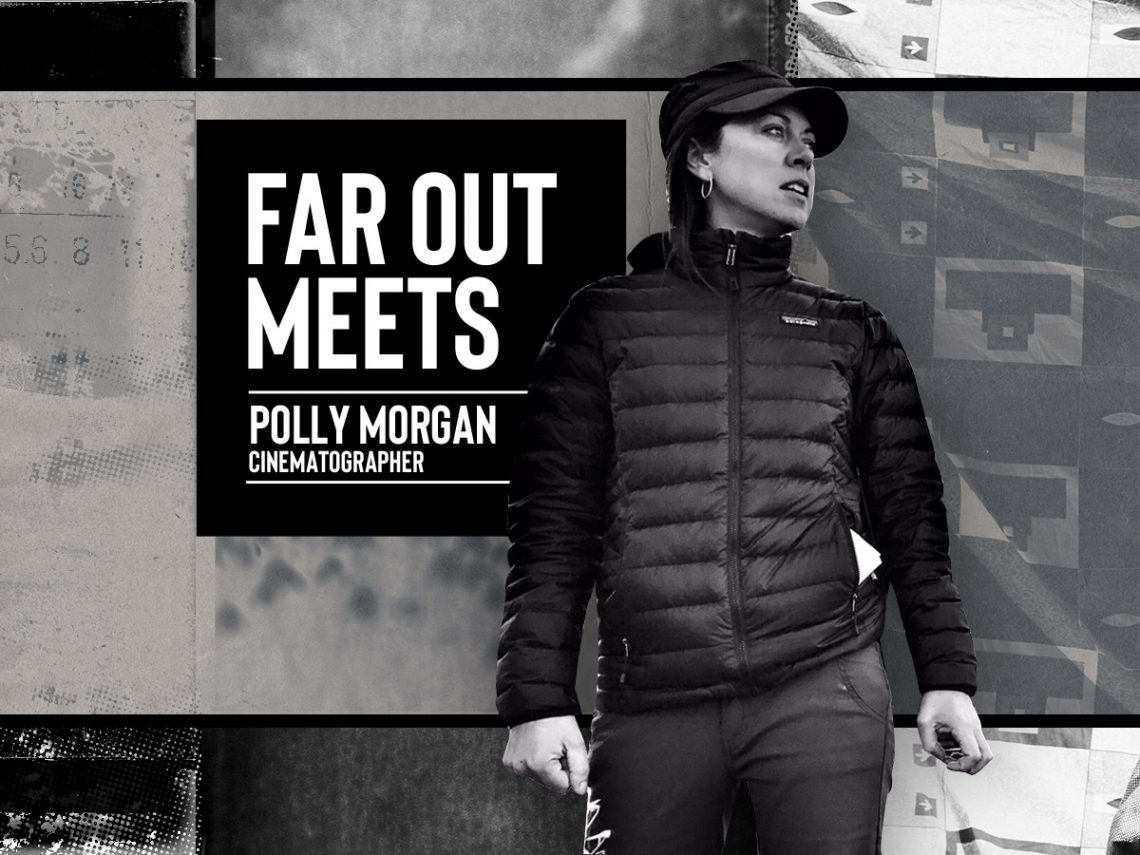
Far Out Meets: ‘The Woman King’ cinematographer Polly Morgan discusses new movie

Recently released historical action film The Woman King, directed by Gina Prince-Bythewood and starring Viola Davis, made a considerable impact on its audiences. The film dealt with a largely overlooked part of history, with a fact-based dramatisation of the former African kingdom of Dahomey in the early nineteenth century. Specifically, it told the story of the nation’s highly trained, all-female army known as the Agojie.
Any viewer of The Woman King will recognise that a big part of its success as a drama comes from the film’s striking visuals and masterful camera work. That aspect of the film is largely due to the expertise of cinematographer Polly Morgan, an artist in her own right, whose skill has brought films such as Where the Crawdads Sing and Lucy in the Sky to another level. Far Out had the chance to talk with her.
“My love for movies happened at a young age,” Morgan says. “I loved Stephen Speilberg. Emotion in story-telling made me fall in love with cinema.” She named Close Encounters of the Third Kind and Empire of the Sun as films which had the most impact on her approach but declined to single out any one movie as her professional role model: “There are so many movies in which I love the cinematography; such a broad range of styles,” but what she finds most important is the ability to “perfectly blend to the story they are telling… My ideal is just to be able to diversify and be a chameleon. There really is no ideal. I appreciate cinematography that is not overly flashy or draws attention to itself. It’s a subtle, creative tool to help tell the story.”
Polly Morgan received a great deal of attention for her work in recent years, such as being named ‘one of ten cinematographers to watch’ by Variety and being nominated for an Outstanding Achievement in Cinematography award by the ASC for the television series Legion. Asked what accounts for the quality of her work, Morgan replies: “I love to tell good stories.” While talking about her selection process for potential projects, she adds that it is “important to choose material that really resonates with me and that I feel my work can support the performances to help the viewer connect and feel emotion”.
Morgan admits that she is a “good collaborator and communicator. Always learning how to improve this… Communication is the most important thing, to communicate with the director and with crew and actors. How to be precise with direction. How to lead and inspire a crew to want to do their best work; make them as passionate as you.”
When whether her work depends more on the technical or the artistic, Morgan responds: “Absolutely, a combination of technical skill and artistic vision,” and goes on to list, in quick bullet points, the qualities she finds essential: “Imagination of how to conceive a scene and tell the story through light, framing, and motion. Conversations with directors. How they see it. Work together. Technical skill. Always learning and growing. Teamwork. Figure it out together”. Morgan says she is “drawn to projects that challenge me” and which “do something different”.
When asked about an earlier film on which she was director of photography – Lucy in the Sky, which was released back in 2019 – Morgain explained the film’s unusual challenge to show both reality and the main character’s perception. The cinematographer said: “I always approach my work in a subjective way. How can I use my craft to help immerse the viewer in the character’s journey? I want the viewer to get lost in the experience, to get taken away from real life for a moment, and feel empathy and emotion for the character and story we are telling. With Lucy in the Sky, I was able to explore this process in a deeper way. Noah [director Noah Hawley] has such a creative mind and was excited to push the visuals to express her emotional state.”
Morgan moved on to the more technical aspects, giving some interesting background on using camera work creatively to produce a mood. “We used a variety of tools to illustrate [Lucy’s] disconnection with the world after returning from space…miniatures to create her point of view, looking down on herself in her day-to-day life. We used very wide aspect ratios to make things feel small; we used narrow aspect ratios to make things feel claustrophobic. We used vaseline on the lens when her world feels foggy. We used ‘long oners’ – where we shot scenes in one long shot, to not give the viewer a break from the action; to take them on her journey with her, with no respite.”
Since Polly Morgan is the only woman, so far, to be invited to join both the American and British Society of Cinematographers, she is often asked if there are any particular challenges to being a woman in this field. Morgan feels that the situation is improving: “In the past, it was very challenging to be taken seriously as a female DP or to be given the same opportunities as men. I am happy to say that that is a thing of the past – for the most part – and I see a lot more women coming into the field and being encouraged. I see producers actively wanting to hire for diversity, both in sex and race, and I applaud that. Important to have a diverse set and have stories told by us all.”

Morgan confesses that her experience of working in Los Angeles might be something of a “bubble” of acceptance: “I think there are still some men out there that find it challenging to be directed by a woman”. While providing more details about the disparity in the field, she mentioned other, more personal challenges for a woman: “Filmmaking is a challenging career because you are self-employed and working in unique places and situations all the time. In the last few years, I have had two babies, which has definitely complicated the situation. Luckily, my family are always willing to travel with me to new locations, and at the moment, we always make it work.”
She adds that a cinematographer who is also a mother needs to plan carefully simply to avoid exhaustion, saying: “You really have to figure out how to live in a way that will give you the energy you need to be successful on set and also when you get home.” When asked about The Woman King and her collaboration with director Gina Prince-Bythewood, Morgan was enthusiastic. She called the work a “wonderful collaboration” in which she was constantly involved in all aspects and described Prince-Bythewood as “so calm under pressure, steadfast… incredible with people”.
The director, she explained, “wanted to be challenged” and to “approach the movie in a different way than she had before. She wanted it to be intimately epic”. An essential goal was to produce a “historical epic with scope, but to also focus on the drama between the women” and to “contrast the scope and action with the quiet intimacy of the women and their relationships”. There was discussion about the effects different types of cameras might have: the director “loved handheld but wanted to use a more fluid camera to represent the Agojie warriors” and to make the scenes “subjective” and “powerful”.
An interesting aspect of the director’s vision was how the women warriors were portrayed. The director “wanted the women to look beautiful; wanted to show off the beauty of black skin. More beautiful than had been done before”. Morgan notes that the director gave some attention to lighting, as she found it “frustrating as a Black filmmaker to see people not light black skin correctly”.
It may be worth noting that, while the scriptwriters for A Woman King were still looking for backing, the script was withdrawn from more than one studio because the executives wanted to cast only light-skinned Black women as the Agojie. In a pre-release interview, Viola Davis called the film “an illustration of the insurmountable beauty, strength, vulnerability, femininity, and absolute power of the dark-skinned Black woman,” a view the director seems to share.
Morgan agreed, saying it was “a great responsibility to tell the story of these real-life women and capture the beauty of Black skin. I wanted to show off how exquisite dark skin tones are and the beauty of all the women”. She sought the “balance between making them beautiful but keeping it real,” noting that the Agojie were true to life even in small details, from armpit hair to natural skin with only the most realistic stage make-up.

While describing the technical aspects of the film’s visual style, Morgan nods towards the “wide epic shots” instead of close-ups, using specific lenses when close to the actors “to pull the viewer into the moment and not feel like a spectator”. The cinematographer also cited the use of fluid camera movements, using cranes, dollies, or other equipment as needed, ‘to illustrate their strength and power” during action scenes.
A Woman King was shot on location in South Africa, a decision with which Morgan was directly involved. She explained: “I first met Gina on a plane to Africa for a director’s scout. The production designer had been there for weeks, shortlisting locations for us.” Morgan advised on “which locations would work best for the story, and also photographically. Where is the path of the sun? How to make best use of it?”
There were minute discussions on how exterior scenes could be shot: “We often wanted to shoot sunsets/sunrise, so had to make sure it was west/east facing,” as well as ways to use the sun for lighting, and very simply, the logistics of accessibility. In addition, a replica of the Dahomey palace had to be placed in a suitable location, and some heavily treed areas were needed for a particularly dramatic battle scene.
Morgan admits that making the film was a challenge, partly due to the remote location in which actors, crew, and supplies, as well as film equipment, had to be transported. The setting up of lighting, rigging, and multiple cameras, and the extensive stunt management in battle scenes, proved to be more than tricky.
Despite the abundant action segments in the film, Morgan says: “My favourite scenes are intimate moments between the women. I enjoy the challenge of action scenes and scenes that have a lot of scope, but my favourite place is close to actors and camera, in a good, quiet, dramatic moment”. She insists that it was “never my intention to make dazzling visuals. Just tell the story! Capture the performance and action”, and the “amazing production design and costumes and incredible performances can’t help but be dazzling.”
Asked about working with The Woman King’s impressive cast, she commented that it was “incredible to have a front seat on the performance; like watching a master class. Some scenes gave me goosebumps. Other scenes made me cry on set… [It was] powerful to be a part of that.” Of the lead, Viola Davis, Morgan said: “I didn’t really approach filming Viola in a different way to the other women. I wanted to find that balance of strength and beauty mixed with rawness and authenticity. Not too glossy or commercial, but real.”
Intriguingly, Morgan used different techniques in scenes featuring the European colonisers and slave traders: “Higher contrast. Handheld. Light not as ‘pretty,’ not as soft”. She described favouring high contrast and bright, overhead sun for those scenes to give a subtly different presentation. “The camera didn’t take sides but never wanted to beautify the horror of the slave trade.”
Morgan was strongly aware of the responsibility to portray characters based on real people, as opposed to the comic-book characters they bear some resemblance to. “Our intent was always to remain as authentic as possible to our research on the history of the Agojie and the people of Dahomey.”
Speaking of herself, the director, and the other crew members as a team, she maintained, “We did a deep dive, and for the most part, our decisions were all based on staying true to fact. Our women were vulnerable. They were not superheroes. They fought and lived as real humans did. I think because the sets and costumes were all designed to be true to the research, and the lighting all motivated from natural sources, it feels real. Not overly glossy photographically. All departments worked together to keep it raw and authentic.”
