

Far Out Meets: Peter Hook discusses Joy Division, New Order and new tour dates
Read More


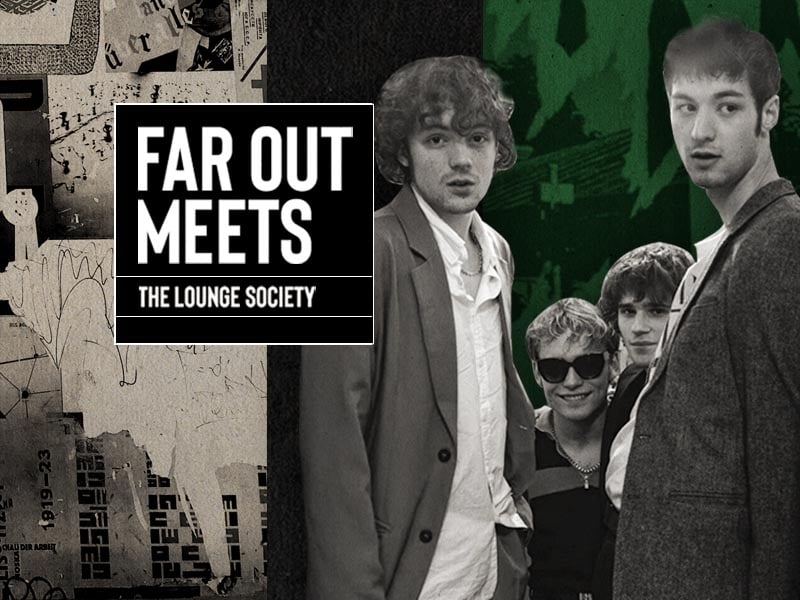
West Yorkshire’s The Lounge Society – a band made up of vocalist and bassist Cameron Davey, guitarists Herbie May and Hani Paskin-Hussain and drummer Archie Dewis – have caused ripples in the UK’s blossoming alternative rock scene that seems to be returning to prominence with post-punk music, for want of a more modern and befitting term.
As a promising up-and-coming act, some of us have had the chance to hear the boys play, but, until very recently, few have met the minds behind the music. Last week, I was lucky enough to chat with Davey and May to become better acquainted with their work and discuss their musical influences and exciting upcoming album, Tired of Liberty.
I began the conversation with May, who apologised for his bandmate’s tardiness. It transpired that Davey was caught up with his day job as a postmaster at the local distribution centre. With Davey absent for the first few minutes, I thought it logical to journey from the depot with May; where did it all start for this fledgeling foursome now delivering hits?
May told me that the four of them had met at high school and grew close after recognising a shared passion in music class. “We’re all very interested in similar music,” he said. “And so we had some of the same music classes. And then, every lunchtime, it seemed to be that the four of us would gather together. And we learned a few cover songs like some Sonic Youth, The Strokes and Arctic Monkeys and just things we were into at the time. We spent a lot of time just sharing music and talking about music, and then lunchtimes spilled over to after school; it still seemed to have that same kind of energy; we still are the sort of four boys in the classroom at lunch break.”
May then outlined that, after finding palpable chemistry, the foursome presented their early covers to the public. “We applied for some local open mics and stuff like at the Golden Lion in Todmorden, which is just down the road from us. And then some support [shows] at the trades club and just kind of grew from there really.”
With such a shared passion in music, I wondered whether the four members still had subtle differences in their tastes that might allow each to bring a slightly different flavour to the creative process.
“We definitely share a lot of common ground because we’re quite analytical. We can spend quite a long time talking about one album and the lyrics of a song of that album and ranking it track by track,” May replied. “But I think, for us, it’s just how it’s going to be. We’re not always going to have the same taste and when we’re trying to create a piece of music, we’re going to have different ideas of where it could end up, but I think it’s healthy because it means we end up with something that is a compromise between four very disparate ideas and it makes it a little bit weird and a little bit interesting. But yeah, some of us are more into ambient music than others, some like funk and others are more into darker guitar stuff.”
Appreciating the band’s very wide base of sonic influence, I told May that I can hear traces of Joy Division and Echo and the Bunnymen in their music, but also a more modern indie sound similar to that of The Libertines and Arctic Monkeys. I was interested to hear where they would rather place themselves in terms of a prime era of influence. “I think, formatively, when we were very first getting going. It would be sort of difficult to deny that, like you say, Joy Division… those early post-punk bands. They were incredibly influential to us in developing an identity and that sound. I think there’s definitely something about Northern bands and Joy Division that just go hand in hand. I still think they’re the reason that a great many bands have formed, that story and that sound.”
“I think in terms of ambition, we’d probably more likely to be seen in the mould of one of those ’60s groups, I don’t want to be extreme but like the Velvet Underground,” May said, outlining that they would love to be pivotal and influential.
However, as well as having a certain cutting-edge style akin to The Velvet Underground, May also said that they would love to be intensely popular on the scale of The Rolling Stones if their creative direction allowed it. “In an ideal world, we’d be The Rolling Stones… unlikely, and we sound a lot more like Joy Division anyway. In terms of that attitude, I think we would like to sell records as well as dress well, or whatever, but I still think we’re working out our identity, really. We don’t know whether we want to be stadium fillers or to be a cooler, cult-style group. But, I think we definitely want to take it as far as possible.”
After these early revelations of influence and aspiration, our missing postmaster joined us on the call. Continuing along the same lines, I had the idea of giving the pair Lou Reed, David Bowie, and Bob Dylan in a kiss, marry or kill’ scenario whereby they had to choose one they would work with prolifically, one to collaborate with on one occasion and one to leave out entirely. As I had hoped, the question sparked a moment of deep thought and deliberation between May and Davey. Revealing that all four members of the group contribute to the lyricism and songwriting process, May explained that despite Dylan’s sound not aligning with that of The Lounge Society, he would marry the folk-rock legend because he “is God”.
Meanwhile, Davey agreed that all three were massively influential, but he would have to meet Bowie at the altar and have Dylan for a one-off collaboration. With a hint of surprise to his voice, Davey said: “I think Lou Reed is at the bottom for both of us! But we wouldn’t be in this band if it wasn’t for Lou Reed, possibly more than the others [laughing].”
After establishing that they both have great taste in music and that my question was somewhat “brutal”, the conversation flowed toward their own creations. Davey picked out the group’s latest single, ‘Upheaval’, as one of the Tired of Liberty cuts they are most excited about. “It’s quite a detour from what people expect,” he said of the track. “Which, to be honest, is what we’d say about all of our songs whenever we release them because that’s our general ethos. But especially that track is going to be quite unexpected. I’m happy we’re releasing that a little bit before [the album] just so people really get the idea that this album is going to be going everywhere.”

Later, I asked what track the group likes playing best during live performances. “We definitely all individually have songs that we like to play more than others,” Davey opined. “I’d say ‘[Cain’s] Heresy’ is quite fun. I think older tracks are definitely nicer to play because they’re kind of just like second nature… ‘Generation Game’ as well,” he added, remembering their brilliant debut single.
Davey also showed some love for the band’s newer material, adding, rather enthusiastically: “I think ‘No Driver’, our latest single, is also fun to play, but for very different reasons. It’s hypnotic, and you have to have a little bit of patience, but not that you’re waiting for anything. It’s just, by the last chorus, you’re completely enveloped in the song.”
The Lounge Society have a notably wide pool of influence that is immediately apparent when you listen to a few of their tracks. Much of that variation comes from the sharing of songwriting duties within the group. One common presence within their often abstract lyrics is a loose political slant.
I asked whether a political agenda is important to them and an intentional component of their songwriting process. “I think in a lot of cases, it’s a bit of an inevitability that it will have some form of link to what’s going on politically,” May explained. “I think more recently though, particularly with the record as opposed to the [2021] EP, it’s become more domestic, like more about what we see in front of us and what you feel when you wake up in the morning, rather than what’s on the news headlines.”
“Yeah, I think that’s a show of our maturity,” Davey agreed. “We’re entering adulthood now. We’re seeing everything through the lens of what surrounds us on a daily basis. So, not every song will be political in the traditional sense. I don’t think that’s the overall theme that people pick up on [in the new album], but that’s not to say that there’s not something in there.”
Our time was coming to an end, and feeling satisfied that I knew where The Lounge Society had come from and where they were going, I asked one final question: “If you could change anything about the modern music industry, what would you change?”
After highlighting the pressures of streaming and the importance of the vinyl comeback, Davey stressed the grassroots venue crisis as one of the biggest issues currently. “Independent venues, like the venues that are near us, are fading away a little bit,” he said with genuine sincerity. “I think bands like our band just need to be coming out of nowhere all the time.”
Davey explained that, as well as listeners supporting the smaller venues, he would like to see more inspired young artists coming to play at the venues. “With more young people starting bands, these independent venues have options, and they have the mates of these young bands. That’s how we started, we had our mates come to the trades club, and then they wouldn’t really need to think about tickets; you’d have all these kids coming along just to have a party with their mates or in a band. The more that that happens across the country, the more grassroots venues can prosper, and then that will just whirlwind into a better way of consuming live music.”
May agreed and added: “I think, for me, that would probably be the main thing, the protection and reignition of grassroots venues, but I think the other thing would be the ability for bands to play abroad in Europe without the hassle that they seem to have now. I mean, in terms of playing in Europe, we’re a post-Brexit band, and we never got the chance to before Covid-19 and Brexit. In fact, we weren’t even formed before the Brexit vote. But obviously, we try to play over there, and we can, but we basically have to accept that despite how much higher the fees are in Europe, we will lose money. So it’s not sustainable.”
“Especially more recently, there’s been some hellish journeys,” Davey interjected. “With paperwork, we’ve done our best to fill it out, but any tiny discrepancy, or even if it’s perfectly filled out, they’ll leave you stuck for hours. You miss the ferry…we once spent ten hours on the French border,” May remembered. “You can only go to play in Europe if you’re sort of already successful, which just destroys the whole ecosystem because really you should be able to get over there as soon as you can. Small bands should be able to play over there and become bigger bands.”
Adding: “And likewise, fans coming to the UK or any European artists coming to the UK is a valuable thing for the way people learn about music and get inspired by different cultures and things like that. We’re very lucky to have a couple of venues that do have international acts come over occasionally in the Golden Lion and the Trades [Centre], but there’d be a lot more if there wasn’t such a financial and legal barrier for them.”
Concluding his important point, May said: “We’d like to be able to tour Europe more without having to be stressed out the entire time and knackered. It reached a point recently where we’d go over for just one show. Really that’s not worth it, which we’ve learned the hard way. It just means there’ll be less British acts in Europe and less European acts in Britain and I can’t help but think that’s just a tragic thing.”
As our chat came to an end and we said our goodbyes, I remembered that the boys were just 19 years old. Wise beyond their years, Davey and May had given such articulate and honest answers to my questions. I now had a clear understanding of where The Lounge Society came from and what they hold dear as they head into the stormy seas of adulthood.
The highly anticipated debut album, Tired of Liberty, will drop on August 26th ahead of a tour of the UK and Europe that kicks off on August 29th in London and concludes in Brussels on November 2nd.
Listen to ‘Upheaval’, The Lounge Society’s latest single, below.
