


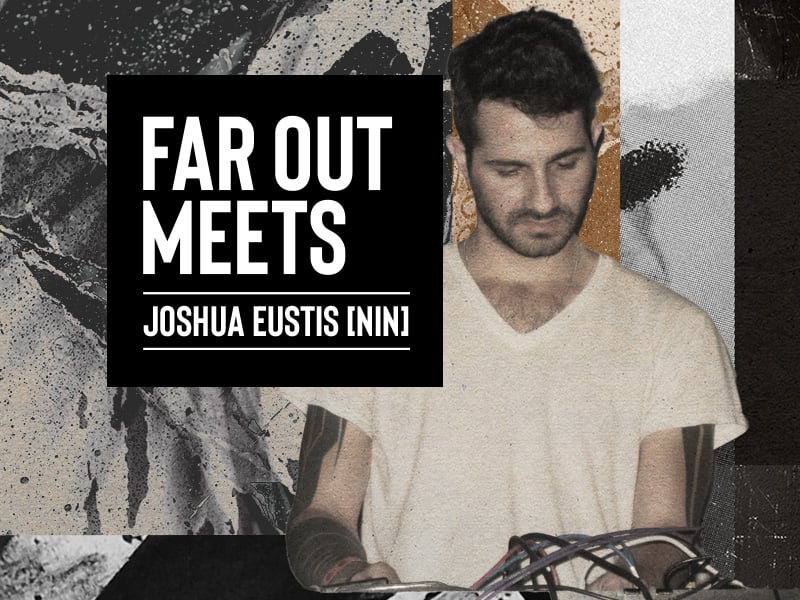
Far Out Meets: Joshua Eustis on ‘Serial Cleaners’, ’90s house and Nine Inch Nails

You’d be hard-pressed to find a working musician today with a wider scope than Joshua Eustis. Since the turn of the millennium, Eustis has brought his singular approach to electronic music through his work with Telefon Tel Aviv, the project he originally started with late bandmate Charles Cooper.
But Eustis has done way more than just Telefon Tel Aviv. There are his solo projects, including music released under the names The Second Woman and Songs of Magdalene. There’s his electronic supergroup, The Black Queen. And then there are his extended collaborations with Trent Reznor and Maynard James Keenan as a member of both Nine Inch Nails and Puscifer.
His most recent project has been as a composer, creating the score for the stealth video game Serial Cleaners. Recently, Eustis sat down with Far out to discuss his how ’90s house music and jazz-influenced his work on Serial Cleaners. We also got into the nitty gritty when it comes to geeking out over music tech and uncovered what it’s really like working with Trent Reznor in Nine Inch Nails.
FO: Let’s get into a little bit of Serial Cleaners. First off, tell me how you got involved with the project.
Christoph Kowaltik used to book me in Poland to play shows there years ago. He became sort of a, how do I describe it, kind of the musical director at Draw Distance [the developer of Serial Cleaners], and they were like, ‘We need a composer that can do all this kind of stuff. It’s a lot of different styles. Do you know anybody?’ And he said, ‘I think I know a guy’.
He called me out of the blue, I hadn’t talked to him in a year or two. I hadn’t talked to him since maybe late 2019, when I was in Europe touring. And he hit me up out of the blue and says, ‘Do you want to do this?’ So I said, ‘Yeah.’ That’s kind of how it went down.
FO: Did you have any kind of experience with video game music or soundtracks in regards to this specific kind of medium before?
Yeah, in the 90s I did some real mom and pop style video game stuff. In 2007, I did some stuff for PlayStation. Not a ton of it, though. And then I did a movie in the early aughts, I did a film with my late bandmate [Charles Cooper, from Telefon Tel Aviv], I guess in like 2000. And that was from Miramax. So I had written scores before, but it had been had been a while. I did a documentary for CNN in 2017. You know, on and off little bits and pieces for maybe 20 years.
FO: So how does the creative process kind of change when you’re writing specifically for something that already exists?
Well, you’re you have to toss your vanity entirely out the window, which is really hard for me to do musically, because I have a lot of musical vanity. I’m musically very vain. So I had to completely just light that on fire to do this, because you have to write something in service to a story, which, in this case, also is made even more complicated that it had to be specific genres from a specific time period, with certain amount of kitsch undergirding it, which makes it even more complicated.
You’re having you’re having to get in a very, very tiny, specific, almost narrow headspace to do this kind of stuff, which I’ve never done anything like that before. I can write music in service of other things. That’s not that hard. But to write in service of other things, but within a very narrow bandwidth, very strict rules about it, became a massive challenge.
FO: [The setting of the game is] ’90s New York, which has a pretty big cultural impact already. So did you feel like you had to fit into that, or reference it but kind of stay out of it? What was it a big presence, or was it like a guide that you could do anything with?
Oh, no, it was, it was a big, big, big presence. I mean, we really needed to stick the landing on that musically. So it was a lot of me thinking about when I was in college what music was like in the ’90s: what hip hop felt like at the time and how totally dominant, at least in terms of hip hop, how totally dominant, New York was at the time. It was right at the peak of all of the east coast versus west coast stuff. And of course, west coast was doing tons of great music at the time, that is still iconically ’90s. But taking place in New York, I had to really lean in on to what was going on in hip hop on the east coast at the time.
But then, also going back to what it was like for me in the ’90s to go to raves at the time and what kind of music was getting played there, and what kind of what sub genres of dance music were starting to gain traction at the time. Drum and Bass was becoming a thing in the mid-’90s. It was coming out of hardcore and the sort of United Kingdom hardcore continuum started spilling over into American states, American rave parties and stuff. Detroit techno had informed Berlin techno really strongly and then Berlin techno was being brought back to the states. So all of this kind of stuff was just going across the ocean.
And all the while bands like, Nine Inch Nails Rammstein, whoever, you know, anybody doing drum machines and synths and guitars was blowing up in the states. These bands were really big at the time. So yeah, it was fun to dig into all that.
FO: Well, you have a unique view of, you know, having got over 30 years of experience with it…
Almost. I’m not that old yet [laughs].
FO: Not trying to bring into the old man sphere at all…
That’s fine. I’m in it. I mean, I technically got my first keyboard, my first synthesizer, 30 years ago.
FO: Do you remember what synth it was?
It was a Korg M One, with the house piano and the Robin S. organ sound. I didn’t know what was in it. I just was like, ‘Oh, that looks cool. It’s got a sequencer, and drum sounds okay, cool.’ That’s what I needed to make music when I was 15 or something. I got it, and I couldn’t believe it. It was so cool. Because it had the Robin S. bass organ, the ‘Show Me Love’ bass organ sound, and I loved that song in high school, even though it was like, you know, uncool to like it, I secretly loved it.
An interesting tidbit about why the M One hit me so hard, is because it’s like the house music workstation. It was the thing that defined a lot of early-to-mid-’90s house music because the piano sound and the organ sound were just everywhere. I didn’t know what I was getting when I got it. I sort of bought it sight unseen. But the cool thing about it was, when I was in high school in New Orleans, if you wanted to hear dance music – I mean not industrial or goth stuff, there were great clubs for that – but if you wanted to hear house music, there were no places to hear that except gay clubs on Bourbon Street.
So my friends and I in high school would go party at the gay clubs. And they were like super fun. They would let us in and, they wouldn’t let us drink or whatever, but they would let us party. And nobody fucked with us. We had this awesome experience for the last year of high school of partying in the gay clubs and listening to house music all the time. So when I started hearing all of this, as I started to get more and more familiar with house in all of the shades of house music, from the commercial stuff all the way down to like the less commercial and more underground stuff, I realized that like this Korg M One, this first thing that I got, was like thhe Rosetta Stone.
It was like the key that can unlock all of music, I can make this kind of music on this workstation. So it was a real big eye-opening moment of learning about house music, and then I had the instrument that could do it.
FO: Are you the kind of guy that likes to go back to older technology for the sounds and for the styles that you can get out of it? Or is it about kind of approximating those sounds with new technology?
It depends. For Serial Cleaners, it was definitely about going back to these older things whenever I could and trying to incorporate the original instruments. A lot of this stuff you can’t find anymore, or I used to have it, and I sold it a million years ago. So I work with whatever I can work with.
In my own music: never. Almost never. I mean, I have a have 115-year-old piano that I use, if that counts. I’m not a gear-obsessive person. In fact, I generally, cordially dislike gear at this stage. I’ve been through a million phases where in the ’90s, I accumulated a ton of gear, a room full of synthesizers and keyboards, all the old Roland stuff, all the classic stuff. And then I sold all of it. And then, in the late aughts, and mid-aughts, I started accruing synthesizers and drum machines again. I had a huge console and tons of outboard and all of these synthesizers and all these drum machines. And then, over the last seven years, I just got rid of all of it.
I just go through these phases where I have a ton of gear and then no gear, and for seven or eight years now, have steadily been in the, ‘I don’t want gear’ or ‘I just want one synthesizer that is hard to recreate with software.’ There’s a lot of software that’s amazing, and hardware stuff can’t do what that does. And then there’s some hardware stuff like, like, the Prophet-5, where it’s never really going to be quite right. If it’s recreated in software, it’ll be fine in the context of a mix, but it’s missing a little something.
I like having a real Prophet-5, for instance. It’s the main synth that I used for all music on Serial Cleaners. Which is cool, because it’s versatile. I could do watery pad stuff for drum and bass. I used it on some of the jazz stuff, like just for like little swells. All the industrial stuff. It’s just all about heavy metallic bass sounds. It’s all over the soundtrack. It’s probably the most used instrument.
FO: How do you get jazz out of a Prophet-5? Because it doesn’t seem like they necessarily line up in the in the traditional sense.
You’d be surprised? Mostly what I did, it’s on the parking lot song, you can hear it in the background. It’s these little chord swells. And I’m just outlining the chord changes as we’re as the group is playing through the chord changes. The Prophet five is just doing these little swells that just sort of outline it. It’s barely there. When it’s there, it’s like, if I take it out, you’d be like, ‘What, something’s wrong.’ Because I was gonna take it out originally, it was just there to just outline stuff for the horn players. Because the bass is moving through a chord progression, but it’s kind of an ostinato-ish sort of pattern. So I didn’t know if it was going to be enough when we went to record. I did these little pads swells. But I ended up liking it and leaving it in and the guys were like, ‘Hey, they’re cool. You should leave them.’ So, well, there it is.
FO: You have to put on so many different hats: the the work that you’ve done with Nine Inch Nails, Puscifer, Telefon Tel Aviv. How is it different for your creative mindset when you’re more extensively on somebody else’s project?
It’s different from project to project. I mean, working on Nine Inch Nails stuff is different than working on Puscifer stuff with Maynard [James Keenan]. That’s all different than working on Telefon Tel Aviv or Second Woman or Sons of Magdalene. It never really feels the same. It’s kind of different. Every time, every sort of creative process, you’re sort of starting from scratch: to relearn everything as you go.
FO: When you stepped in with Nine Inch Nails, what was Trent Reznor’s attitude towards what you were contributing? Was it heavy direction, or was it light?
Honestly, that was the best part of being in Nine Inch Nails: Trent coming in here and saying, “The way this is gonna work is you’re gonna have total control over what you’re doing. I’m gonna give you ideas about what parts I think you could be doing and stuff that I think might be in your wheelhouse. We’ll go through the songs together and kind of divvy up parts, who’s playing what, but I’m not going to tell you how you’ve got to play it.”
He’s like, “I might give you some ideas. Like, hey, maybe try play this.” It was great. He would give me an example. He would say, “Hey, this guitar part in this one song, I think it’s good for you. Think about playing it on a guitar. But think about not using the pick or your fingers to play.” He would present little challenges like that. It was like, “See if you can find a way to do this, where it sounds like it’s just going ‘Oooooooooh‘, and it’s not going ‘didladidladidla.'”
You know, it was a lot of little engineering challenges and little playing challenges that come up. And that’s what made it so, so, so fun. It was the kind of thing where I would stay up all night trying to figure out weird ways to play these parts or new ways to play the parts that have been played a certain way a million times before. A lot of that stuff got tossed out. [laughs]. You know, I would work on something and Trent would come in and go, “I don’t know if that’s it, man.” But he would also be, like, ‘I didn’t mean to send you on a goose chase. Let’s go back to the original and start with that.”
It was great. He just put total faith in me to sort of figure it out. And then he would give me feedback saying like, “Yeah, this is sounding great. Maybe try this or like, it could be a little better,” or, “You’re consistently playing this one funk part behind the beat, you work on that tonight.” He was great for feedback.
FO: Since Trent is such the face of Nine Inch Nails, I don’t think people have a very detailed idea of what Atticus Ross does with regard to the band. How do you view what he does?
Atticus was only a studio guy when I was in the band. And then Atticus kind of became a live guy after I left, and so the band got built up to, like, nine people at one point. And then Trent was just like, ‘Okay, I need to get back to the bare bones.’ And so those of us who were sort of, I would say, side players, you know, who were like kind of the shortstops running around – me, Pino [Palladino], the singers – he took us off and then restored it to the core members and then brought Atticus in.
It kind of only made sense because Atticus is, like, the other half of the band as far as how the records have gotten made for like the last 20-something years. Since like 2000 or 2001 or however long Atticus has been around. So it only kind of made sense for him to be on stage too.
FO: Did you have any interaction with Atticus?
Yeah, yeah. I was around in the studio for a week or two, a couple of weeks maybe for a few sessions. I was just goofing off by singing backups on something or I did some drum stuff on another one. But that’s Atticus’s show, the studio stuff. That’s his baby. Trent writes it, and will make beats and play keyboards and stuff. And Atticus is kind of like the, I don’t know, air traffic controller. He sort of puts it all together.
FO: So is there just no ego involved when you go to a project like that?
It’s kind of hard to have an ego around Trent. You’re gonna get pancaked. Ego something that Wu Tang crushes. [Laughs] Let me tell you, yeah, you can’t go into that project having an ego and there’s plenty of egos around. Let me tell you, there’s a lot of them.
Everybody kind of goes in stoked and having an ego and then you get flattened and it’s cool. You know, you learn that stuff that you get older.
