


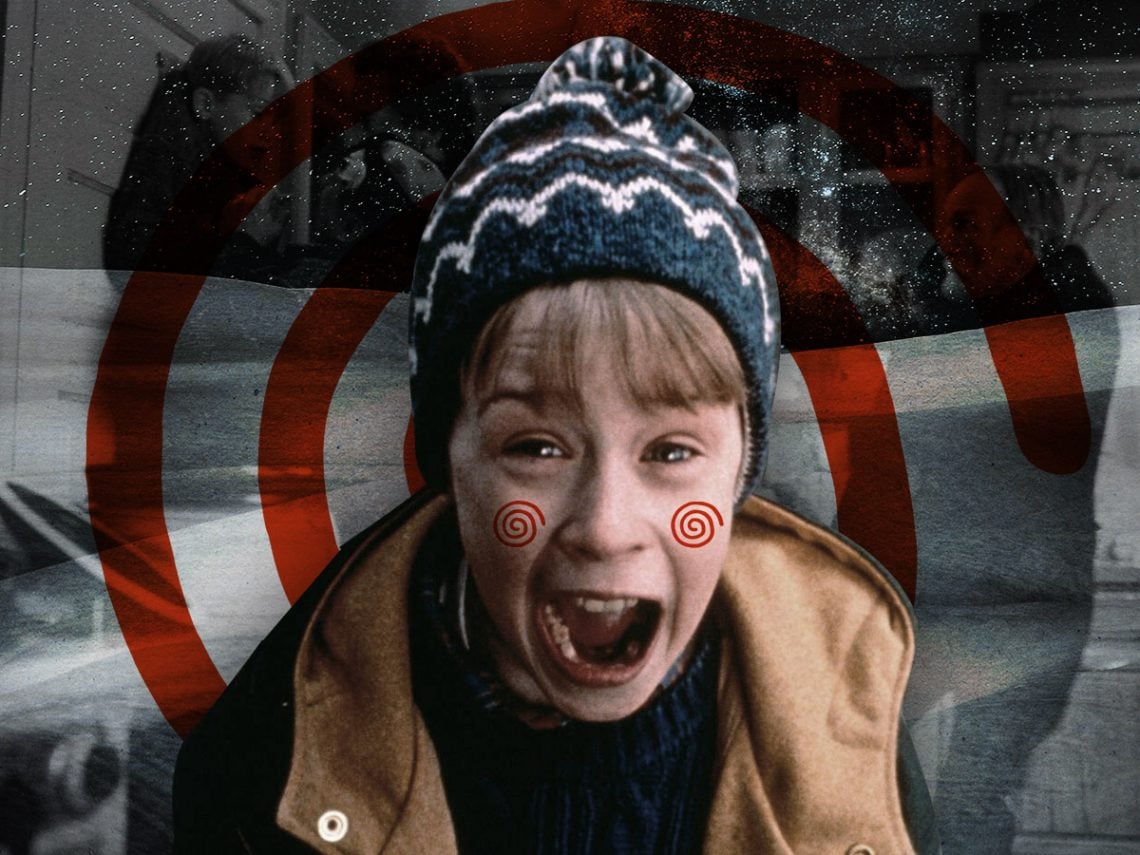
Exploring the fan theory that Kevin McCallister from ‘Home Alone’ is Jigsaw

Fan theories are a prominent interest for movie fans, with imaginative proposals and perspectives often elevating a film’s material and impact. Audiences are afforded the chance to act as undercover detectives by identifying relevant and insightful clues to come up with creative conclusions. One popular theory that has continued to blow the minds of fans for years is a suggestion that Kevin McCallister, the protagonist of Home Alone, is Saw’s menacing antagonist John Kramer, also known as Jigsaw.
Kevin McCallister is the face of arguably the most iconic Christmas movie ever created. Home Alone is a festive comedy-drama directed by American director Chris Columbus and written by John Hughes. It follows a typical American family heading off to Paris to celebrate Christmas. However, they accidentally leave their eight-year-old son, Kevin, home alone. The young boy seems to enjoy his newfound freedom without his family until the house is targeted by two local burglars, who Kevin has to fight off using some homemade devices.
Home Alone‘s trap sequence makes for some of the film’s most iconic imagery, alongside the immortalised vision of Kevin’s screaming face. His traps include a fire torch connected to a door, a nail on the stairs and a falling iron, and countless others. These booby traps constantly frustrate the burglars – Harry and Marv – with the two being taken back so that a child could conjure up and execute such devices.
The traps make for some painful visuals, with some having audiences cringe every time. YouTuber Jack Roper was curious to discover if the burglars would have survived any of the traps in real life. He recreated the situations in his own experiments, and one of these replicas from the film includes flinging a 13lb metal paint pot over the stairs and into the ballistic dummy’s head. Roper explains: “As the paint falls, it picks up speed. It works out to about 17mph. If you give it a bit of a shove, you have a 13 lb gallon of paint coming at your face at 20mph.”
He adds: “It’s like getting bare-knuckle punched by Mike Tyson twice at one time.”
Home Alone‘s inflictions of pain counteract its overall family comedy tone. Kevin’s later traps fit perfectly within the grizzly and harrowing atmosphere of the Saw horror franchise. James Wan and Leigh Whannell created the series in the early 2000s and found critical acclaim with the very first film.
Despite being a psychological thriller, later additions to the series contributed to its categorisation as torture porn, as the over-the-top gore came to override the overall story.
This overarching narrative concerns the mastermind behind the iconic traps from the first film. John Kramer is an engineer who, after being diagnosed with terminal cancer, becomes sickened by what he believes is society’s ungrateful approach to life. Kramer becomes convinced that people have become too selfish and have forgotten how precious life is. His way of fixing this is to kidnap people he believes have done wrong, put them in horrific traps that threaten to tear them apart and force them to find their lost survival instincts.
These traps are psychologically scarring, with some victims barely making it out. Jigsaw believes that these grizzly traps are making the world a better place, cleansing the victims of their alleged sin of neglecting life and showing them how valuable every day truly is.
So, how exactly did the mind-blowing theory about these two characters being the same person come about?
Well, there are some steady connections between Kevin and Jigsaw, as a post from Reddit reads: “They both punish criminals, have strained relationships with their families and devise insidious death traps to maim and kill all of the people they lure to their location. Plus, we know they both live in America.”
Looking at all the evidence for this theory, it’s clear both characters are innovative in designing and building successful traps to target immoral criminals. Kevin’s victims may be relatively harmless cat burglars; however, Jigsaw traps people who have committed crimes ranging from insurance fraud to murder. After Jigsaw dies in the third film, his accomplices carry out his philosophy, eventually submitting child molesters to rigged traps they cannot survive. This is a significant jump in scope from his alleged early days in Home Alone.
This sadistic and twisted outlook on life comes across as a downward spiral. Kevin McCallister is characterised as an upbeat and delightful child who thrives in the spirit of Christmas. It’s unsettling to imagine this beaming youth was beaten down by hardships and a diagnosis to the point where he sees no issue with torture and murder.
However, the timeline must be considered to prove or disprove this theory once and for all. If Kevin was eight in the first film, and we can trust it was set in 1990, he would have been born in 1982. As for Kramer, we are only told any indication of his age in Saw IV, where his autopsy revealed he was 52 when he died. The third film was released in 2006, but the franchise is famous for its complicated and twisted timeline, with sequels taking place at the same time as its predecessor. However, Kramer technically died in 2006, as this is the date seen on his autopsy tag, meaning he was born in 1954.
Even though years and ages are not on this theory’s side, the thought that a sweet eight-year-old child who pulls some pranks on two robbers grows up to become the sadistic mastermind behind some of the most painful events seen in American horror is a creative rollercoaster. Those who are too invested in this proposal can overlook the chronological aspect and re-watch both movies under the impression that they chart one inventor’s journey from slapstick to torture.
Check out this infamous clip that summarises Jigsaw’s philosophy below, and imagine he was once Kevin McCallister.
