


Exploring the theatrical side of indie music in 10 songs

Musical theatre has almost always been decidedly uncool. Between over-the-top costumes, exaggerated vocal intonations, and synchronised choreography, the drama and excess of theatre is at odds with the understated realism of indie and alternative countercultures.
Despite this, some artists still seem to be incorporating elements of performance and theatricality into their indie output. From costumed and themed live shows to orchestral swells to lyrical storytelling, the marriage of theatre and indie can be seamless or induce cringe in cult followings.
Perhaps the most recent example of the latter is supergroup Fizz, whose debut single ‘High In Brighton’ featured all the optimistic joy of musical theatre, accompanied by bright costumes and exaggerated vocals. Though some bands veer too far into theatrical territory, some have triumphed in their inclusion of storytelling and theatrics and succeeded in making theatre cool.
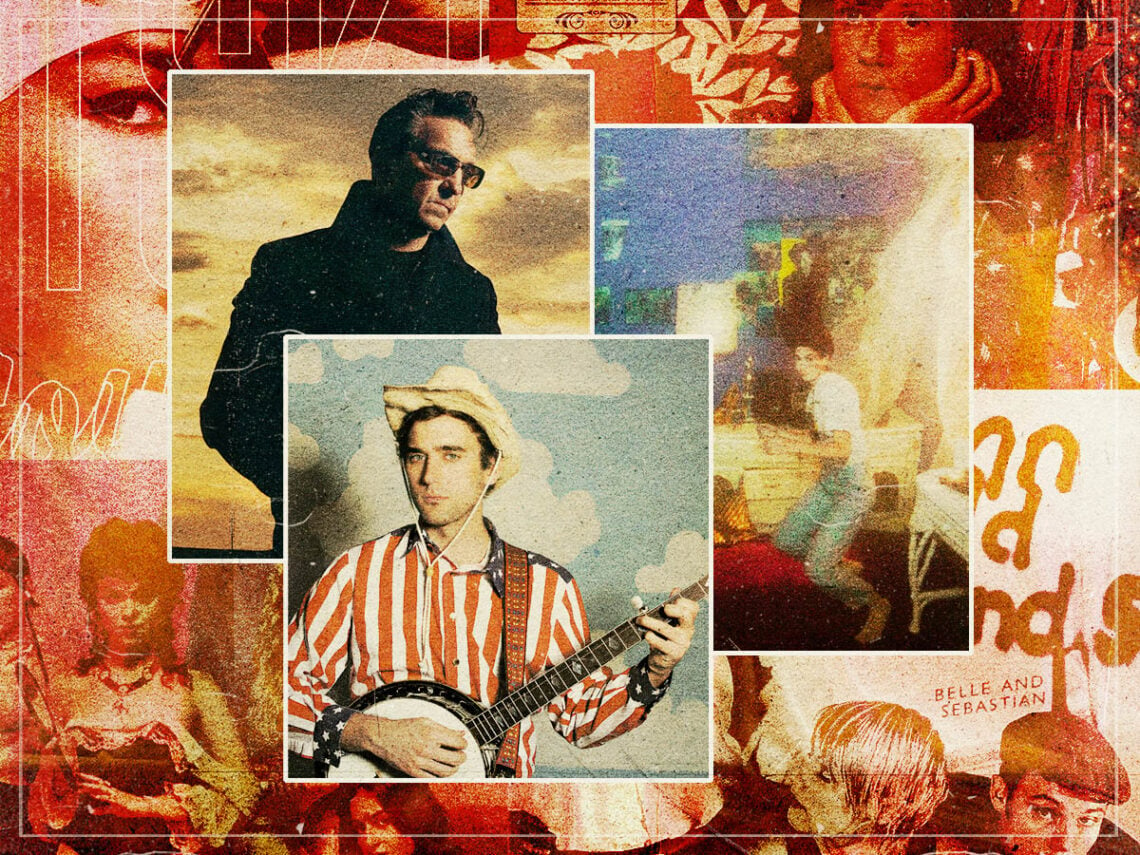
Masterfully blending the polished narratives of theatre with the rough edges of indie can make for a unique listening experience, though it’s a hard one to master. Beginning with the twee indie pop of Belle and Sebastian and God Help The Girl and tracking the movement all the way to Black Country, New Road’s most recent live album, we’ve collated ten tracks which explore the increasing theatricality in indie music.
The theatrical side of indie music:
‘I’m Waking Up To Us’ by Belle and Sebastian
Led by singer-songwriter and filmmaker Stuart Murdoch, Glasgow-born Belle and Sebastian are widely renowned by critics for their whimsical, twee style of indie pop. Murdoch’s sweet vocals are backed by an assortment of band members, including a violinist and a cellist. It’s an ensemble large enough to fill a stage with a sound just as capable.
‘I’m Waking Up To Us’ is Belle and Sebastian at their most theatrical. Released as a single in 2001, the song tells the tale of a lost love, simultaneously snarky and sad. Over a chorus of “Ahh”, Murdoch’s lyrics are a specific and poetic portrait of two lovers. He bitterly declares, “You like yourself and you like men to kiss your arse”.
At the climax, Murdoch laments, “She was the one love of my life, she showed me the road, I loved her dog, her steady gaze, the chapter is closed.” It’s a clear narrative, punctuated by swelling violins which serve to punctuate the narrative.
‘Chicago’ by Sufjan Stevens
Indie icon Sufjan Stevens is no stranger to soundtracking a story. The singer-songwriter’s contributions to the soundtrack for Luca Guadagnino’s Call Me By Your Name proved his dramatic capabilities, as ‘Visions of Gideon’ accompanied the film’s tragic final scene and ‘Mystery of Love’ earned him an Academy Award nomination.
Stevens’ own music also contains an element of theatricality. On ‘Chicago’, he tells a simple story of love, singing, “I fell in love again, all things go”. The song’s lyrics triumph in their specificity and emotion – at its climax, Stevens almost speaks, “If I was crying in the van with my friend it was for freedom”, before repeating the refrain, “I made a lot of mistakes”.
Through its repetition, choral elements, and strings and trumpet sections, ‘Chicago’ contains a theatricality which sets it apart from indie. It also happens to share a name with one of the most famous musicals of all time.
‘Lloyd, I’m Ready To Be Heartbroken’ by Camera Obscura
Following in the footsteps of Belle and Sebastian, Glaswegian band Camera Obscura forged their own kind of theatrical, twee indie pop in the 1990s and 2000s. On their third studio album, Let’s Get Out of This Country, the band included a track called, ‘Lloyd, I’m Ready To Be Heartbroken’, which formed a response to the Lloyd Cole and the Commotions song, ‘Are You Ready To Be Heartbroken?’
It’s this narrative which makes the track feel theatrical – beginning with the line, “He said, ‘I’ll protect you like you are the crown jewels’, yeah”, it contains specific quotes and names akin to a track you’d only find in a musical.
As Camera Obscura directly address the character of Lloyd, it’s not hard to imagine how a male lead might sing Cole’s track, followed by a female lead taking on ‘Lloyd, I’m Ready To Be Heartbroken’. Sonically, the track is fairly straightforward indie pop, though the inclusion of an organ and strings sets it apart.
‘Tonight the Streets Are Ours’ by Richard Hawley
Richard Hawley might not be the first person to spring to mind when you think of polished, musical style songwriting, but Hawley’s ‘Tonight the Streets Are Ours’ is the kind of track you might find at the peak of an epic romance, as two lovers run the streets hand in hand.
With second-person lyricism, Hawley directly addresses his lover, making dramatic declarations like, “And no one else can haunt me, the way that you can haunt me”. As the song draws to a close, the instrumentals swell amongst a chorus of operatic female voices. It’s a far cry from the laddish Britpop of Hawley’s work in Pulp, although there’s definitely a case to be made that ‘Common People’ would make for an excellent stage production.
‘God Help The Girl’ by God Help The Girl
In 2009, Belle and Sebastian frontman Stuart Murdoch put out his first release under the moniker God Help the Girl. The self-titled record featured Catherine Ireton on vocals and formed a concept album which followed a girl’s nervous breakdown. In 2014, Murdoch followed the project with an accompanying film featuring Emily Browning, Olly Alexander and Hannah Murray.
The title track ‘God Help The Girl’ features Ireton’s casually musical theatre-inspired vocals, full of playful emotion, as she simultaneously denies her need for a boy and declares, “My love for him’s absurd”.
The line, “I think of him when I’m doing the dishes”, is followed by a high-pitched repetition of “doing the dishes”, in true musical theatre style. With playful piano, a continuous narrative, and character-building, the entire God Help The Girl project is theatrical indie at its peak.
‘Me and My Husband’ by Mitski
Vulnerability and storytelling are often at the heart of Mitski’s music. With huge climaxes and swinging vocals, she’s more than capable of commanding a stage and evoking emotion from audiences. ‘Nobody’ contains all the repetition and desperation of a protagonist at their lowest, while the poetic ‘First Love/Late Spring’ features Mitski’s strong, smooth vocals, gorgeous imagery, and stirring lyrics like, “One word from you and I would jump off of this ledge I’m on, tell me don’t so I can crawl back in”.
Many of her tracks would fit perfectly on a modern stage, particularly ‘Me and My Husband’ from her 2018 record, Be the Cowboy. Beginning with a sigh that’s half exasperated, half enamoured, Mitski launches into an upbeat, melodic tale of dependency and domesticity.
It’s the story of her own low self-esteem and her resulting need for her partner – the tale of a woman you’d find in old literature; she sings, “And I am the idiot with the painted face in the corner, taking up space, but when he walks in I am loved, I am loved”.
‘A Lot’s Gonna Change’ by Weyes Blood
Few modern indie musicians are as committed to their artistry as Natalie Mering, also known as Weyes Blood. Her music, visuals, and live performance are all tailored to her chosen aesthetic. For her most recent record, she incorporated a glowing heart prop into her live set, which mirrored the album’s artwork and title. For Titanic Rising, she committed as far as building a bedroom underwater and diving beneath it for the cover art.
Her sound is just as dramatic and imaginative, with the opening track to Titanic Rising containing all the spectacle and gravitas of a climactic ballad. Mering’s grand vocals swing high and low over a transcendent soundscape. From then, the album creates a whole world of its own, charting themes of climate change, modern dating, and more over-dramatic baroque pop.
‘The Boy’ by Black Country, New Road
Few modern indie albums have incorporated the influence of musical theatre as masterfully and heavily as Black Country, New Road’s Live at Bush Hall. Whether it’s the switching of vocalists, varied instrumentation (violin, saxophone, accordion, flute, you name it), or the narrative style, the record contains a theatricality and drama that negates the cool, post-punk of their work when Isaac Wood was at the helm. The songs were written around three themes, one of which was prom night which also formed the aesthetic background for the live performance.
Though ‘Turbines/Pigs’ is almost definitely May Kershaw’s highlight on the album, ‘The Boy’ best encapsulates the album’s storytelling theatricality at its most overt. In three chapters, Kershaw narrates the story of a robin, a mole, and a deer. It’s fable-esque and features the kind of vivid imagery that would translate to stage while retaining the nihilistic tendencies of Black Country, New Road. The story is accompanied and enhanced by gentle strings and a twinkling flute.
‘Across The Pond Friend’ by Black Country, New Road
Further demonstrating the dramatic theatricality of Black Country, New Road’s most recent full-length endeavour, ‘Across The Pond Friend’ represents a different side of the band’s new era. For the track, Lewis Evans takes on the vocalist role.
It’s the kind of track you can imagine opening a musical, as he sings, “Crowded trains, cement, and cats’ eyes after dark, who’d have thought a square bagel’s where it would start?” There are references to other characters, Winnie and May, swelling soundscapes juxtaposed against quieter moments, and choral backing vocals. In its final moments, striking stings of sound end the track in a way that warrants a curtain close.
‘Sinner’ by The Last Dinner Party
Everyone’s new favourite girl band, The Last Dinner Party, rose to acclaim at an unparalleled pace. Following the overwhelming success of their debut single, ‘Nothing Matters’, they returned with ‘Sinner’, a glistening art pop song marked by a simplistic piano melody, harmonies, and a striking guitar riff.
The Last Dinner Party’s music is drenched in emotion, with lead singer Abigal Morris’ powerful vocals taking centre stage amidst swelling instrumentation and harmonised backing vocals. But most of The Last Dinner Party’s theatricality comes from outside their music. Donning masterfully coordinated renaissance-inspired outfits that verge on fancy dress and cordially inviting fans to the last dinner party, they’ve cultivated a niche and visual style that stretches beyond their sound.
