


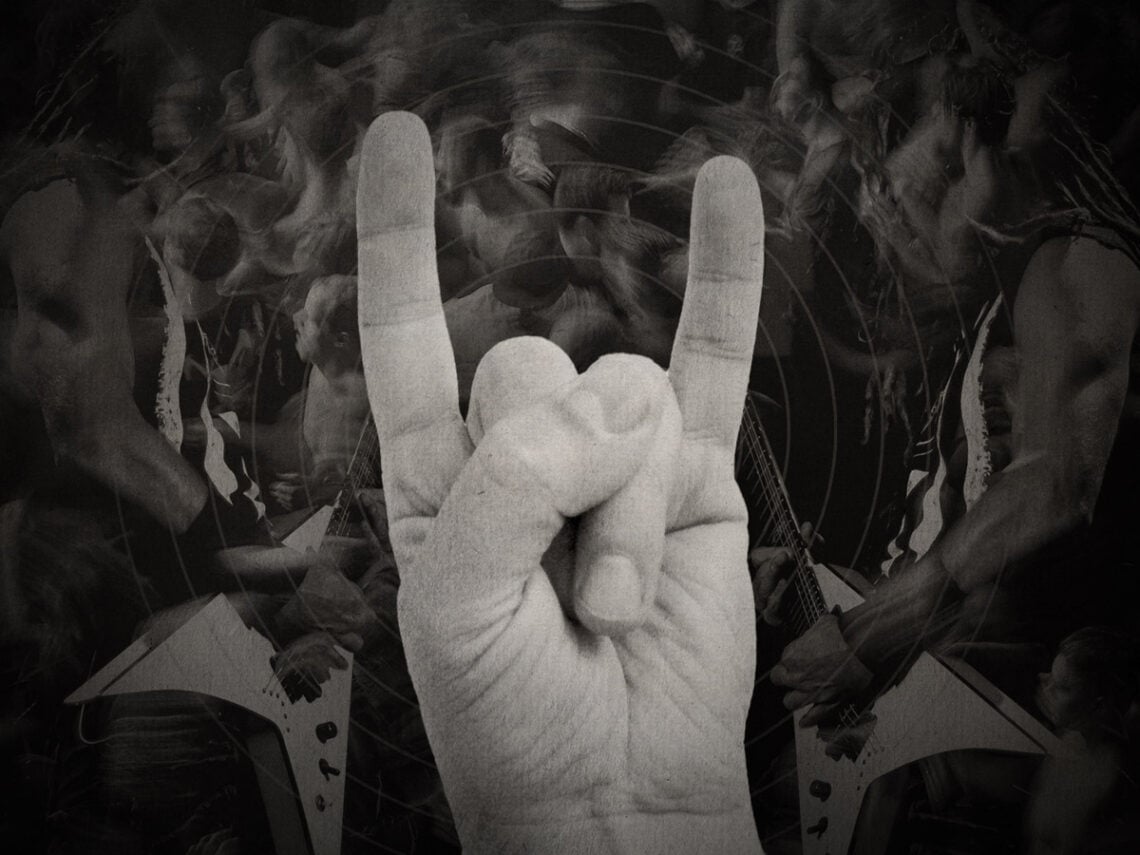
Exploring the origins of the metal horns gesture

At any given rock show, whether your personal preference leans towards the likes of dad rock or death metal, or somewhere in between, chances are you’ve had your line of sight blocked by someone throwing their arm in the air to hold up the sign of the horns.
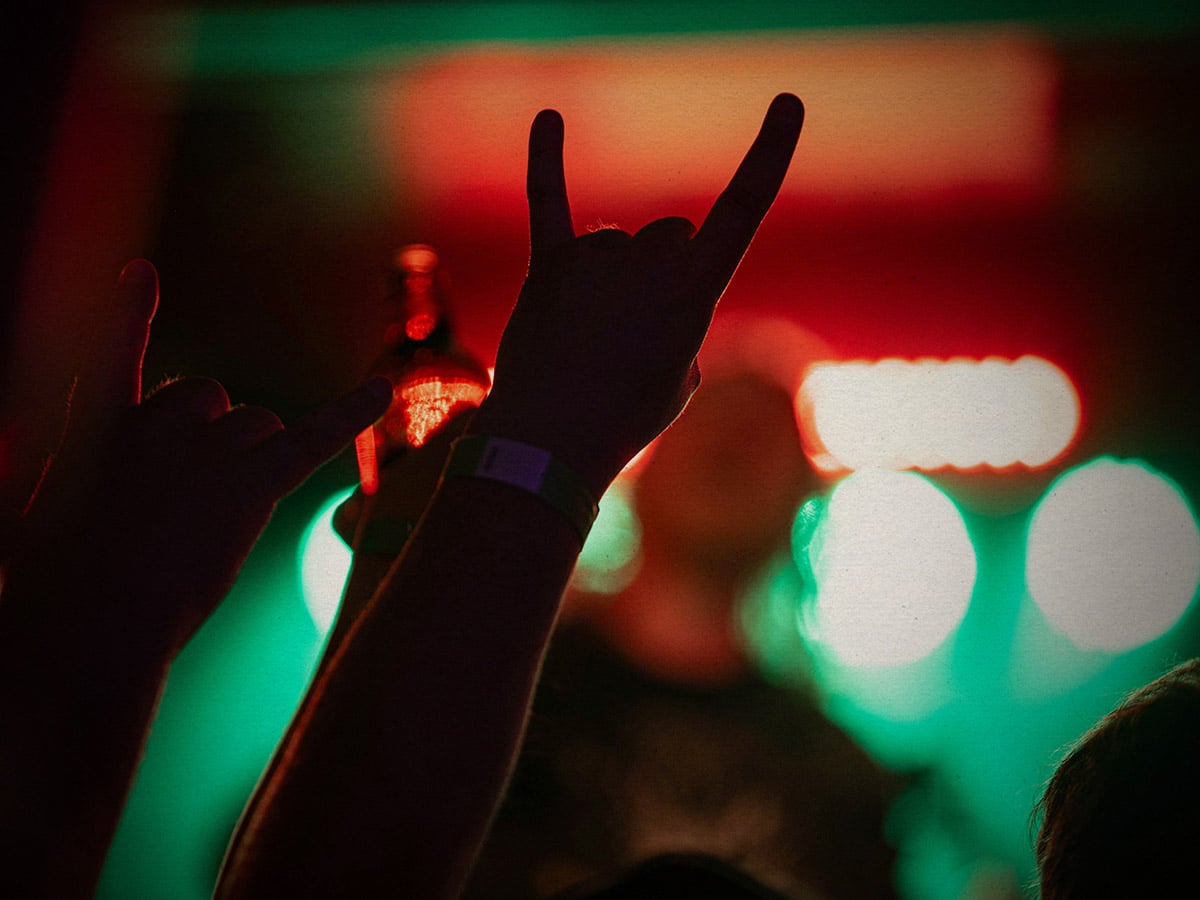
The index and pinky fingers raised, and middle and ring fingers held down with the thumb, to resemble ‘Devil horns’ or ‘metal horns’, as they’ve come to be known, this hand gesture is almost instinctive, in some cases, a sign of mutual understanding among strangers at a gig, or even in somewhere common like the supermarket or pub, spotting someone wearing the T-shirt of your favourite band.
While the gesture is most associated with heavy metal culture, it has a longer history that spans across various cultures and religions. In Indian classical dance forms, for instance, the horns symbolise the lion, while in Buddhism, the ‘Karana Mudrā’ is a sacred hand gesture, regarded as an apotropaic (or protective) means to expel demons, remove negative energy and ward off evil.
The gesture is also depicted often with Siddhartha Gautama, commonly known as the Buddha, and is found on the Song dynasty statue of Laozi, the founder of Taoism, on Mount Qingyuan, China. Horns also expand to Italy and other Mediterranean cultures, as well, with a similar intention of warding off evil and misfortune, or the ‘evil eye’. Italian culture refers to the gesture as the ‘corna’ (horns), and with the fingers pointing downwards, it is a common apotropaic gesture, meant to grant protection in unfortunate situations.
In many Mediterranean and Latin countries, however, including Colombia, Greece, Portugal, Spain, Mexico and Italy, the gesture has a negative connotation, wheere, especially in Italy, pointing the gesture downwards (though occasionally upwards, too) serves to ward off bad luck, but the positioning of the hand and the context of its use are imperative to not directly insult someone.
How the horns found their way into popular culture is a different story. Glimpses of it linger in early recordings and films: the 1972 jazz recording, ‘Throwin’ the Horns’ by the New Orleans Owls, for instance, references it, while Ike Turner once claimed in an interview with GBH that he used the sign while playing the piano on Howlin’ Wolf’s ‘How Many More Years’ back in 1951.
Four years later, in the film Guys and Dolls, Marlon Brando throws the gesture as a sign for snake eyes in the craps game he is involved in. Famously, in 1967, John Lennon posed with the horns in a photograph promoting The Beatles’ cartoon movie, 1969’s Yellow Submarine, where his cartoon self throws the horns above Paul McCartney’s head.

Before the horns were a symbol associated with heavy metal, they were associated with science fiction music: in the early 1970s, the band Parliament-Funkadelic, an American music collective, used the ‘P-Funk sign’, as they referred to the horns, as the password to the ‘Mothership’, an element of their sci-fi mythology. Fans in the crowd would wield the horns in return.
The horns’ first instance in the realm of rock ‘n’ roll came from the Chicago-native psychedelic-occult rock band Coven. On the back cover of their 1969 album, Witchcraft Destroys Minds & Reaps Souls, the band members, led by their vocalist Jinx Dawson, are shown giving the “sign of the horns”. Coven’s commonly used themes of the occult and Satanism became synonymous with the horns and vice versa, particularly when Dawson began incorporating the gesture during their live performances.
“It’s not a mano cornuta, like in Italy, where they point the fingers at the eyes of little kids and say ‘be good’,” Dawson explained to the Chicago Reader, “In the sign of the horns, you hold the two middle fingers down and other ones up, and it looks kind of like a goat in the shadows. It meant that they’re in the secret society, almost like a secret handshake. That’s what it means: ‘You’re one of us’.” From Dawson’s perspective, the horns were the opposite of the peace sign from the waning hippie era and, as she explained, “People thought it was kind of a weird, bastardised version of that”.
The release of Witchcraft Destroys Minds & Reaps Souls coincided with an era of Satanic panic in the United States, particularly, in the wake of the Manson Family murders and a sensationalised mention in Esquire magazine’s ‘Evil Lurks in California’ article from March 1970, which linked the countercultural intrigue with the occult to the recent murders, and saw the album promptly pulled from circulation. The horns persisted, nonetheless, incorporating into heavy metal culture with large thanks to the late Ronnie James Dio. While it is widely believed that he ‘invented’ the gesture, a belief that even he himself denied, he did popularise its use, thanks in part to his grandmother.
By Dio’s account, his grandmother, a Catholic Italian, used the gesture to ward off the evil eye (malocchio in Italian), and he adopted it as his own after joining Black Sabbath in 1979. Recognising that Ozzy Osbourne often used the peace sign at his performances, Dio wanted to use a gesture of his own, and thus, the horns became second nature for both himself and, soon, for heavy metal fans worldwide.
“It’s to ward off the evil eye or to give the evil eye, depending on which way you do it,” Dio explained to Metal Rules in 2001, “It’s just a symbol, but it had magical incantations and attitudes to it, and I felt it worked very well with Sabbath”.
His bandmate, Geezer Butler, preceded him, often wielding the gesture that is immortalised in a photograph dating back to 1969, included in the CD booklet of Black Sabbath’s 2002 Symptom of the Universe: The Original Black Sabbath 1970-1978 compilation album. The horns, then, were intrinsic to Black Sabbath’s lore from its earliest days.
Coven may have been the first to wield the horns in a way that associated the gesture with rock ‘n’ roll, but, in a somewhat ironic twist, its origins date back much farther as a symbol of protection, rather than an invocation of evil.
