


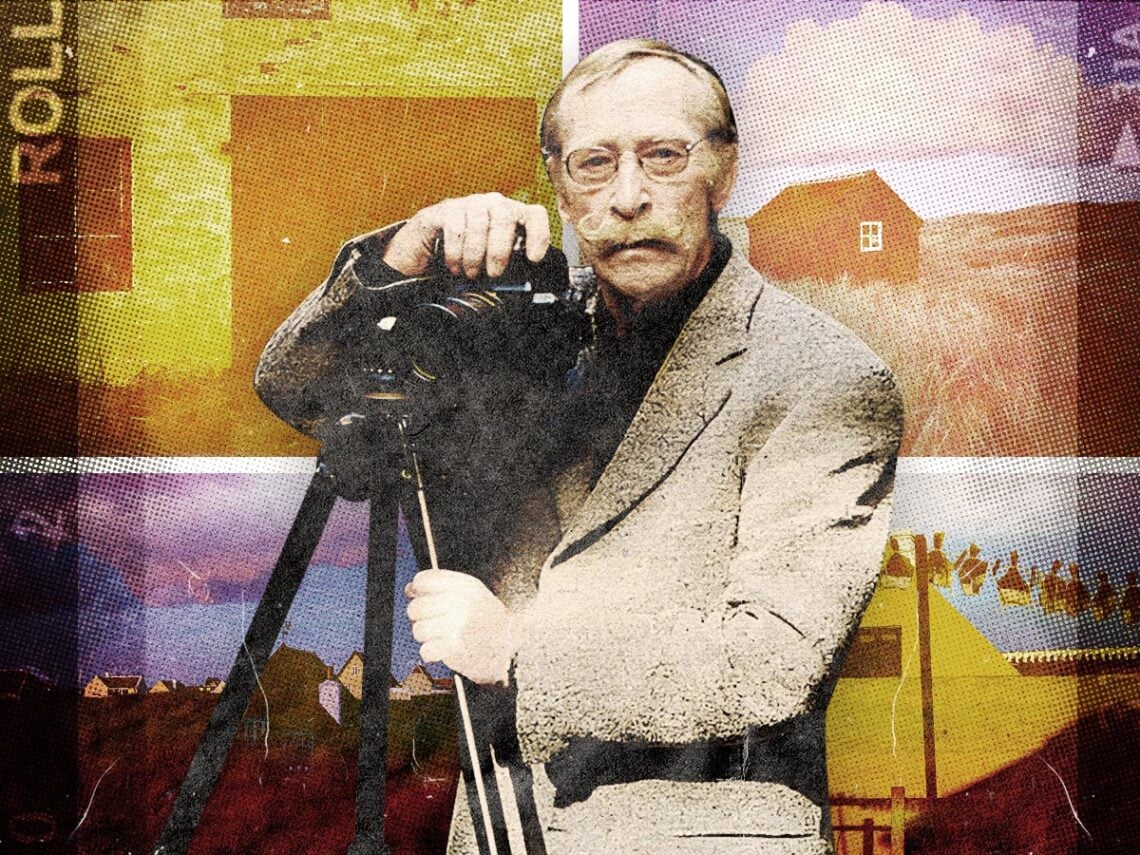
Sea, timber and light: exploring the Danish fishing village of Skagen with Bent Rej

An amalgamation of sun, sea and sandy moorland, Skagen sits between the tumultuous blue Skagerrak and the bottle-green Kattegat. To place a foot in either is to occupy the Baltic and North seas sumiltenously. As well as occupying a uniquely liminal position, this neat little fishing town boasts some of the widest skies you’ll ever see. As the sun dives towards the horizon beyond the Skagen Odde peninsula, it melts into shades of rose, lavender and indigo before coating the landscape in a wash of midnight blue. This is Skagan’s world-famous “Blue Hour”.
Rocky, portless and isolated from the mainland, Skagen was once nearly impossible to reach. Its Inhabitants kept themselves to themselves, and visitors were few and far between. That all changed in the 1870s. Back in Copenhagen, a generation of young artists were growing frustrated with the Royal Danish Academy’s steadfast devotion to Neoclassicism. The rest of Europe had already embraced impressionism, but Denmark was unwilling to follow suit. Determined to capture the world on his own terms, Michael Ancher travelled to Skagen from Copenhagen, having already familiarised himself with its various promontories and peninsulas on his first visit in 1871. His friend Karl Madsen joined him soon after, and they quickly began painting the local fisherman as they hauled in their heavy jade nets, gleaming with incandescent fish.
That summer, Ancher befriended the local Brøndum family and fell in love with their daughter Anna. He returned in 1877 with both Madsen and their friend Viggo Johansen. Adopting the Brøndum’s guesthouse (which still exists today) as their collective digs, they met regularly to discuss their work, embarking on trips to the various coves, beaches and meadows beyond the town’s periphery. When Anna and Michael married in 1880, their home was already the centre of a blossoming artists’ colony. It wasn’t long before Ancher’s work attracted the attention of King Christian IX, who bought his oil-on-canvas painting Will He Round the Point? on its completion in 1880. Anna, who spent her formative years observing the Skagan artists, was also an established artist in his own right by this point, having learnt how to capture ordinary people going about their daily business from Christian Krohg, who first came to Skagen in 1878.
The arrival of the railway in 1890 put an end to the Skagen artist’s blissful seclusion, but the light they cherished remains. In this photo series, Danish photographer Bent Rej captures that light at its most vibrant, tracing its development from dawn to dusk.
Across the first two weeks of April, Far Out will delve deep into Rej’s work from all spheres, including his musical, travel and pin-up model exploits. From April 1st, follow the Far Out Photography section or the official Bent Rej page for a full run down.


