


Death of The Nuclear Family: exploring America’s atomic ‘Doom Towns’

In American movies, the suburbs are never what they seem. They almost always conceal something sinister, their immaculate streets and pristine, timber-framed houses only heightening the sense that somebody behind the scene is up to no good. More often than not, these picture-perfect neighbourhoods turn out to be simulations or, as is the case in The Truman Show, gigantic movie sets. This well-worn trope might seem like yet another example of American anxiety made manifest, but here’s the thing: the US government was actually in the game of building fake suburbs. And If you’re wondering why I have just two words for you: Cold war.
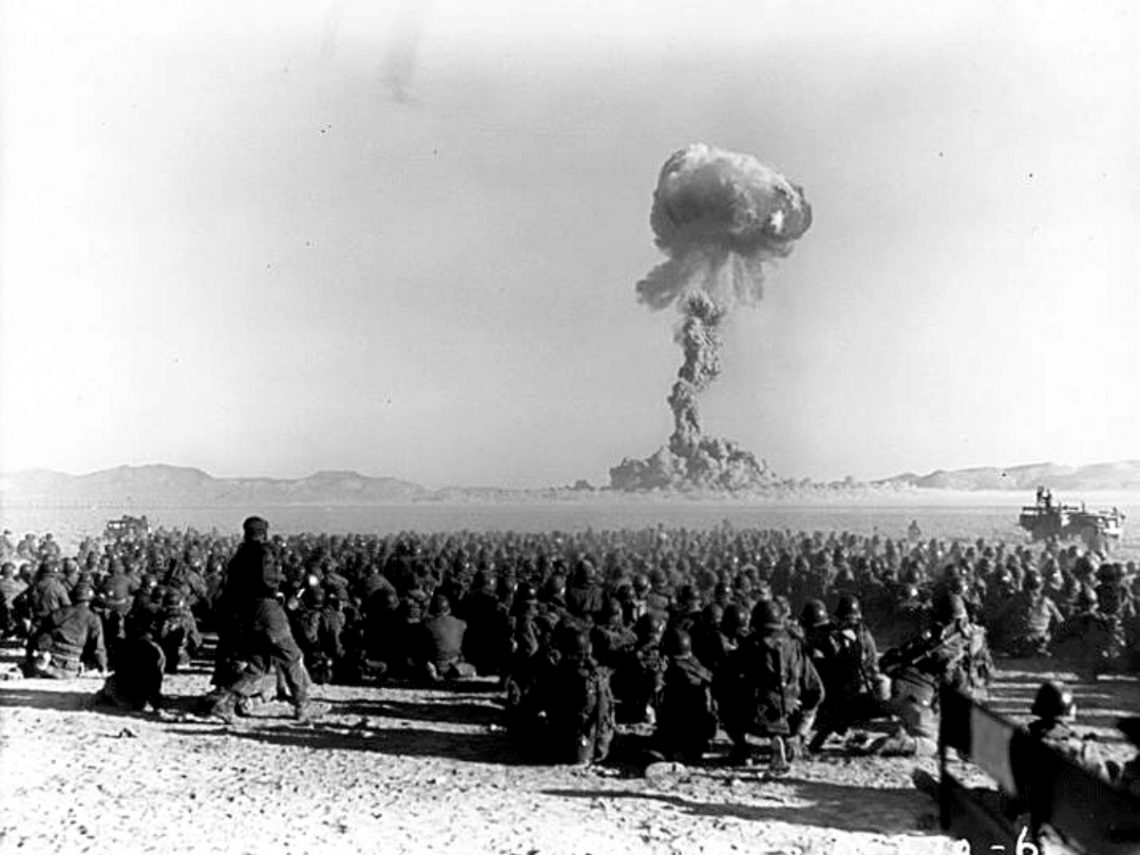
In the spring of 1973, iconic CBS News anchor Walter Cronkite travelled to the Nevada atomic test site where he and a busload of fellow broadcasters reported on Annie, one of the eleven 16-kiloton nuclear test shots conducted in 1953 as part of Operation Upshot-Knothole. By the ’50s, the US government was no longer interested in whether atomic weapons could be used in warfare; they’d already demonstrated that with the bombings of Hiroshima and Nagasaki during World War Two. No, what they were really interested in was measuring the effect of atomic bombs on civilian life.
The Annie test site was home to “Doom Town”, which was built specifically for the US military to simulate the effect of Soviets nuclear weapons on small-town America. Doom Town included all the hallmarks of the classic ’50s suburb: luxury cars, two-story homes (complete with interior furnishings and stocked pantries), not to mention multi-generational families of fully-dressed mannequins, some with coins in their pockets. As the name suggests, nothing of Doom Town remains.
On the other hand, a portion of the more fortunate “Survival Town” still stands in the Yucca flat today. This second mock suburb was subjected to the Apple-2 test from Operation Teapot in May 1955. When it was built, Survival Town boasted industrial buildings, a selection of shops and utilities, furnished houses, a propane tank farm, and even its own radio station. The streets were filled with cars and fire engines, and all the houses were fitted with gas and electricity.
When the bomb hit, the town lost power but not gas or telephone service, not that anyone would have been able to make a call even if they’d wanted to. The bomb decimated the town’s 70-strong mannequin population on detonation, blowing sleeping grandmas out of bed, and babies out of cots, showering everyone in a deluge of sharp glass fragments. The destruction was total. Even mannequins that had been placed in basement shelters were found with their heads torn off. They were all wearing clothes from JC Penny, which miraculously remained unscathed. I suppose that’s the real tragedy.
