


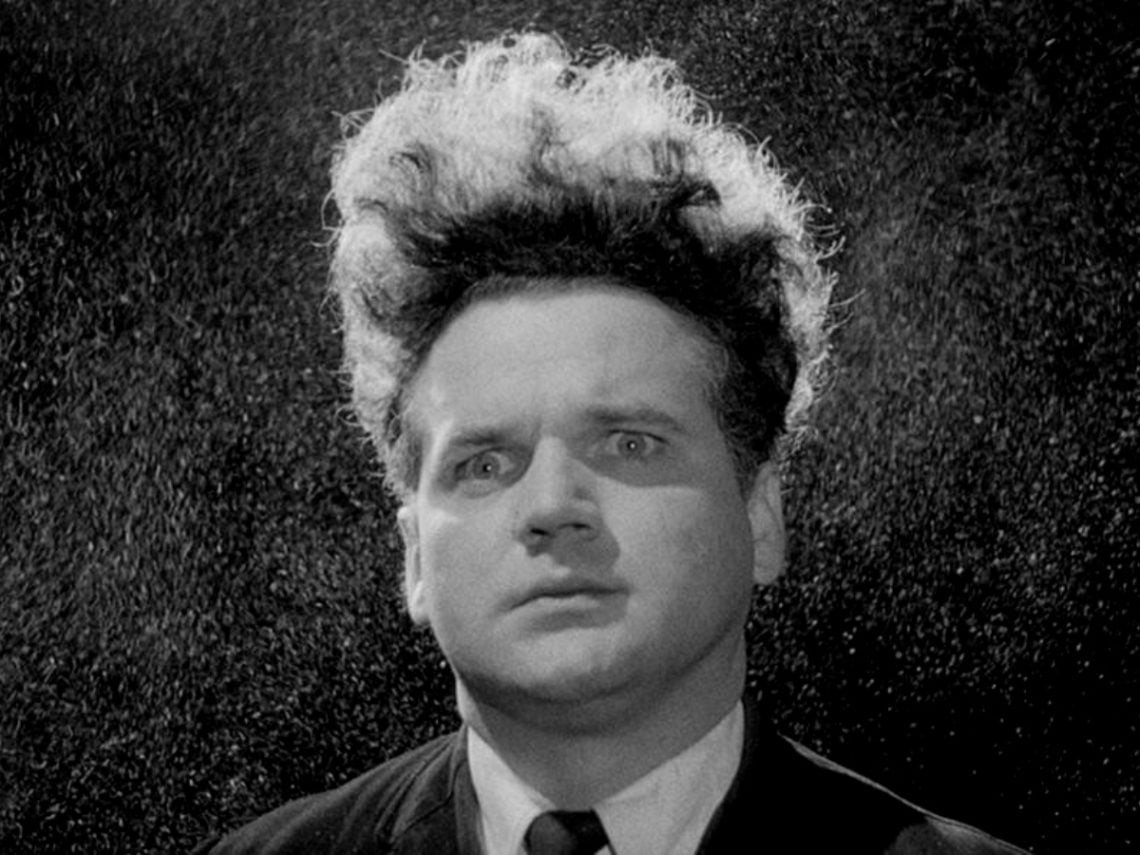
Explaining the meaning behind David Lynch’s ‘Eraserhead’

Very few directors are so influential in their form and style that their surname is turned into an adjective to specifically describe a cinematic identity, yet such should demonstrate just how influential the work of American filmmaker David Lynch has become. A Lynchian film can be characterised by dreamlike surrealism that, more often than not, delves into the suburban nightmares, such as in the director’s 1977 debut Eraserhead, rather than the bliss of dreams.
A monochrome oddity created on a shoestring budget, Eraserhead remains one of Lynch’s greatest-ever artistic efforts, even almost half a century since its release, largely thanks to its distinctive, untainted vision and absorbing style that transports you into a dark otherworld previously not seen to the same extent in the history of cinema. Made while Lynch was still studying at the American Film Institute, although Eraserhead gained very little interest upon its release, the cult cinema fans of the late 1970s guided it to underground success.
Yet, part of the enigma of Eraserhead is explaining what it is even about and the subsequent meaning behind the project, with Lynch being consistently elusive as to the truth behind his debut feature. Indeed, he has always been reluctant to reveal the meaning behind any of his movies, TV shows or short films, telling The Guardian in 2018, “When you finish anything, people want you to then talk about it. And I think it’s almost like a crime”.
Continuing, he added: “A film or a painting – each thing is its own sort of language and it’s not right to try to say the same thing in words. The words are not there. The language of film, cinema, is the language it was put into, and the English language – it’s not going to translate. It’s going to lose”.

What is Eraserhead about?
Although undoubtedly enigmatic, Eraserhead tells the story of Henry Spencer, played by Jack Nance, a man who struggles to navigate his own nightmarish reality where his girlfriend wishes to avoid him and his mutant baby incessantly screams. An introverted man, clearly terrified of the future that beholds him, it’s unclear whether this nightmarish world is Henry’s immediate reality or whether we’re witnessing an exploration of his subconscious.
The secret to understanding Lynch’s enigma lies in the bulbous baby that squeals and wails in the shadows of the monochrome indie flick, acting as a constant dagger of anxiety in the back of the protagonist. A confusing, alien-like being, Henry has no idea how to look after the child, with the baby refusing all food their father offers, mocking him almost with a cry that flitters between laughter and distress.
The crisis triggers an existential nightmare in the protagonist, who is now forced to question what and who this child really is and also figure out how he is supposed to keep it alive in a world where he can barely function himself. Put simply, Eraserhead is an exploration of the fear and anxiety of fatherhood, with these subconscious questions and concerns manifesting in the form of a very literal nightmare in the case of Lynch’s surreal cult horror.
“Eraserhead is my most spiritual film,” he admitted to Bafta back in 2007, “But no one has ever gotten that from it. The way it happened was that I had these feelings, but I didn’t know what it really was about for me”. Indeed, while most people see it as a mere ‘trip’ into surrealism that would be well paired with a joint and a glass of red wine, in reality, it is something far more tender and spiritual, asking who we are and who we must become when put in charge of another human life.
Such becomes all the more tragic when you interpret the film’s ending, where Henry kills his child after becoming overwhelmed by his monstrous presence, as his existential fears eventually condemn him to a state of total mental incapacity. Yet, on the other hand, in Lynch’s surreal world, it could equally be seen that in the killing of the child, Henry kills his source of anxiety and triumphs within his own subconscious. The true meaning of this polysemous ending will largely depend on what you, as the viewer, bring to the remarkable odyssey into the human subconscious.

How did David Lynch make the Eraserhead baby?
Countless questions surround Lynch’s Eraserhead, but one of the most pertinent is just how did the filmmaker make the weird mutant baby? The answer is just as mysterious as the film itself, with everyone staying tight-lipped as to the exact origins of its creations, but most do believe that it was made from the fetus of a rabbit, calf or goat, even if no definitive answer has ever been provided by the director or the crew of the film.
Other theories revolve around the doctor, actually a veterinarian, who appears in the end credits for the film, with many believing that the figure helped to source and dress the fetus for the movie. Yet, Lynch later cleared this up, with the vet helping to source the dried cat that sticks to Henry’s leg in a deleted scene that appears as a special feature in the film’s DVD release. Still, others believe that the vet would have been able to access various animal fetuses, giving Lynch free creative reign in the special effects department.
In reality, the Eraserhead baby was likely constructed using a mixture of real-life animal products and some smart puppetry. After all, in the late 20th century, smart, simple puppetry was all the rage, featuring in everything from George Lucas’ Star Wars to John Carpenter’s The Thing.
Dive into the world of David Lynch’s Eraserhead by revisiting the original trailer from 1977, below.
