


The truth behind Stanley Kubrick’s ‘Dr. Strangelove’comedy ending

The 1964 movie Dr. Strangelove (or: How I Learned to Stop Worrying and Love the Bomb) consistently ranks among the greatest comedy films of all time. I mean, what couid be funnier than an atomic device capable of blowing up the entire planet and everyone on it?
That was what writer-director Stanley Kubrick and writing collaborator Terry Southern found when attempting to adapt Peter George’s novel Red Alert into a serious Cold War drama film. There was no getting around it: only human beings would be ridiculous enough to invent something deliberately intended to end the existence of their species. The subject matter may be dark, but it’s ripe for razor-sharp comic satire.
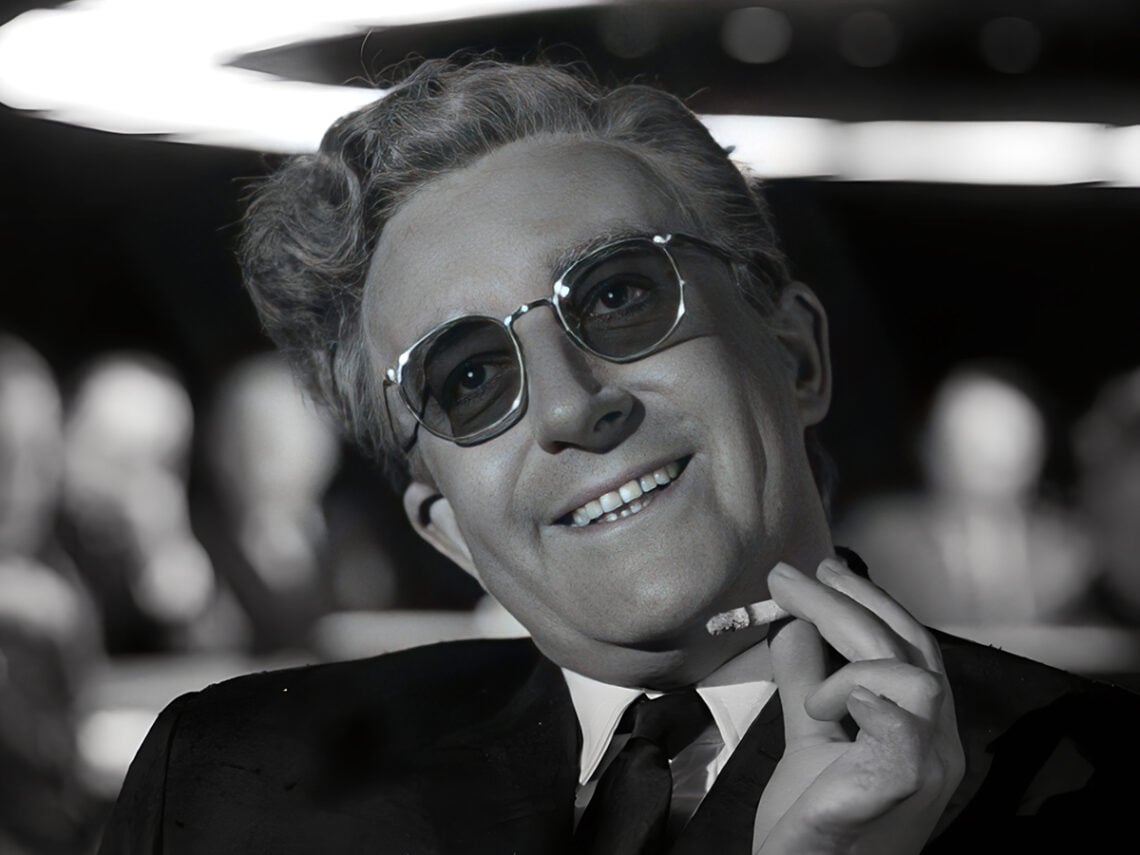
And so, Kubrick and Southern set about writing multiple characters into their script especially for the finest comic actor of the moment, Peter Sellers. Kubrick had worked with Sellers on his previous film, the first screen adaptation of Lolita, and Dr Strangelove was developed as a project specifically with the actor in mind.
Never are Sellers’ comic talents more apparent than in the film’s pitch-black ending, which still leaves audiences perplexed today.
After Soviet defences failed to stop one partially damaged US B52 bomber jet because it was flying below their radar signals and had lost contact with the American command post trying to recall it, the plane dropped a nuclear bomb on Russian soil. Back at The Pentagon, all hell breaks loose.
Why is everyone so upset that the bomb was dropped in Dr Strangelove?
Earlier in the film, the Russian ambassador reveals to everyone in the War Room that the Soviet Union has created a nuclear “doomsday device”, capable of blowing up the entire world. The device would be detonated automatically the moment any nuclear attack is launched against the Soviet Union, according to algorithms pre-programmed onto a computer.
The “doomsday device” of the movie satirises the real-life Cold War principle of mutually assured destruction (fittingly abbreviated to the acronym MAD). It takes this principle to its logical conclusion, embodied in a single weapon of preposterously destructive proportions.
Despite scepticism from the American military chiefs in the film about the existence of such a device, their nuclear weapons expert, the ex-Nazi Dr Strangelove, confirms the likelihood of its creation. And so, with one of the US bombers able to hit a Soviet target with a nuclear missile, the entire American and Russian military executives recognise the prospect of an impending apocalypse.
And when it’s over?
How do these decorated generals and politicians react to the coming end of the world?
First, they listen attentively to Dr Strangelove’s plan for sending them and other “important” people down into secure mine shafts with a ratio of ten women for every man, a “sacrifice required for the future of the human race”. Even the Russian ambassador expresses his approval of this plan.
This scene is consistent with the rest of the movie, in which men in power are consistently lampooned for their primitive preoccupation with crude sexual desires. There’s General Ripper’s obsession with his precious bodily fluids and General Turgidson’s private calls to his mistress during a war cabinet meeting. Even as the American atom bomb falls towards its Soviet target, pilot Major Kong is riding it in ecstasy as though coming to orgasm.
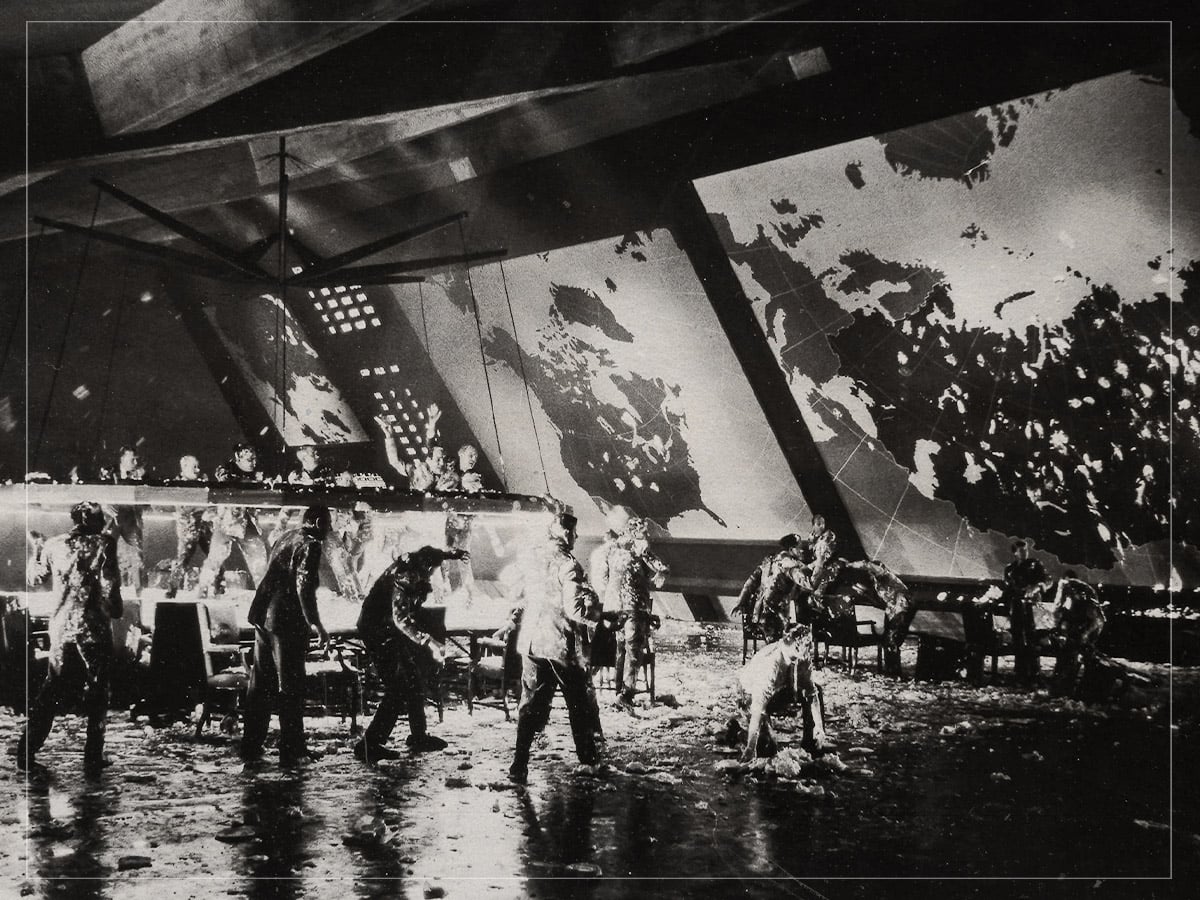
Then, we hear American generals pushing the President not to allow a “mineshaft gap” to develop between the USSR and the US in a hypothetical post-apocalyptic arms race. Meanwhile, the Russian ambassador covertly takes pictures of the War Room’s giant board designed to attack US attacks on Russia. Despite him knowing full well that the board along with everything else above ground on planet earth is about to be blown to smithereens.
Peter Sellers improved the ending of Dr Strangelove
Kubrick’s original plan for the film’s conclusion was for the absurdity of this scene to be ramped up until it ended in complete farce, with a massive pie fight. But Peter Sellers, the only actor Kubrick ever allowed to improvise in his films, had other ideas.
During one take, Sellers seemingly forgot that his character Dr Strangelove was confined to a wheelchair. Upon realising his mistake as he got to his feet, he remained in character and declared off-the-cuff: “Mein Führer! I can walk!”
Kubrick loved the spontaneity of this moment so much that he decided to scrap the film’s original ending and make it the final line. A fitting epitaph for a species being led towards barbarism by self-serving, mass-murdering narcissists.
Sellers had a hand in the film’s final shots, too. Kubrick used a montage of footage showing atomic bomb detonations during testing to represent the simultaneous explosions triggered by the Soviet “doomsday device”. The footage is soundtracked by a haunting rendition of Vera Lynn’s World War Two anthem ‘We’ll Meet Again’. This choice of song was Sellers’ idea, and Kubrick went with it, convinced that the bittersweet optimism of its lyrics only served to underscore the horrifically violent images of the montage.
Is it Stanley Kubrick’s best movie?
Dr. Strangelove is undoubtedly the funniest film Kubrick ever made, a fact that becomes tragic when the film’s context is taken into consideration. An incisive satire about the paranoia of the US and the USSR during the Cold War, Dr. Strangelove presents hilarious glimpses of the failures of the officials who govern us.
“I started work on the screenplay with every intention of making the film a serious treatment of the problem of accidental nuclear war,” Kubrick said. “As I kept trying to imagine the way in which things would really happen, ideas kept coming to me which I would discard because they were so ludicrous. I kept saying to myself: ‘I can’t do this. People will laugh.’ But after a month or so, I began to realise that all the things I was throwing out were the things which were most truthful.”
