


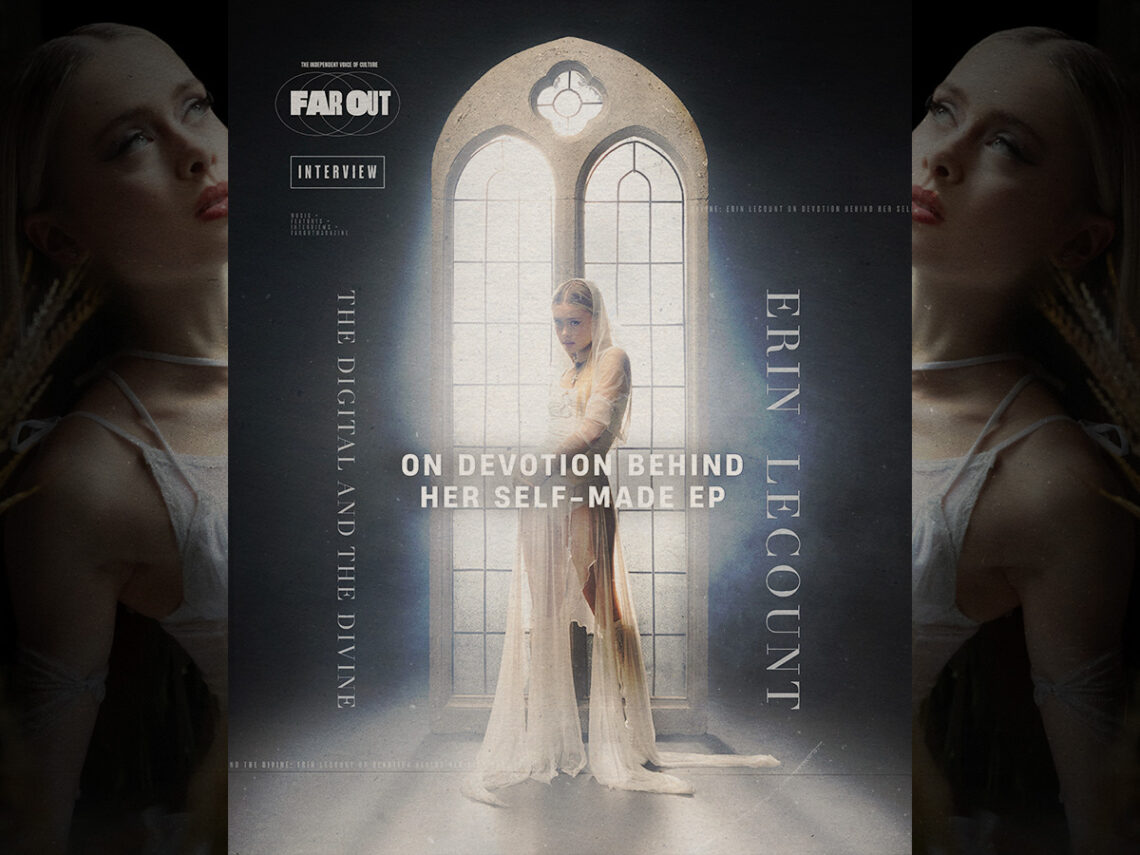
The digital and the divine: Erin LeCount on the devotion behind her self-made EP

Vocal chops building a chorus of distorted voices. Birds chirping. Harps, but made on a plastic keyboard with the help of a plug-in. That same harp reversed for some weird textures. Huge drums. More percussion, but built from the sound of swords hitting each other. Bass so big you feel it in your stomach. Layers upon layers of harmonies. Synths. A sample of an entirely different song embedded somewhere in there, and perhaps, most crucially, Erin LeCount’s own breath and her own heartbeat. That’s what you hear on ‘Marble Arch’, an incredibly intricately crafted song, crafted entirely by LeCount, alone, in her shed.
It’s a staggering composition, and the artist herself feels that way too. She heard it in her head long before she ever tried to make it, and when she did try eventually, she realised quickly that it would take some time. “It was a year and a half of trying to make it,” she explained. “I’d never had such a strong idea of what I wanted something to sound like.” She knew that all of those elements needed to be there, and she knew exactly what this song needed to be in the end, but first, she had to confront the fact that maybe she didn’t know how to do all that yet.
“I had some of the lyrics for so long. I loved the first verse so much that I knew that whatever I produced around it had to give me the same feeling that those three lines did, and that was really difficult. I could hear where I wanted it to be, but as a producer, I had to catch up to be able to make it,” she revealed candidly. And so, ‘Marble Arch’ became an endurance race, and every other song on her new EP, I Am Digital, I Am Divine, was part of the process. ‘Marble Arch’ became the pinnacle that the rest of the tracklist helped her reach; “All the other songs were training”.
But LeCount was never going to give up. Her mission for the song that appeared to her and stayed strong in her mind like a spectre, but required skill to complete, perfectly captures her artistic ethos; this clean split between the digital and the divine.
In her music, those two things are inseparable as LeCount’s obsession with the digital, the nitty-gritty, the process of making music, stem by stem on her computer, is exactly how she honours the divine element of these songs appearing to her. When she talks about her way of working and her desire to luxuriate in the process for as long as the song needs, tirelessly perfecting it with intricate little details, no matter how time-consuming or tricky, there is something ritualistic about it. And when she realised that and began to honour it, everything changed.

Honouring the ritual is exactly why LeCount decided to learn to produce in order to produce her own work. Given the divine and deeply personal aspect of her work, the more sterilised process of going into a session, often with a relative stranger, almost always with a man, didn’t work for her. “You’re trying to get something across, and you come out of the room with a product. To me, everything’s like a diary entry, or a stamp in time, or an experience that’s made into something tangible,” she elaborated. “I was coming out with a really well-produced, neatly packaged song but I don’t think that songs are always meant to be neat and beautiful.”
That’s why her heartbeat is almost always right there in the song, and that’s why handing her ideas off to someone else stopped making sense. “There’s something about seeing things through from like the feeling to the writing to the production to the end of it that makes me feel more connected to the songs,” she claimed. Given how personal the making of any art is, and given that divine aspect as inspiration striking LeCount, why would she put it in the control of someone else when these ideas are speaking through her? “I kind of see it as painting things,” she explained. “I don’t understand why I would ask someone else to paint my experience or what I’m writing about.”
But in an industry so often characterised by speed and the drive for quick hits and quicker cash, LeCount is aware that her process sits outside what people might expect or want. But, to put it bluntly, she doesn’t care. “It’s external pressure from people watching, like, labels and managers and stuff being like, ‘if it’s not worked by now, or by the end of the day or the end of the month that you’ve been working on it, then, let’s discard it. It’s taking up too much time,’” she said.
When I commented about how ridiculous it would have been to ever say something like that to a painter or sculptor, to tell Da Vinci to give in if a work was taking too long, we both laughed. LeCount shows complete defiance in the face of anything that would dare to downgrade her music to anything other than that same level of artistry, stating, “I think anyone who’s consuming music passively or in this kind of like fast fashion-esque way, isn’t necessarily my target audience, and I, in the nicest way possible, have nothing to gain by trying to cater to those people, and I have no interest in catering to those people.”
Since becoming devoted to that mindset, people have flocked to her. Her latest singles, ‘Silver Spoon’ and the hard-earned by utterly worth it ‘Marble Arch’ have seen her draw in a vast new audience of exactly the kind of people she always hoped to connect with. “It’s an incredibly nice realisation that the more I trust my own instincts on things, and the more expressive I am in what I want to say and do and make, the more it seems to connect with people,” she said, beaming at this fresh wave of support for this new music which feels, to her, like her true introduction now that this new EP is utterly and uncompromisingly reflective of her.
The lesson learnt once again comes down to those two points: the digital and the divine. The digital was covered when the making of this EP—all done in service to the making of ‘Marble Arch’ as LeCount dreamed it to be—saw the artist become a skilled producer, needing no help to realise her vision. The divine comes in when she also realised that her vision was all she needed, and she would never need any help connecting with that. “People talk a lot about world building in music, and I realised I didn’t have to do anything for that, I already had it in me. It’s me and all of my interests and everything I like and love, and the way I am when I’m on my own. That’s what I present with and around my music, and it’s really gratifying that I’m getting to do that now, and it seems to be clicking.”
