


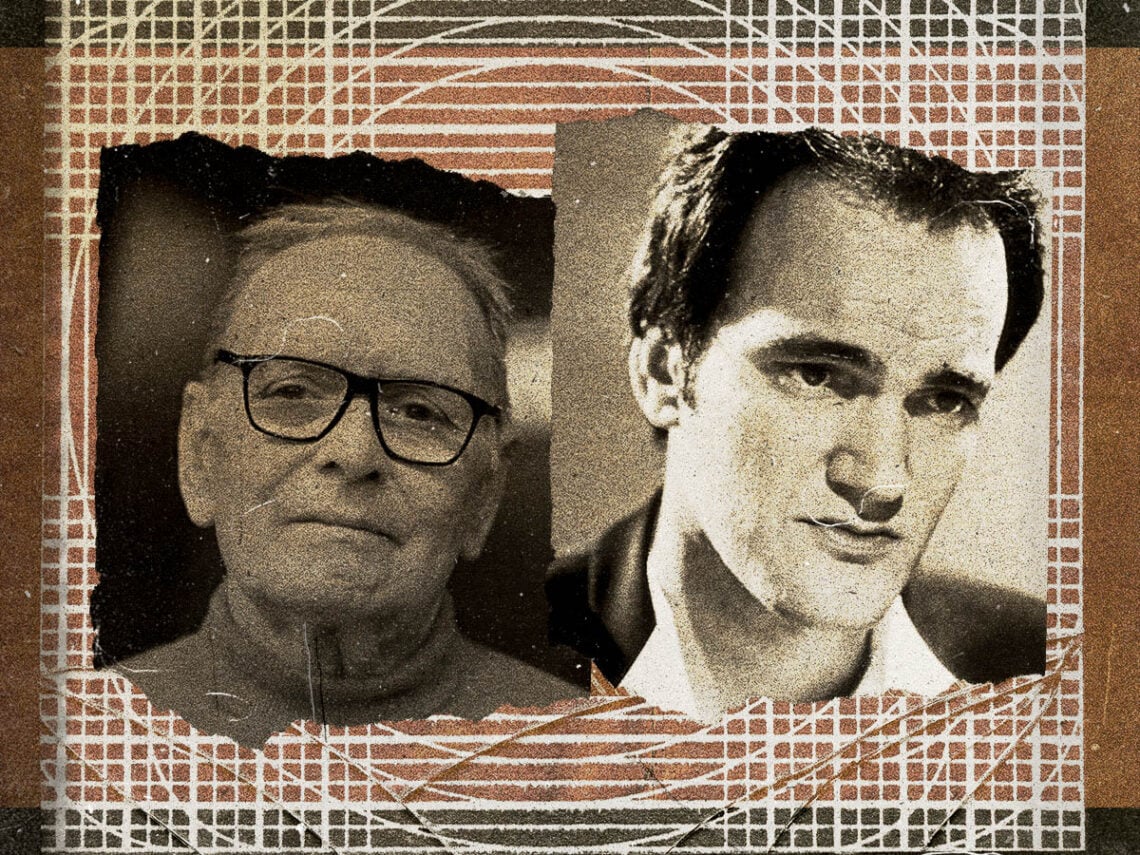
How Ennio Morricone came to work with Quentin Tarantino: “I’ve never had that voice in my ear before”

There’s no doubt that Quentin Tarantino is a great admirer of the legendary film score composer Ennio Morricone. The Italian cinema musician wrote over 400 scores for film and TV shows, most notably Sergio Leone’s Dollars Trilogy, which we know Tarantino is a huge fan of.
After all, it’s often the music that really elevates cinema into the unique art form that we love. Cinema is simply the union of sound and vision and uses both senses to inform, entertain and provoke. Tarantino is no stranger to this idea, and music has formed a central basis in many of his films, which boast some of the greatest soundtracks of all time.
Interestingly, though, prior to 2015’s The Hateful Eight, Tarantino had never used an original score in one of his movies. That was until he had the opportunity to work with one of his heroes, Morricone himself. Tarantino had, of course, used pre-existing music from the Italian composer in the likes of Kill Bill, Inglorious Basterds and Django Unchained.
The director once discussed his decision to seek out Morricone for The Hateful Eight in an interview with The Wrap. “I finally broke down. And it was the maestro that made me break down,” he said. “I didn’t know if it was going to work out, but I felt I owed it to myself, and I owed it to him to investigate it. To explore that idea. Only to find out that he felt the same way – he wasn’t sure if it was necessarily the right thing”.
Tarantino went on to explain how the discussion with Morricone went down. “We start talking, and he goes, ‘Well, I’m kind of wondering what you’re thinking, why you’re even here. Because hiring a composer to compose an original score is not necessarily what you do. You take a collection of scores from other movies, cut them in as you see fit, and you do a pretty good job of that, and people seem to like it. So why would you want to change?’”
The iconic filmmaker then noted what it was about The Hateful Eight that made him want a proper score. “What makes this one different from the other ones is that I have a little whispering voice in my ear that says this material, in particular, deserves to have an original score,” he said. “And I’ve never had that voice in my ear before. This is the one time I have it. And so I thought we would explore it.”
Morricone had actually told Tarantino that he did not have time to take on the project but would consider what the film’s main theme could be. It wasn’t long, though, before Morricone became invested in that theme, and it grew into an entire score, the sign of an artist dedicated to his craft.
“Well, that sounded pretty great,” Tarantino said of the film’s main theme. “Then he sat down to write that theme, but he got inspired, and 10 minutes of music became 30 minutes of music, and one theme became four pieces of original music, and working with an editor that became 12 pieces of original music. And I think it’s magnificent in the film and gives it a wonderful quality.”

Never Miss A Take
The Far Out Quentin Tarantino Newsletter
All the latest Quentin Tarantino content from the independent voice of culture.
Straight to your inbox.