


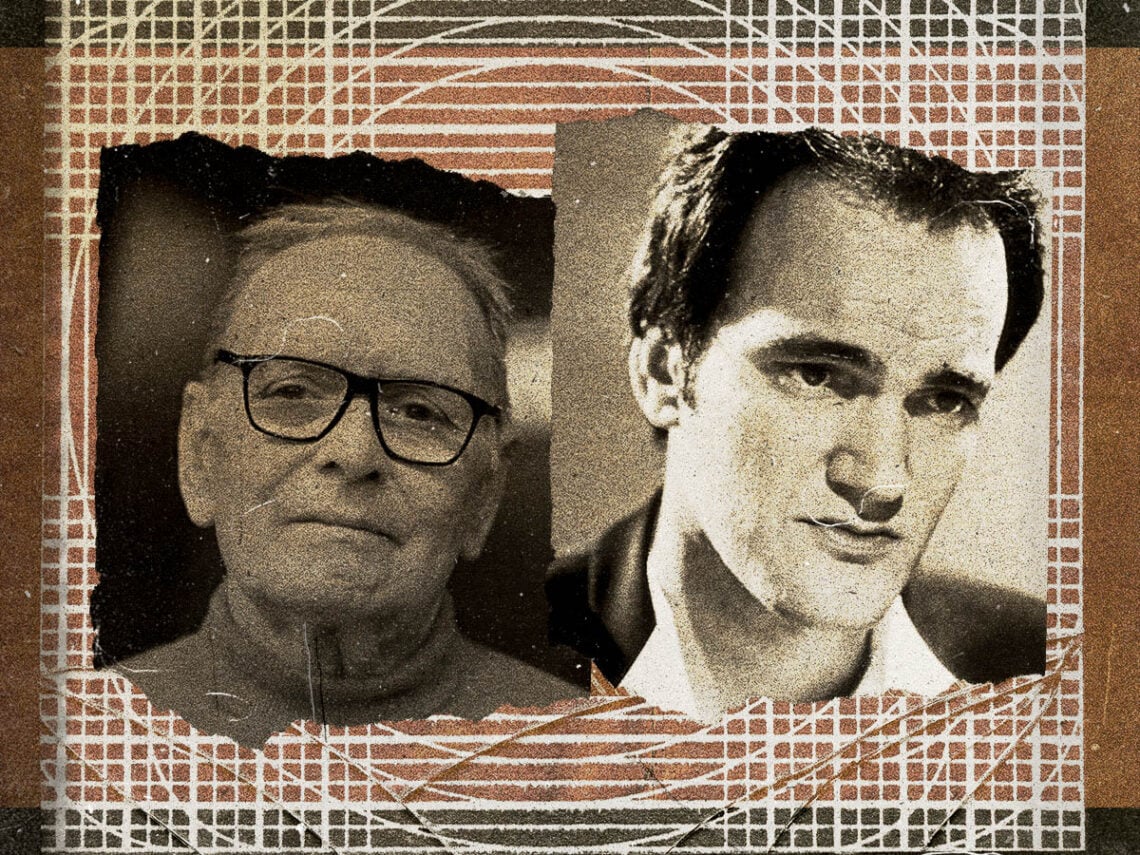
Inside Ennio Morricone’s fractured relationship with Quentin Tarantino

No stranger to a Mexican standoff, Ennio Morricone possessed an unwavering will throughout his long life and career. It was a quality that helped to secure his legacy as one of the greatest film composers of all time, but it also meant creative tension with his collaborators was always a distinct possibility. Such tension, it seems, may have been especially inclined to boil over in response to one person in particular: Quentin Tarantino.
The two men are now inextricably linked together in the history of film, but their relationship doesn’t appear to have been smoothest. Tarantino, of course, has long been enamoured by the work of Morricone, managing to weave samples and snippets of some of the maestro’s existing compositions into several of his films. Django Unchained even featured a new piece called ‘Ancora qui’, though Morricone didn’t actually create that with Django specifically in mind.
The peak of Morricone and Tarantino’s association came with The Hateful Eight, for which the former created 50 minutes of original music and, in doing so, secured his first-ever Academy Award for ‘Best Film Score’ in 2016. He’d been nominated five times before that, plus he’d received an honorary Oscar in 2007, but, strange as it seems, ‘Best Original Score’ had always eluded Morricone until this point.
Upon accepting his award, at last, Morricone heaped praise upon Tarantino. “There isn’t a great soundtrack without a great movie that inspires it,” he said, speaking in his native Italian. “This is why I thank Quentin Tarantino for choosing me…”
Standing at the podium that night, Morricone’s praise for Tarantino was effusive, but at other times, his feelings appear to have been far less complimentary. Back in 2013, for instance, not long after Django had come out, The Hollywood Reporter published snippets of a speech Morricone supposedly delivered to students at LUISS University in Rome. His words for Tarantino weren’t quite so glowing back then. “I wouldn’t like to work with him again on anything,” he reportedly said. “He said last year he wanted to work with me again ever since Inglourious Basterds, but I told him I couldn’t because he didn’t give me enough time. So he just used a song I had written previously.”
Morricone expressed frustration with the way Tarantino “places music in his films without coherence,” and he even critiqued the entire movie itself. “To tell the truth,” he supposedly stated: “I didn’t care for it. Too much blood”.
It’s difficult to know what to make of these comments, as they seemed, in no uncertain terms, to imply Morricone would never again work with Tarantino. But just a few years later, he was scoring The Hateful Eight.
Things got even more complicated a couple of years after that film had been released. Yet again, the press was reporting Morricone’s apparent distaste for Tarantino and his work — except, this time, the words deployed were even harsher. In its December 2018 edition, the German-language version of Playboy quoted Morricone as saying: “He is not a director. [Tarantino] is absolutely chaotic. He talks without thinking, he does everything at the last minute. He has no idea. He calls up out of the blue and wants a complete score in just a few days. That’s not possible. It makes me so mad. I’m not going to put up with this. And I told him so last time”.
It got worse. “The man is a cretin,” Morricone supposedly told the magazine. “He only steals from others and puts stuff back together again. There’s nothing original about that. That doesn’t make him a director. He is nothing compared with the Hollywood greats, such as John Huston, Alfred Hitchcock or Billy Wilder. They had class. Tarantino simply recooks old dishes”.
There could be no doubt now: Ennio Morricone had no respect for Quentin Tarantino. Except, no. Another twist was on the horizon, as Morricone released a statement on his website denying everything. It read: “This is totally false… I have not given an interview to Playboy Germany, and even more, I have never called Tarantino a cretin and certainly do not consider his films garbage.”
The statement went on: “I consider Tarantino a great director. I am very fond of my collaboration with him and the relationship we have developed during the time we have spent together. He is courageous and has an enormous personality. I credit our collaboration responsible for getting me an Oscar, which is for sure one of the greatest acknowledgements of my career, and I am forever grateful for the opportunity to compose music for his film.”
Now it was back to Playboy Germany, which doubled down. In a statement to The Guardian, the magazine add: “We are surprised to hear that Ennio Morricone denies having given an interview to German Playboy. The conversation did, in fact, take place on June 30th, 2018, at his property in Rome… We are also confused by the claim that parts of the published statements were not made in this form.”
It was all becoming a bit he-said-she-said, but then Playboy suddenly relented. Editor-in-chief Florian Boitin issued a statement to Deadline, where he admitted his publication was in the wrong.
“Up to now,” he said, “We have considered the freelancer who conducted the Ennio Morricone interview on our behalf to be a renowned print and radio journalist. In the past, we have had no reason to doubt his journalistic integrity and skills. Based on the information now at our disposal, we must, unfortunately, assume that the words spoken in the interview have, in part, been reproduced incorrectly.”
So, after all that drama, it seems Morricone never really did diss Tarantino in such blunt terms — not publicly, at least. In truth, we’ll likely never know how he really felt about the filmmaker and his work. But whether or not he respected Tarantino and his films, there can be no question that the maestro will forever be bound to him.

Never Miss A Take
The Far Out Quentin Tarantino Newsletter
All the latest Quentin Tarantino content from the independent voice of culture.
Straight to your inbox.