


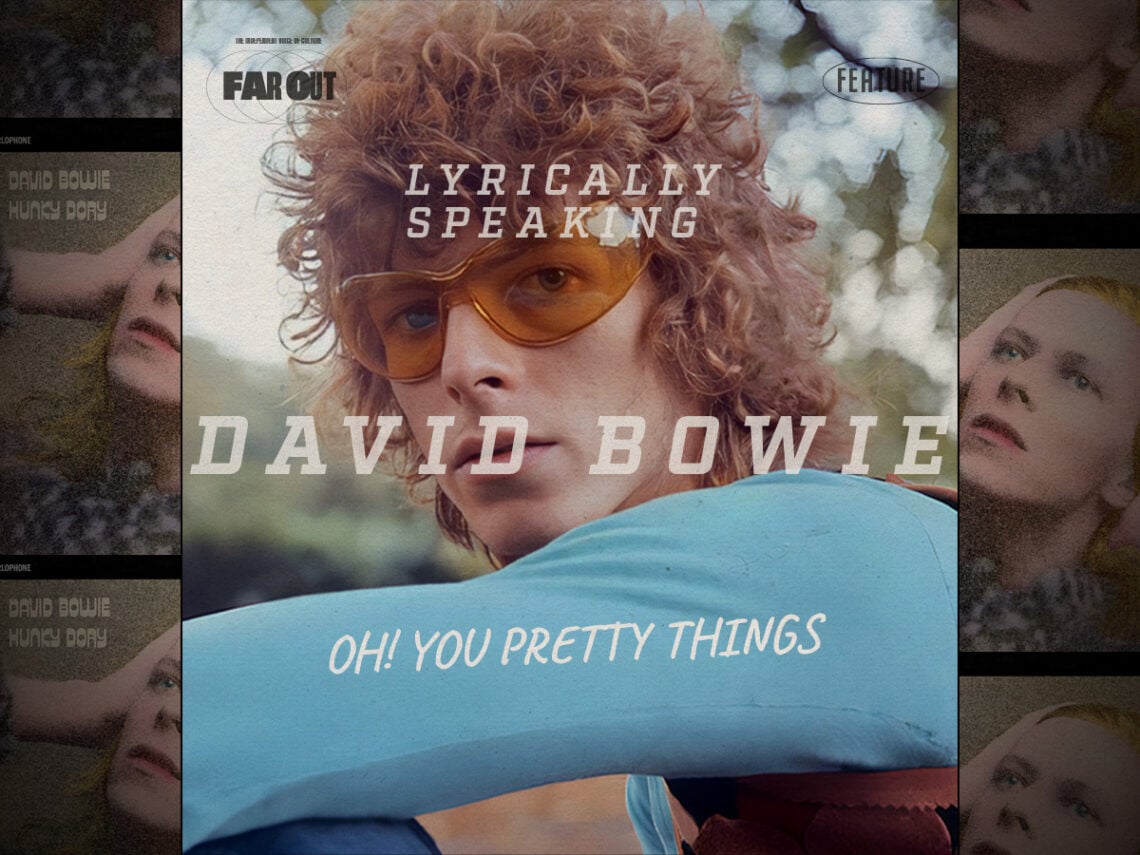
Lyrically Speaking: Embracing the new order in David Bowie’s ‘Oh! You Pretty Things’

In 1971, there was much to fear. And most of the leading artists, including David Bowie, felt compelled to write about it.
The uncertainty that came at the dawn of the ‘70s left a lot of creatives wistfully watching the shrinking image of the 1960s in their wing mirrors. A lot of societal upheaval was to blame, as it usually is. But then came a harsher storm that not even the most skilled of poets could weather.
But they tried, and it’s one of the reasons that those who embraced it surged ahead. Like Joni Mitchell and Carole King, who reflected on things lost, all while creating new ground as they did so. Then there was Bowie, definitively taking all these risks to create the record people would eventually call the one where he grew into himself: Hunky Dory.
A rich textual undertaking, the album was a bit everywhere and nowhere at the time, Bowie ruminating on the nature of the world from his signature resigned alien-like state. And this came to the forefront on ‘Oh! You Pretty Things’, a track so melodically charged it came to him in the night, not leaving him alone until he sprang into action and made a song of it.
What followed was an exploration of the new world. Taking notes from Aleister Crowley, Friedrich Nietzsche, and other doom, dystopian texts like The Coming Race, Bowie anchored this idea of a new race coming to take over earth, creatively tying the idea of otherworldly intervention to the real perils of the new generation. Specifically, how the media rots minds.
“We have created a new kind of person in a way,” Bowie told Melody Maker in 1972. “We have created a child who will be so exposed to the media that he will be lost to his parents by age 12. A lot of the songs do in fact deal with some kind of schizophrenia, or alternating id problems, and ‘Pretty Things’ is one of them.”

This is immediate from the moment Bowie’s voice comes in, but it’s done with a charming defeat, almost like a tired parent coaxing their child out of bed. Obviously, there’s a darker undertone the further he enters the plot device: “Wake up, you sleepy head / Put on some clothes, shake up your bed / Put another log on the fire for me / I’ve made some breakfast and coffee / Look out my window, what do I see? / Crack in the sky and a hand reaching down to me”.
Then comes the main message, the one that says these are how things are, and they’re not going to change: “All the nightmares came today / And it looks as though they’re here to stay”.
The way he sings it, along with the matter-of-fact nature of the words themselves, lends the song relatability and a cutting depth. Bowie isn’t bitter about what he’s talking about; he’s simply observing, even if he’s talking about what he later said was just a reflection of his own “repressions”. And the “crack in the sky” is what he built his vision around, something, as he put it, “solid” that “could be cracked”.
Put simply, it could have been his way of capturing the numbness of malaise, of shrugging off uncertainty because there was nothing that could be done about it. Referencing Crowley’s secret society, the second verse takes this further, talking about the “golden ones” who find the Earth in ruins, searching its texts for answers, the ones written by “a puzzled man who questioned what we were here for”, Crowley himself.
But it also hints at the new generation being left, too, perhaps even joining forces with alien life (the media, general corruption) in a way that perpetuates all the problems the previous generation faced. “Don’t you know you’re driving your Mamas and Papas insane?” Bowie sings, dazedly tapping into the friction of the generational divide. “Let me make it plain,” he goes on, “Gotta make way for the homo superior.”
There, he also connects societal shift with subtle notes of sexuality, a sign that the new order, even if it displeases some, is inevitable yet fluid. And it’s inherently kitsch, like the resignation comes from the old mantra, if you can’t beat ‘em, join ‘em. Or as though he’s saying you’ll get there, too; it’s only a matter of time. Which is what he also suggests nearer the end, words coloured with a sinister standoffish flair: “The Earth is a bitch, we’ve finished our news / Homo Sapiens have outgrown their use”.
