


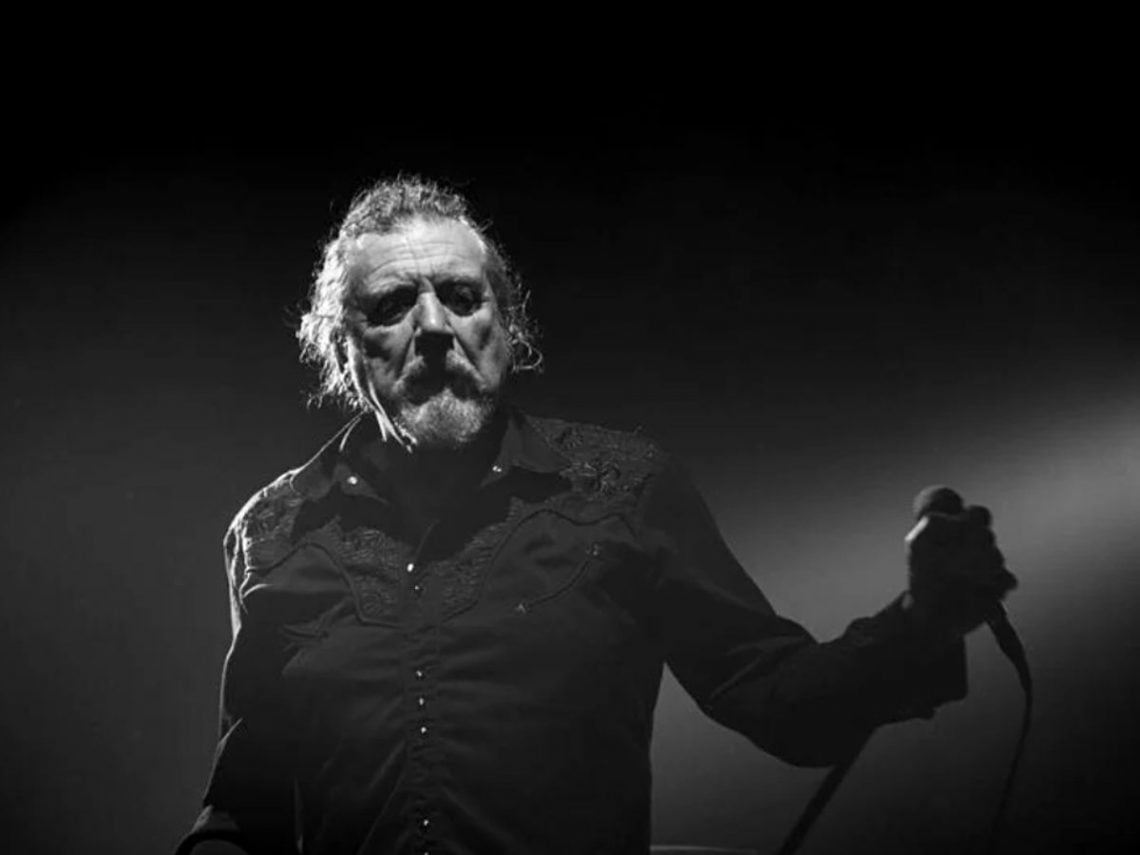
The life-changing impact of Elvis Presley on Robert Plant: “He was totally unique”

Led Zeppelin frontman Robert Plant has never been afraid of discussing his love for American rhythm and blues. Pioneering a heavy take on the form, the band’s nods to their heroes were evident in their sound, particularly in their early days, when they were known to cover a blues classic or two. Whilst many of that era influenced Plant, one man who significantly impacted him, his bandmates and the rest of their generation was Elvis Presley.
Spending much of his youth daydreaming and soaking up music, the idea that Plant would one day accompany Presley in the pantheon of rock greats seemed unfathomable to the young Black Country native back then. Yet, within 15 years of him first hearing Presley’s 1956 cover of ‘Hound Dog’, he too would be hailed as one of the greatest musicians of his generation. This rise was fuelled by the influence of Black America that Elvis introduced to the white masses.
Plant discussed the first time he heard ‘The King’ in conversation with Jools Holland. “There was this sort of haze behind me of English ballads,” he remembered. “The BBC wasn’t very kind to youth culture in those days, but every now and then on Two Way Family Favourites on a Sunday lunchtime, some servicemen would send messages back to Mom and Dad and request a song.”
Of course, the track played that day would become one of the most important of Plant’s life. “And it was ‘Hound Dog’. Elvis,” the Led Zeppelin frontman continued. “That was the kind of lock-in. It was an opiate. Something happened when I heard the sound of that record. It certainly made me put my stamp collection to one side for a bit.”
When speaking to Charlie Rose in 2005, Plant looked deeper at the influence of American music and Elvis Presley on his life. Asked if rhythm and blues from the States were influential to him from early on, he replied: “Yeah, I think there was a huge movement towards Black Americana in the British pop scene. I was just perhaps two or three years behind The Rolling Stones and The Pretty Things, and there was an amazing sort of… The impulse on the ground listening to Black rhythm and blues. In your cities, you had music from New Orleans, Philadelphia, Chicago; so many different cities had so much absolutely different music to offer us, and I never realised.”
“I was absolutely infatuated,” he added. “Well, you know, there’s a kind of saccharine sweet thing about British pop music. It was somewhere between Johnnie Ray and Pat Boone. It was something that was happening, and with Presley mimicking the Black voice and bringing a little lift of Black music into the mainstream, that was the first, that was the sort of hors d’oeuvre, and then a little later on you’ve got all these Black American bands who started to permeate”.
Asked by the host if Elvis Presley influenced everybody in the United Kingdom in the 1950s, Plant confirmed the notion. Labelling the American icon as “totally unique”, he then recalled just how Presley did it: “I would say so, because he was totally unique, I mean, he took a lot of the sort of elements of the Johnnie Ray approach – the kind of sobbing voice and that sort of thing -, but he mixed it with the music that he was surrounded by when he was a kid in Memphis.”
The conversation then took an interesting turn, with Rose asking Plant if he would have been able to tell if Elvis was a white voice if he didn’t know anything about him. The Led Zeppelin man admitted: “I think on some of the very early songs, I wouldn’t have known, no. The stuff which he was taking, the Arthur Crudup music, ‘That’s All Right, Mama’, ‘Mystery Train’, which was Junior Parker’s Blue Flames, I mean, the whole deal of Presley was that he was the original hepcat.”
Noting how Presley’s arrival was his generation’s “call to arms”, Plant concluded: “And what we got on the radio in England, it cut through all the drizzle, and it really gave us something; everybody’s heads turned, and our parents, as you can imagine, it was the same thing in America, rejected it wholeheartedly. They saw something coming around the corner that they couldn’t understand… I think our call to arms.”
