


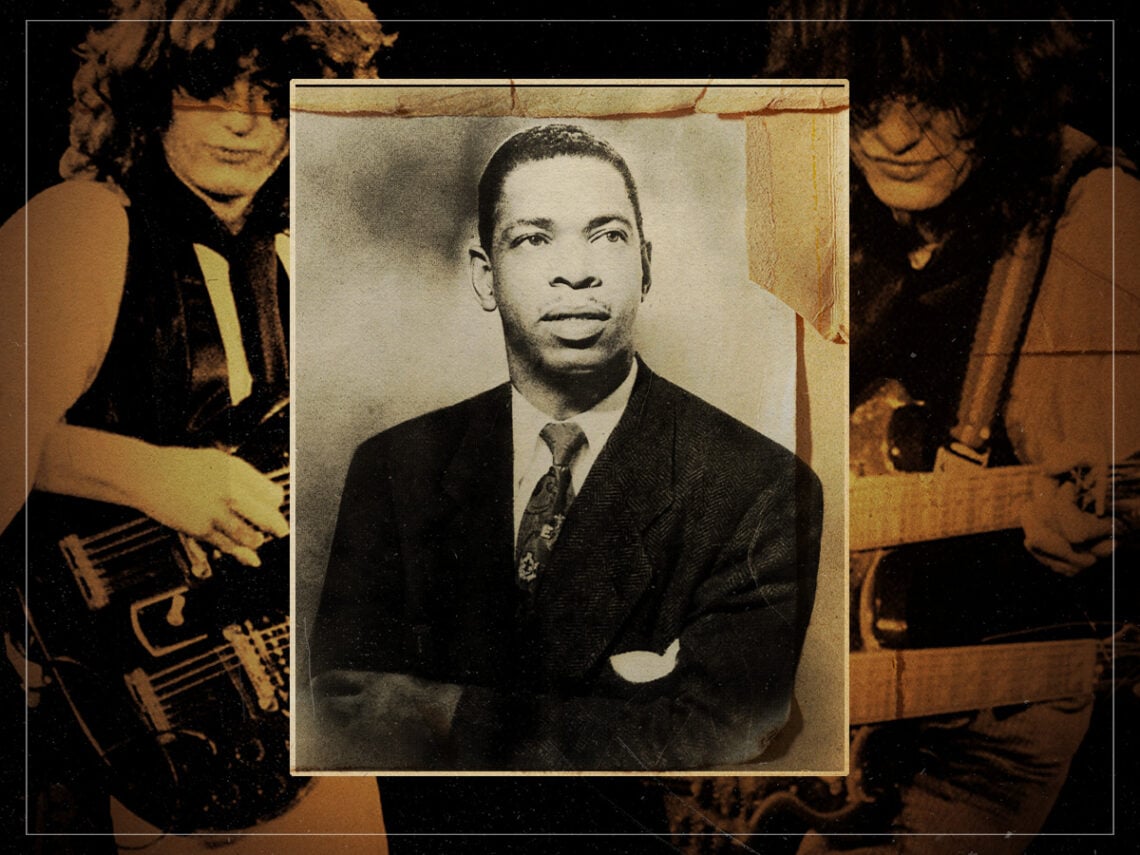
Elmo Lewis: The mystery behind Jimmy Page’s slide guitar sensei

Jimmy Page was a legend long before Keith Moon sneered that the band he was forming with Robert Plant, John Paul Jones and John Bonham would go down “like a lead balloon”.
In fact, the man was something of a prodigy. Only a year older than Eric Clapton, Page developed a name for himself playing in the same scene that the likes of Clapton and Jeff Beck did. The only difference was that the person who spotted his one-of-a-kind talent didn’t bring him into a band, but a record label.
There’s a big sliding doors moment here. Jimmy Page was just as earth-shaking a talent as either of the two guitar legends mentioned previously. Like them, he was a frequent flier at Soho’s legendary Marquee Club, jumping up onstage and jamming with the likes of Cyril Davies’ All Stars and Alexis Korner’s Blues Incorporated. No doubt Page was just as sought after as anyone else on the scene, but instead of joining a band full-time, he was pressganged into working for Columbia Gramophone Company.
The company were in the process of releasing their first singles, including one that hit number-one on the UK singles charts, ‘Diamonds’ by Jet Harris and Tony Meehan. The guitar on all these records was played by Page, which, if anything, says more about his prodigious guitar ability than playing in any bunch of blues chancers. It’s one thing to sound great shredding away for minutes at a time. What Page was proving he could do was, quite simply, anything that was asked of him.
If you needed crisp rhythm guitar, he could do it. If you needed chiming lead patterns, no sweat. If you needed delicate acoustic work, he was your guy. As the world would find out very soon, he could shred with the absolute best of them, of course, but Page was a multi-faceted guitar player. One who could turn to any style of playing, and if he didn’t know how, he would dedicate himself to learning how. However, there was one style that eluded him in particular until he turned to a mysterious guitarist on the scene for some tips.
Who was “Elmo Lewis” and how did he teach Jimmy Page?
As Page has said on a few occasions, the style that he couldn’t get his head around was bottleneck slide guitar, which makes sense when you think about it. Imagine if all you had to go on was the sounds coming out of an imported Elmore James single and not half a century of rock ‘n’ roll history to comb through. Would you immediately clock that the wailing, almost ghostly sounds coming from that record were someone playing a guitar with a literal bottleneck or knife on the fretboard?
Page couldn’t quite believe what he was hearing until he heard of another guitarist on the British blues scene who could play a number of Elmore James songs exactly the way they were played on the record. He decided to see this guitarist, who called himself Elmo Lewis, and work out exactly how to get those sounds out of his guitar. In an interview with Interview, Page proved Occam’s razor right and talked about how he was first introduced to slide guitar.
“Sure enough,” he said, “he gets up on stage and starts doing some Elmore James songs, and he has the equivalent of what everyone would know as a slide on his finger. I started talking to him when he came offstage, and I said, ‘Well you know, you’ve really got that down. What are you actually using?’ You must understand that nobody that I knew played slide guitar at all. This is the first time I’d seen somebody do it, before Jeff [Beck] was doing it, before The Rolling Stones.” Lewis said that all he needed was a piece of car maintenance equipment called a brush, and away you go!
Thus, Page acquired one of the most iconic weapons in his guitar arsenal thanks to this mysterious figure of Elmo Lewis. ‘In My Time of Dying’? ‘You Shook Me’? ‘When the Levee Breaks’? All come from this one interaction. But who was this mysterious guitar slinger? It’s unlikely that a man that white and English would have a name like “Elmo Lewis”, and it’s true, it was a stage name picked as a nod to Elmore James himself. Soon enough, the man would eventually join the previously mentioned Rolling Stones and would do so under his real name: Brian Jones.
