


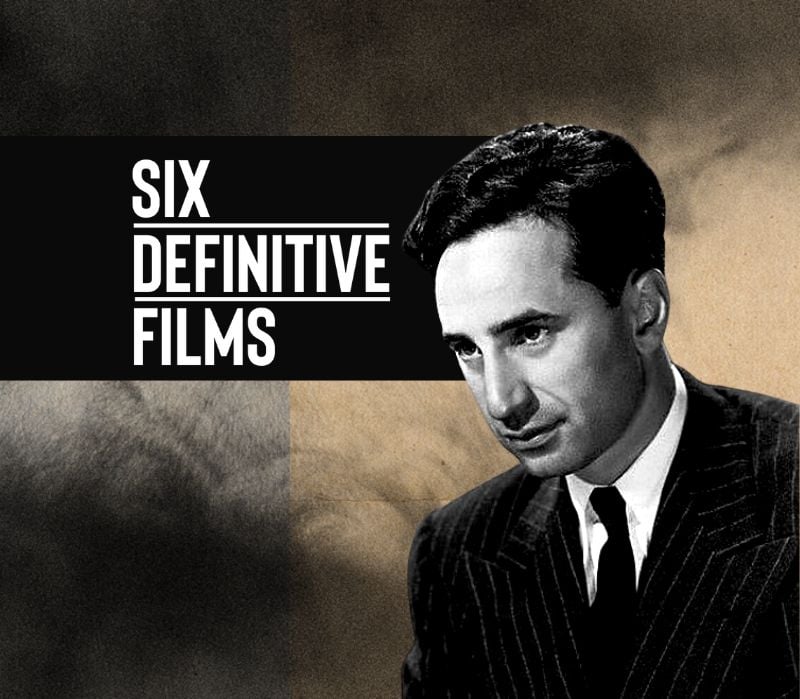
Six Definitive Films: The ultimate beginner’s guide to Elia Kazan

Elia Kazan is one of the most celebrated filmmakers in American cinema history. He has been honoured by some of the all-time greats, including Stanley Kubrick, who once declared that Kazan was “without question, the best director we have in America, [and] capable of performing miracles with the actors he uses.”
When he was younger, Kazan was a brilliant student who studied dramatic traditions at Yale. Although he initially wanted to be an actor, Kazan eventually gravitated toward filmmaking. However, his deep understanding of the craft of acting influenced his directorial style in numerous ways.
Often referred to as an “actor’s director”, Kazan’s work influenced multiple generations of aspiring filmmakers who were transformed by his methods. While his films tackled important sociopolitical subjects which are vital for understanding American history, his contribution to the world of cinema transcends any description.
Here, we follow his career…
Elia Kazan’s six definitive films:
A Tree Grows in Brooklyn (1945)
Kazan’s first dramatic feature might seem unpolished compared to some of his later achievements, but it is important to understand his artistic evolution. Showcasing one of Kazan’s primary interests, the film examines a family of second-generation immigrants living in poverty.
Set in Brooklyn, New York, in the first half of the 20th century, A Tree Grows in Brooklyn presents us with the omnipresent conflict between destitute socioeconomic realities and the illusory American Dream. It’s a fantastic debut by a director who would reach unprecedented heights.
A Streetcar Named Desire (1951)
A Streetcar Named Desire is the film that established both Kazan and Marlon Brando as two of the most powerful creative forces in the film industry. A brilliant adaptation of the eponymous play by Tennessee Williams, this 1951 gem proves Kazan’s ability to bring out the best in his actors.
Brando delivers a career-defining performance as Stanley Kowalski, a volatile, violent veteran who directs his anger and frustrations toward his sister-in-law. Although Brando did not win the Oscar for Best Actor, he announced himself to the entire world.
On the Waterfront (1954)
Another fantastic collaboration between Kazan and Brando, On the Waterfront is a highly effective crime drama based on Pulitzer Prize-winning reporting by the New York Sun. It perfectly recreates the ominous environment inhabited by dockworkers.
The film exposes how American institutions are controlled and compromised by nefarious forces, chronicling the violent activities and corruption on the waterfront. It ended up garnering 12 Academy Award nominations, and it won in eight categories.
East of Eden (1955)
Kazan was responsible for launching the careers of several iconic stars, and one of them was the inimitable James Dean. East of Eden, a loose adaptation of a John Steinbeck work, was the first major role in Dean’s short but widely acclaimed career.
Due to his tragic demise in a car accident, East of Eden was his only feature that was released during his lifetime. Like Kazan’s other major works, it received multiple Oscar nominations, but the highlight was undoubtedly Dean’s definitive performance.
A Face in the Crowd (1957)
A Face in the Crowd is one of those rare masterpieces which continues to gain relevance over the years. It captures the corrupting influence of capitalism by telling the story of a drifter who is reduced to moral emptiness by fame and success.
One of the actors, Anthony Franciosa, described Kazan’s approach: “You felt that you had a man who was completely on your side—no qualms about anything you did. He gave you a tremendous sense of confidence … He never made me feel as though I was acting for the camera. Many times, I never even knew where the camera was.”
America America (1963)
An adaptation of Kazan’s own account of his family’s migration to the US, America America is based on Kazan’s uncle – Avraam Elia Kazantzoglou. One of Martin Scorsese’s favourite films, America America shows how America functions as an oneiric vision for oppressed global communities.
Kazan said: “It’s all true: the wealth of the family was put on the back of a donkey, and my uncle, really still a boy, went to Istanbul … to gradually bring the family there to escape the oppressive circumstances … It’s also true that he lost the money on the way, and when he got there he swept rugs in a little store.”
