


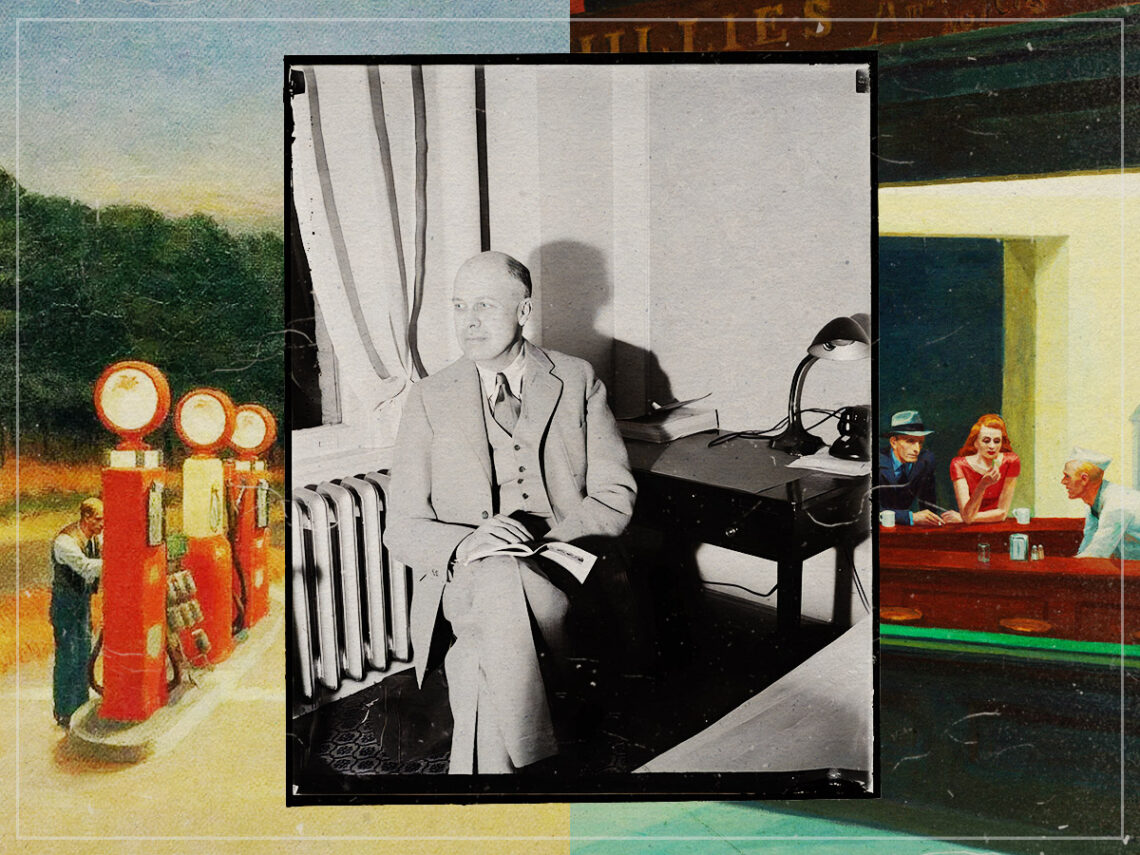
Edward Hopper: exploring America’s most introspective artist

American solitude came to life under the watchful eye of Edward Hopper. He was a singular force whose work went on to shape the lighting of contemporary film sets and is repeatedly recreated in pop culture because, with subtlety and gorgeous realism, a fractured country was distilled in his lonely café scenes. But Hopper’s work was so prolific, so painfully true to universal life, often little is said about his own. Of every detail there is to know, the most important is also the most obvious: he started and ended his life observing the world around him.
Hopper grew up in a Nyack, in a house dominated by women, all of whom encouraged his every creative whim. By age ten, he was studying the bases and bowls dotted around the kitchen and sketching them. He had a command of light and shadow far beyond his years and, by his mid-teens, was reproducing professional artwork so well that it was only recently realised they weren’t his own conceptions. However, his earliest self-portraits were decidedly his, and he often chose to depict himself as awkward and gangly.
That early glimmer of self-consciousness crept into his later work, nowhere more so than Nighthawks. His innocuous diner setting was charged with social alienation in the same unspoken way his self-effacing portraits were. Hopper was shy and reluctant to speak about himself or his work. “The answer,” he once said, “Is right there on the canvas.”
People assume that because his paintings were so melancholic, he must have been, too. Hopper was actually said to have had a great sense of humour but was burdened by introspection. It was almost like everything he looked at, whether it be railroads or people pouring coffee, had the potential to reveal something about America’s social structure, which he then exposed on the canvas.
While he didn’t often explain his methods, he once made a statement in the Reality journal that spoke to how he utilised his introverted tendencies. “Great art is the outward expression of an inner life in the artist, and this inner life will result in his personal vision of the world,” he declared. “No amount of skillful invention can replace the essential element of imagination. One of the weaknesses of much abstract painting is the attempt to substitute the inventions of the human intellect for a private imaginative conception.”
By turning his gaze outward in his work, he shone a light on his own inner workings and, by extension, everyone else’s. His work is rich with ideas and interactions to be projected on it, which neatly sidestepped the self-involvement that was more typical of the art at the time. Hopper was a prolific artist because he made everything but himself a subject.
