


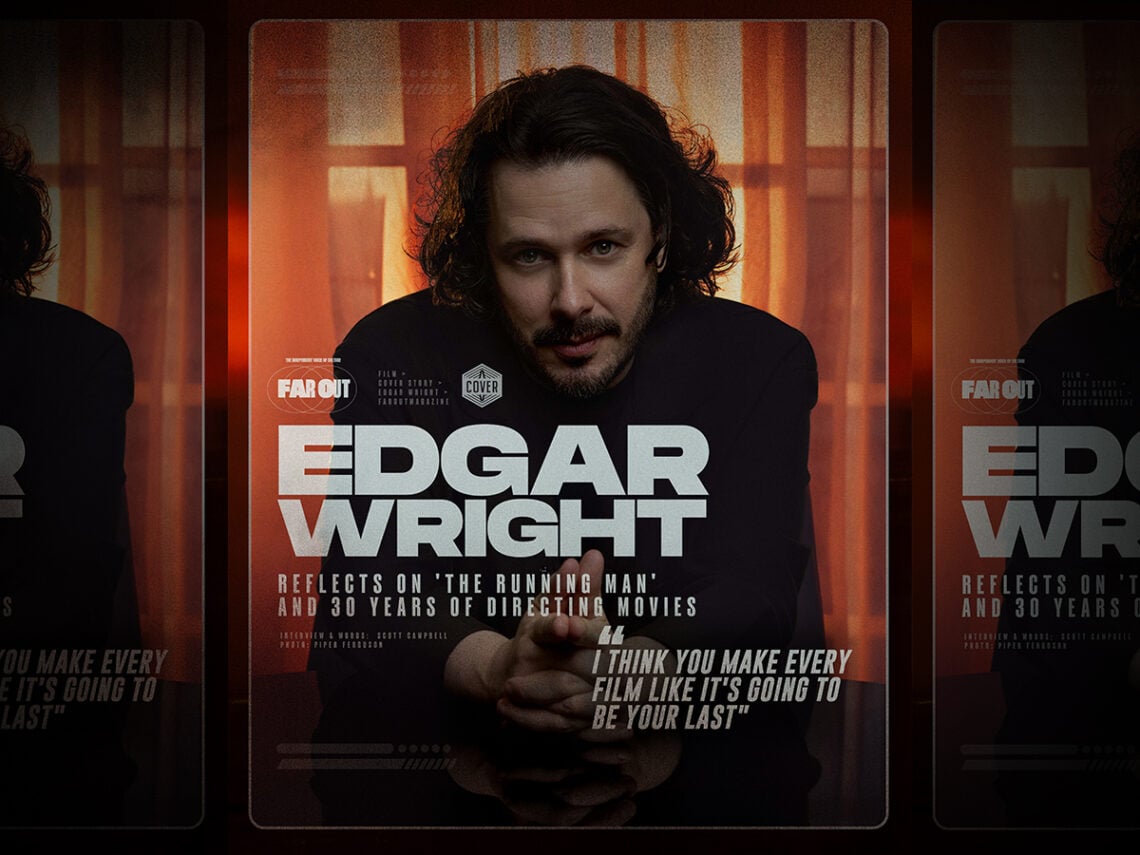
Edgar Wright reflects on ‘The Running Man’ and 30 years of directing movies: “I think you make every film like it’s going to be your last”

In May 2017, Edgar Wright innocuously responded to a social media post asking if there was one movie he’d want to remake more than any other by naming The Running Man. In November 2025, his version of The Running Man arrives in cinemas as the filmmaker’s eighth feature film, ninth if you include the documentary, The Sparks Brothers.
That’s an extreme oversimplification of events, but that’s nonetheless how the ball started rolling. Producer Simon Kinberg caught wind of Wright’s desires, informed him he had the rights, asked if he’d be interested in making his dream a reality, and here we are, with Glen Powell’s Ben Richards signing on for the titular TV series, where he needs to survive for 30 days to win a billion-dollar prize.
Of course, the first adaptation of the Stephen King novel, penned under his Richard Bachman pseudonym, starred Arnold Schwarzenegger in the lead role. The author wasn’t too happy with how his book was translated to the big screen, but Wright had no interest in re-treading familiar ground.
Instead, his spin on the book is much more faithful to King’s original story, which means it technically isn’t a remake at all, with freshly minted A-lister Powell desperate for money to save his ailing daughter and becoming seduced by the prospect of securing her future, albeit only if he manages to stay alive long enough to claim his winnings.
When Far Out asked Wright if he ever imagined his social media activities would be the first domino that fell on the way to The Running Man, his answer was as straightforward as it gets: “No”, with an addendum, “But also, that wasn’t the first time I’d answered that question”.
“I think I’d been manifesting it,” he explained, “It’s like one of those questions that comes up quite a lot in junkets and fan Q&As, right after, ‘Would you ever make a Star Wars movie?’ The second one is, ‘What, if you could remake any film, what film would you remake?’ And the reason I said it, and I should clarify the reason I said it, is because I thought there was a different movie to be made out of the source material.”
“I think of it as a fresh adaptation of Stephen King’s novel,” he added, “And I had read the Bachman books when I was a teenager, which included The Running Man. And I had read the book before I saw the 1987 film, and so, it’s more of a case of, I thought, ‘Oh, there’s another really entertaining movie that could be made out of this’.”

This isn’t the director’s first adaptation (more on that later), but his latest movie is an entirely different beast. He may not be rehashing Schwarzenegger’s jumpsuit-clad exercise in 1980s kitsch, but the combination of the ‘Austrian Oak’ and King cast two huge, indelible pop culture shadows over the production from the very beginning, which he admitted made him ever so slightly trepidatious at the prospect.
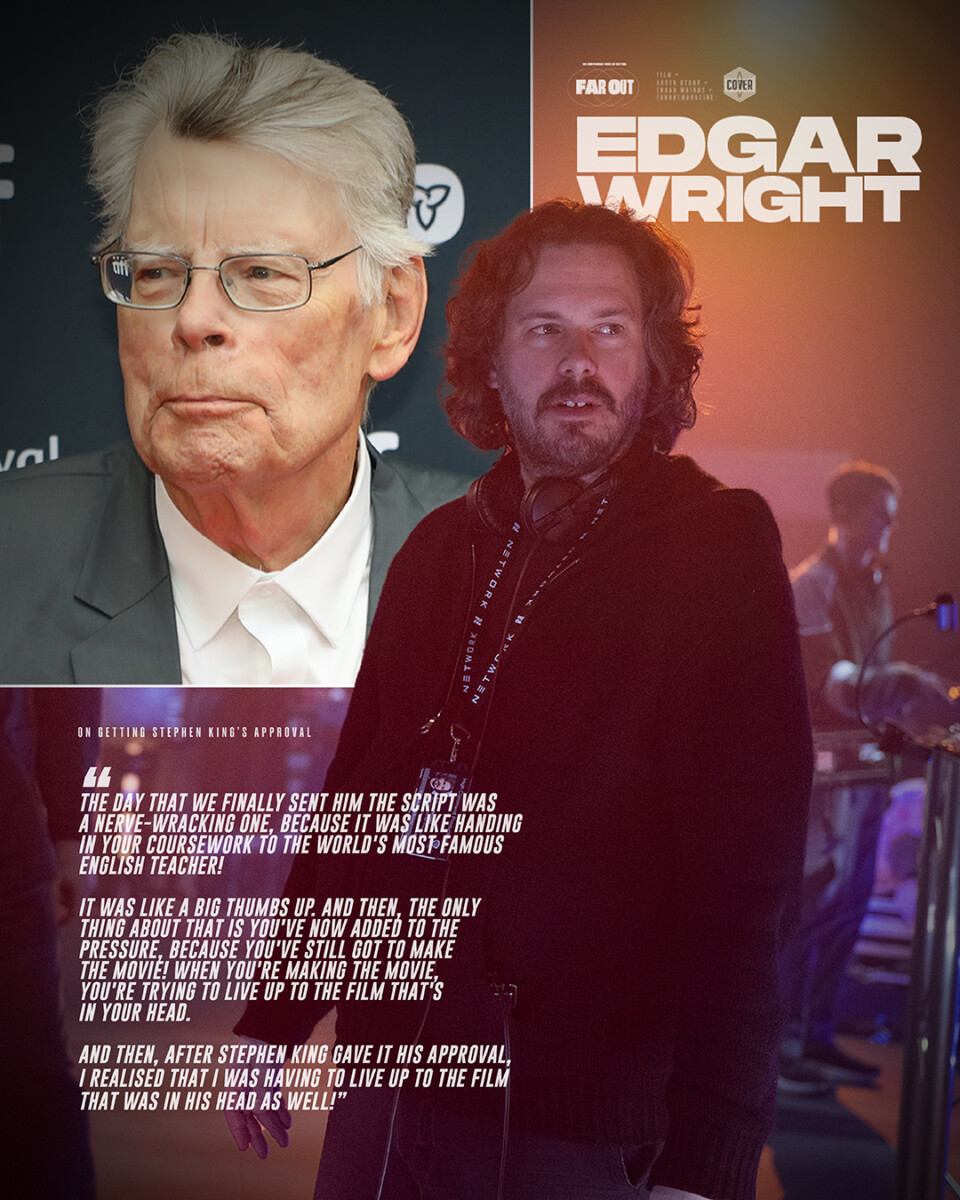
“I mean, certainly in the case of Stephen King, he’s a writing hero of mine,” the director acknowledged, “And also, with this movie, he would have to sign off on the adaptation. So the day that we finally sent him the script was a nerve-wracking one, because it was like handing in your coursework to the world’s most famous English teacher!”
And what did the world’s most famous English teacher make of his screenplay, co-written with Michael Bacall? “The great news was that he really liked the adaptation, and he liked what we’d kept in, and he liked what we changed”, which was a huge relief for Wright, but that was only the first hurdle of many that he needed to cross.
“It was like a big thumbs up,” he continued, “And then, the only thing about that is you’ve now added to the pressure, because you’ve still got to make the movie! When you’re making the movie, you’re trying to live up to the film that’s in your head. And then, after Stephen King gave it his approval, I realised that I was having to live up to the film that was in his head as well!”
“So, for a large portion of the production, the only thing keeping me going through those chilly Glasgow nights was, ‘I can’t let Stephen King down'”. About those chilly Glasgow nights: it’s the city this writer calls home, and it’s a subject that felt like it needed to be broached, especially when Wright had previously described the night-time temperatures as being so cold they bordered on the “insidious”.
“Well, you know, I’ve shot twice in Glasgow in my career, for Running Man, and also nearly 30 years ago, doing Is It Bill Bailey? for the BBC,” he reminisced, “I’m not familiar with the Glasgow winter. I will say the two scenes in The Running Man that were the coldest were the ones that were nearest the Clyde bank. So you’re doing night shoots, and I think when you get closer to the river, obviously, the bone-chilling nature of the wind starts to get you.”
Even though it’s not a remake of the Schwarzenegger film but a truer adaptation of the King novel, did he ever feel like he was working too hard to please three masters? After all, he had to make sure he got the seal of approval from the author, and there’s a part of the audience who’ll be expecting at least one or two instances of nostalgic key-jangling to the ’87 actioner, not to mention the version of The Running Man he’d always dreamed of making to contend with.
“Yeah, I guess so, but I think, hopefully, we navigated that,” he reasoned, “I mean, I don’t think we make too much reference to the 1987 film, but when you say ‘one or two references’, I think we probably did. And I think the things that I’d say that we made reference to, there’s a reference to Arnold himself, and then maybe two things where we were tipping our hat to the ’87 film, is having the cheerleader dancing girls onstage, which were not in the book. One of my favourite images from the ’87 film is that roll cage he gets in. And we didn’t want to do that, obviously, but we did do our own kind of, like, paternoster lift.”
For want of a better word, The Running Man is more of a traditional Hollywood movie than Wright has ever made, in terms of scope, scale, budget, and having a major American movie star in the lead role. It’s far from the first time he’s worked with a studio, but he did admit to there being a hint of wariness in jumping into that world, although those feelings didn’t affect him for long.
“I guess so, but then a lot of that is in the script process,” he reasoned, noting, “By the time we got to the green light stage, we’re green-lighting a script that we’re happy with, and that Stephen is happy with. And, thankfully, it didn’t divert much from that. I mean, there’s a lot of work that we still did, but it wasn’t like I felt it was watered down at that point. And credit the Paramount execs that worked on it, they didn’t push us into changing what we’d written.”
Wright elaborated, “The other thing is, it’s not the first film I’d made with a studio. I mean, technically, as far back as Shaun of the Dead, it’s a Working Title film, but it’s Universal’s money. Scott Pilgrim was with Universal, and Baby Driver was Sony. So it wasn’t a completely new experience for me. What was new was working with Paramount. I had not worked with them as a studio. Actually, I guess I had, in a roundabout way, because I wrote on Tintin. So I guess the answer is yes and no!”
As well as manifesting The Running Man into existence, it feels like the filmmaker may have manifested his leading man, too. Powell previously revealed that he had Wright’s name on his career ‘vision board’ as far back as 2008, but is it a weird feeling to be that guy, a director that actors are actively dreaming of working with? “Oh, it’s very flattering,” he smiled, “How could you not be flattered by that?”
Every single one of Wright’s features is personal to some degree, but from the outside looking in, The Running Man seems less so, if only for the fact that it’s based on a novel and has already been a film. That said, it was a formative read, and his approach to bringing his love of the story to the forefront, meshing it with his vision as a filmmaker, and getting exactly what he wanted out of the experience, was driven by a simple mantra.
“Making movies is not always about making it for yourself, but I think you’re right. The personal aspect of this is something that I’ve been a fan of for a very long time. And Stephen King, I always think of being like a gateway author for me, in terms of probably the first time I had read what I would call ‘grown-up’ books. Even the idea of reading that book when I was 14, having this version, when you read books, you tend to visualise what it looks like, so you sort of made a movie version of it in your head as a teenager.”
Edgar Wright
“It was a gift to work on this material,” Wright proclaimed, “And, you know, I’ve worked on adaptations before. There were things where you, obviously, relate to the characters as well, but I think it was really about… I mean, I’m a huge fan of Stephen’s work, and some of the film adaptations of his books are some of my favourites, so I just consider it an honour to do one.”
There’s a certain amount of irony in the filmmaker’s previous movie, Last Night in Soho, subverting the idea of romanticised nostalgia, only for his next picture to be a Stephen King adaptation based on a formative book that already exists as a film from the ’80s, which wasn’t lost on the co-writer, producer, and director.
He joked, “It wasn’t stopping me from making this film! It’s something I was really excited to do. The thing when I say it’s nostalgic, there’s an actual active choice to make it retro-futuristic as well. I really liked the idea, in talking about designing the world on the page and beyond, let me take a leaf out of Terry Gilliam’s Brazil. That film is an ’80s dystopian fantasy, but it has a ’40s styling, because it seems to be inspired by the decade in which George Orwell wrote 1984.”
“So we thought, ‘Well, by that token, why don’t we make Stephen King’s 1982 version of 2025?'” he illustrated, “Some things have advanced, and some things have remained in an analogue era, and that was a really fun way to tackle it. The book, as you know, is set in 2025 itself. So the idea of having this film out in the same calendar year that the book is set and creating this slightly alternate reality was really fun.”
From Hot Fuzz to Baby Driver via Scott Pilgrim, there’s a clear throughline in how Wright has embraced and evolved several different styles of action-oriented filmmaking. However, The Running Man involves set pieces and sequences that are unlike anything he’s ever done before, which was a learning curve he was eager to get to grips with.
“I think, every film that you make, you have to have some part of the production that you’re somewhat terrified about,” he surmised, adding, “It’s not a good thing to approach a project in a complacent way, of, ‘Oh, this is easy. I’ve got this. I know what I’m doing’. And the most ambitious part of this, on two levels, was the complexity of the action sequences in terms of how much ground they cover.”
“And that was key; that was tied in with what we wanted to keep from the novel, the main part being how expansive the action is. In the book, it takes place over three cities and freeways and country roads, and out into the sticks. So the most ambitious and complicated part of it was these sequences that had several moving parts, the sequence in Boston being the most complicated, just in terms of the amount of different set pieces and interior and exterior sets, and shooting over a matter of weeks.”
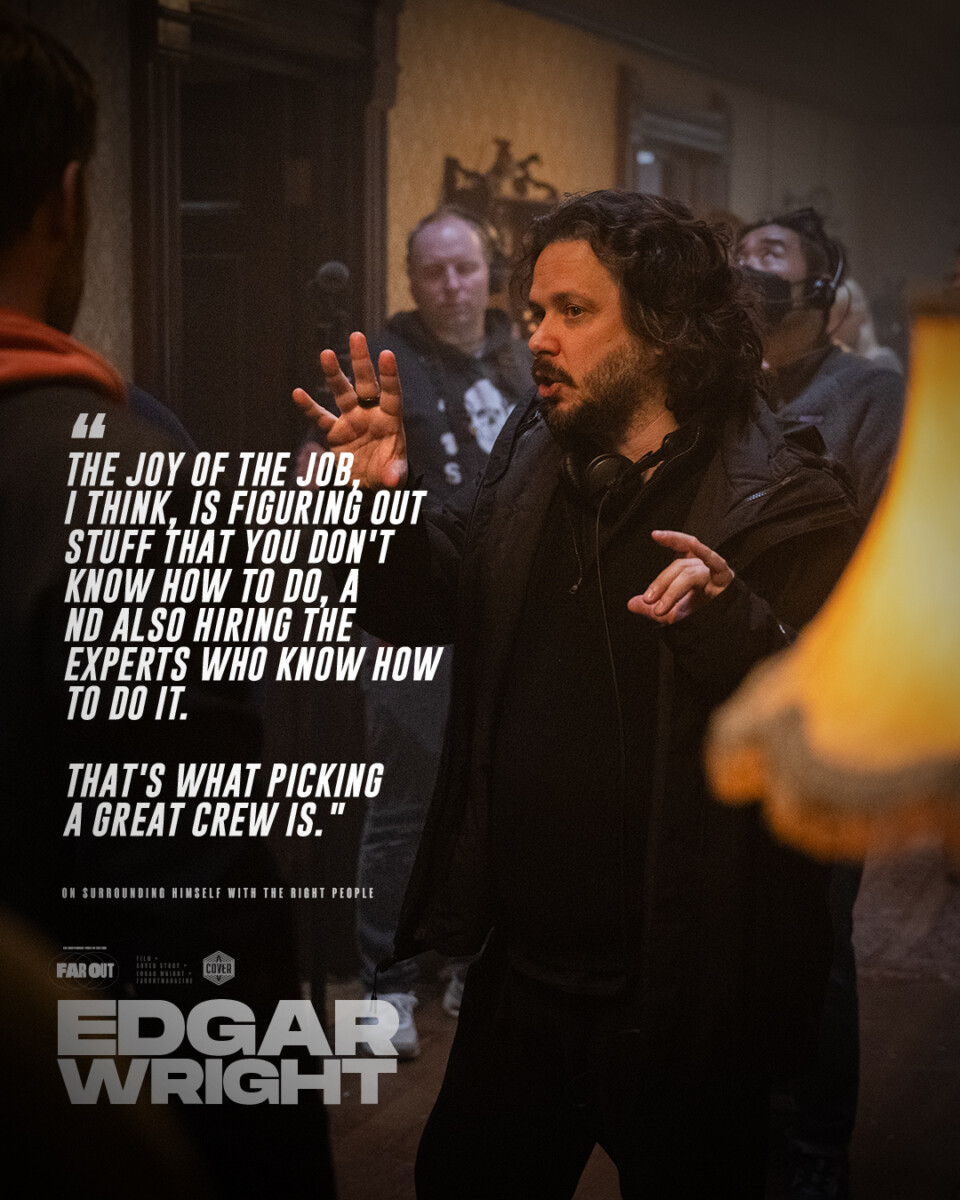
Still, it wasn’t a complete cinematic culture shock, with Wright suggesting, “The process isn’t different from making a low-budget film, or making Shaun of the Dead. You have to prep as best you can so that you’re coming to work with a plan. It isn’t the kind of film where you can come on set and improvise. The truth is, I think you’re always learning as a director. I don’t think there’s any time that I don’t feel like I’m learning something new, and the joy of the job, I think, is figuring out stuff that you don’t know how to do, and also hiring the experts who know how to do it. That’s what picking a great crew is.”
As chance, or perhaps fate, would have it, The Running Man debuts less than two weeks before the 30th anniversary of Wright’s debut feature, A Fistful of Fingers, which held its premiere in London on November 24th, 1995, so it only felt right to take a trip down memory lane and press the filmmaker for his thoughts on rapidly approaching an important career milestone.
“The thing with Fistful of Fingers [is] there was a wakeup call for me. I’d come out of doing a lot of amateur films, first at school, and then at art college. And obviously, when you’re making amateur films, it’s like a goof with your friends. And then Fistful of Fingers was an attempt, I guess, to continue that spirit into a debut feature, and it definitely has that feeling of being sort of, like, friends goofing around,” he confessed.
“But I did have this feeling once I made and edited it, and it wasn’t quite what I wanted to be. It wasn’t maybe as good as it could have been, and I did have this real existential moment where I thought, ‘Oh no, I’ve committed something to film! I can never make my first film again!’ So I kind of have a conflicted relationship with that. On one hand, I kind of think it’s not good enough. But then, other times, I feel very fondly about it, and mostly because of the memories of making it with my friends.”
Edgar Wright
There’s one memory that stands out above all others, though, where Wright’s first flick found itself competing directly against a cultural juggernaut. “The one thing I really remember about it is having a film on in one cinema in London, the Prince Charles, having it open against GoldenEye, the James Bond film, and standing outside the Prince Charles, which was moderately well-attended, and looking at the massive queue outside the Odeon Leicester Square to get in to see GoldenEye, back in the days before credit card booking where you’d have to queue up.”
The two movies may have been screening in close proximity, but Wright couldn’t even afford a ticket home after his premiere, a far cry from the world of 007. “I did two Q&As, but I didn’t watch the movie,” he remembered, “I was either pacing in the lobby, or I was walking around Soho, looking into the windows of Chinese restaurants like a Dickensian character, sort of hungry and salivating. So I think about that a lot.”
Wright’s defining memory from his first feature’s maiden screening has nothing to do with the film itself, but rather the feeling of “standing outside the cinema being hungry and cold, and looking at the queue outside”. Returning to familiar territory, he couldn’t help but get a mischievous dig in: “Not as cold as Glasgow”.
It would be an understatement to say that his world changed forever when his sophomore effort, Shaun of the Dead, was released in 2004. Here was a guy who hadn’t yet turned 30 when the zombie film he’d made for a couple of million quid held its United Kingdom premiere, and all of a sudden, buoyed by the rom-zom-com’s international success, found himself in America rubbing shoulders with Quentin Tarantino, Peter Jackson, and being personally sought out by George A Romero to make a cameo appearance in Land of the Dead.
“It’s like eight years, actually nine years, between A Fistful of Fingers and Shaun of the Dead. And a good period of actually, I guess, figuring out what I was doing, including a stint in Glasgow at BBC Scotland,” he reflected, once again making mention of the city that’s somehow evolved into the running theme of his conversation with Far Out, which is probably my fault for bringing it up first.
“When we made Shaun of the Dead, first and foremost, we wanted it to be as good as we thought it could be,” he said. “We, obviously, wanted success in the UK, and even the thought of it opening in other countries wasn’t something we’d really thought too much about, because we weren’t even sure if it was going to get released in the cinema in other countries.”
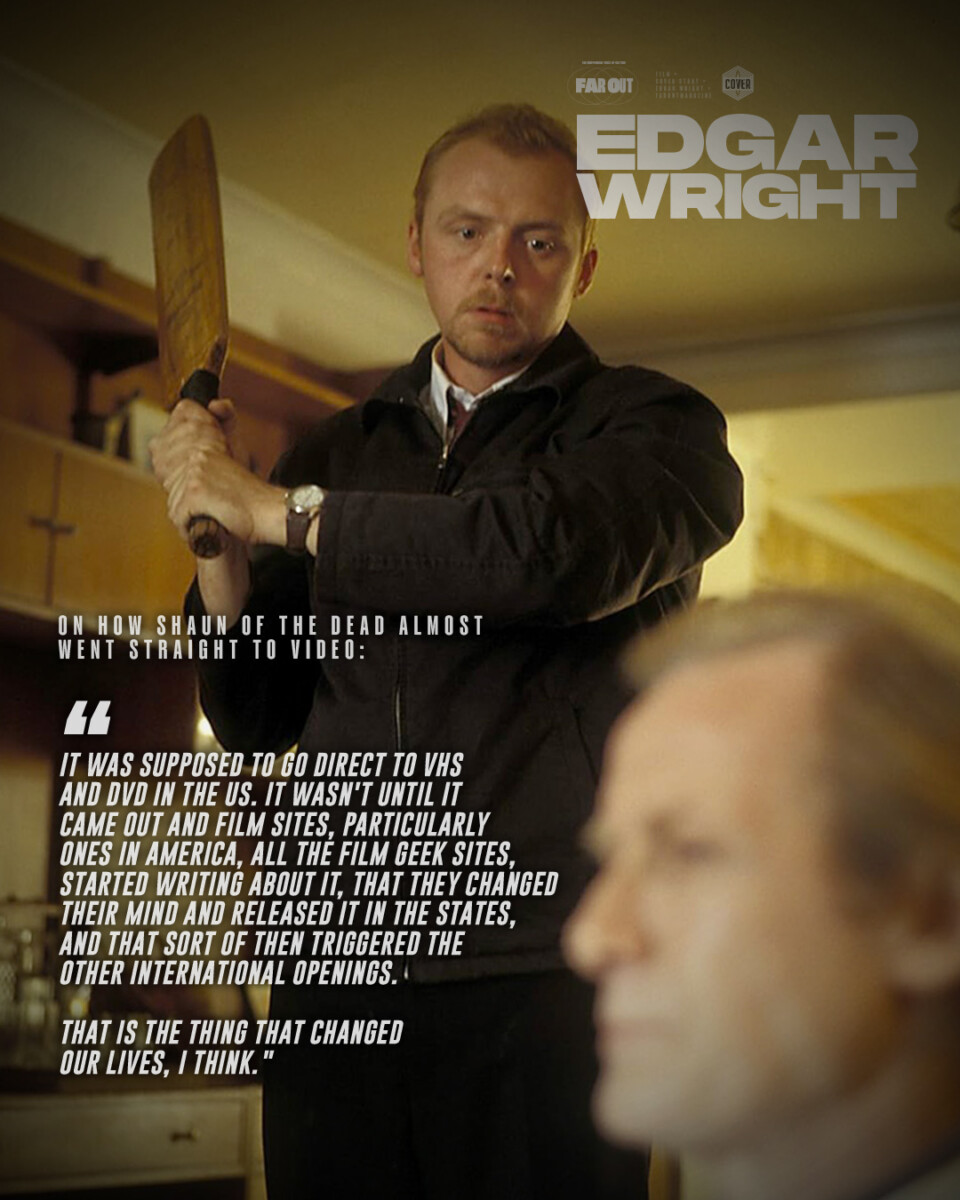
“In fact, it wasn’t,” Wright revealed, adding, “It was supposed to go direct to VHS and DVD in the US. It wasn’t until it came out and film sites, particularly ones in America, all the film geek sites, started writing about it, that they changed their mind and released it in the States, and that sort of then triggered the other international openings. That is the thing that changed our lives, I think. Not just the movie doing well in the UK, but travelling with it and going to other countries and promoting it, which was an incredible experience.”
However, an enduring moment, which Wright called “the day when our world got smaller”, was when he received a phone call from a most unexpected source: “George A Romero called me and Simon [Pegg], having just watched Shaun, and called us up in London to talk about the movie”.
“I remember, I still can remember where I was standing in my flat at the time, having a chat with one of the masters of horror. It was a very surreal experience, but it was also, I really think of that as a change in my life, you know?” Shaun of the Dead instantly increased the spotlight on its key players, who seemed destined for bigger and better things, which came back to bite one of them in particular.
Pegg, famously or infamously, said in the post-Shaun aftermath, “It’s not like I’m going to be starring in Mission: Impossible III,” and everyone knows how that turned out. Was Wright ever of a similar mindset, thinking that he’d never be seduced by the glitz and glamour of Hollywood?
“I wouldn’t be so dumb to say something like that in an interview like Simon did!” he quipped, “I wouldn’t have said that, because I wouldn’t have necessarily thought that. I think, as it turned out, when those opportunities did come, I wasn’t pushing away from that. I think because we’d made Hot Fuzz after Shaun of the Dead, which, if anything, doubled down on its Britishness, I felt like I’d done my bit by the time I went off to make a Hollywood movie, and I came back to British movies.”
That Hollywood movie was Scott Pilgrim vs the World, which, despite receiving plenty of acclaim, didn’t do too well at the box office. “What?” Wright asked in mock incredulity, before demonstrating just how long a life his graphic novel adaptation has enjoyed among its dedicated fanbase, which has seen it become a firm cult favourite and spawn a Netflix animated series that reunited the core cast, on which he served as an executive producer; an oxymoronic sense of instant longevity that helped soften the initial blow.
“The feeling came quite soon afterwards, because even though on its initial release, it didn’t do as well as everybody wanted it to do, and as well as we hoped it would do, by the end of that year… It came out in August… by the end of that year, it was sort of a frequent midnight movie in cinemas. First in Los Angeles, and then all over the States.” It might have bombed, but that doesn’t mean it wasn’t, and still is, hugely popular.
“It’s a strange thing,” he ruminated, “There are some much bigger movies from that year, that once they stopped their initial run, have probably never been seen on a big screen ever again. Films that grossed ten times what Scott Pilgrim did, and yet, I think some of those prints of ours from 2010 are still doing the rounds.”
Since he’s probably sick of being asked about it, Far Out doesn’t bother about his flirtation with directing Marvel Studios’ Ant-Man. Instead, we inquire that since he said that he wanted to make a Marvel movie but they didn’t want to make an Edgar Wright movie, two decades later, does he feel like he’s in a position where he’s confident enough to know that regardless of what he makes or who he makes it for, everything he does is going to be an Edgar Wright movie? “I don’t know, that’s a good question,” he pondered.
“The thing is, it’s difficult to talk about… I think sometimes other people can talk about your sensibilities better than you can. To me, it slightly becomes second nature in a way. A lot of times, people have asked me, ‘How do you balance between making a King movie and an Edgar Wright movie?’ And I was like, ‘I don’t think I ever really think about it’. This is just how I see the story working. So I would hope so,” he concurred. “But again, it’s not something where that’s the be-all and end-all that it has to be, ‘Me, me, me’. As long as the movie works, that’s what I really care about,” he added sagely.
There’s another thing Wright is also sick of being asked about. “Is there going to be another Cornetto film?” he interjects, laughing, before Far Out can finish the sentence. Well, technically, yes, but we’ve got a different spin on it, because there’s only so many times he can say, ‘We’d love to’.
Instead, we ask that now that it’s been a decade of people repeatedly asking and Wright fielding questions on the subject in perpetuity, if there’s any part of him that worries whether if and when he reunites with Pegg and Nick Frost for a fourth movie, the expectations from fans of the first three will be too high, regardless of what they’re able to come up with.
“I mean, yeah,” he agreed, “I even felt that way with The World’s End in a way, because it wasn’t Hot Fuzz 2, and some people are like, ‘Oh, I just wanted more of the previous one’. So I think, really, at heart, it’s got to… making movies is so difficult that it has to be done with real passion. Otherwise, it’s really hard work.”
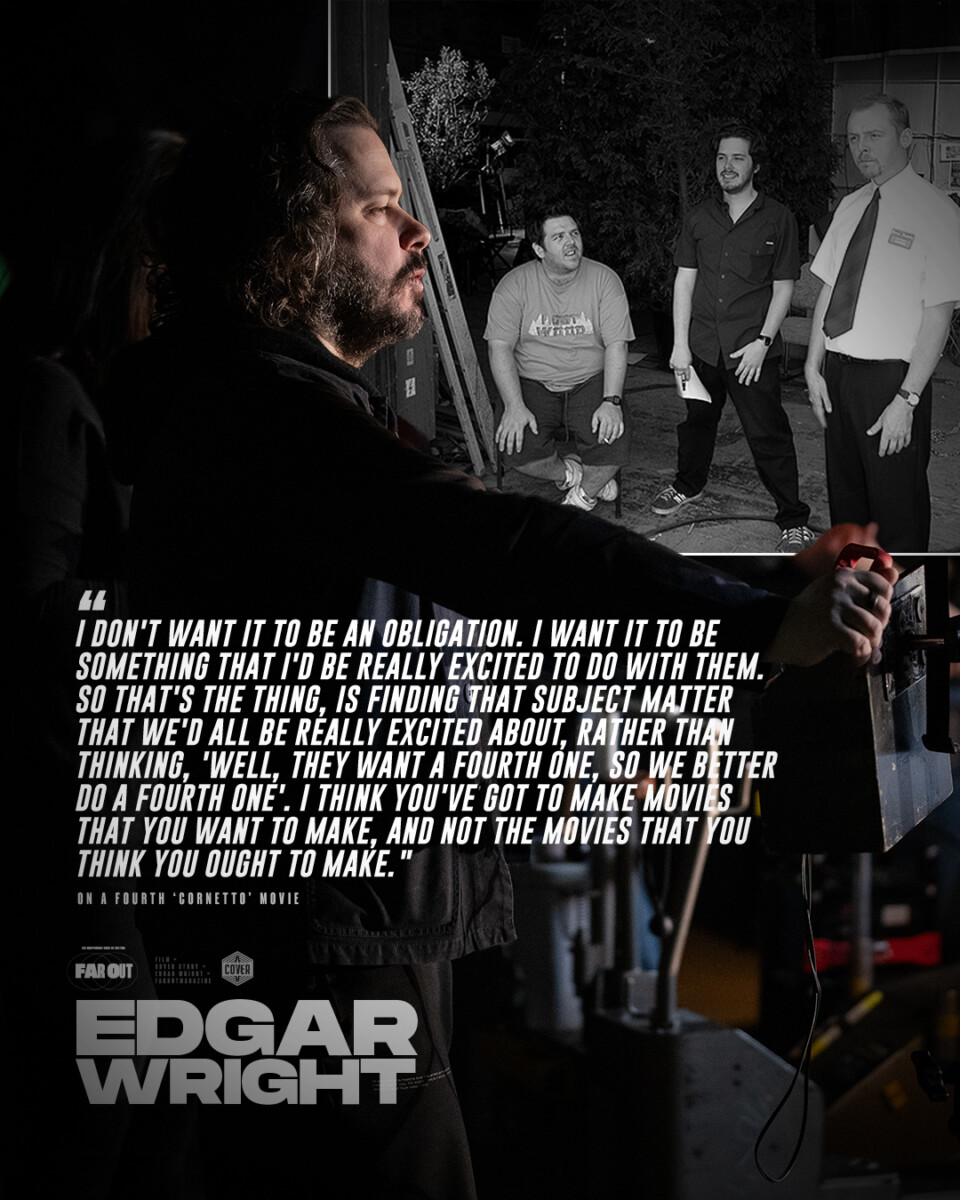
“I would love to do something with Simon again. But, of course, I don’t want it to be an obligation. I want it to be something that I’d be really excited to do with them”.
Edgar Wright
“So that’s the thing, is finding that subject matter that we’d all be really excited about, rather than thinking, ‘Well, they want a fourth one, so we better do a fourth one’. I think you’ve got to make movies that you want to make, and not the movies that you think you ought to make.”
It’s not an entirely dissimilar situation from that of his friend, Tarantino. He’s been saying for so long that he’s only got one movie left, and the bare minimum his fans will be expecting is one of the greatest movies of all time, and no less. Is that the kind of pressure any filmmaker can handle, even experienced heads like Tarantino and Wright?
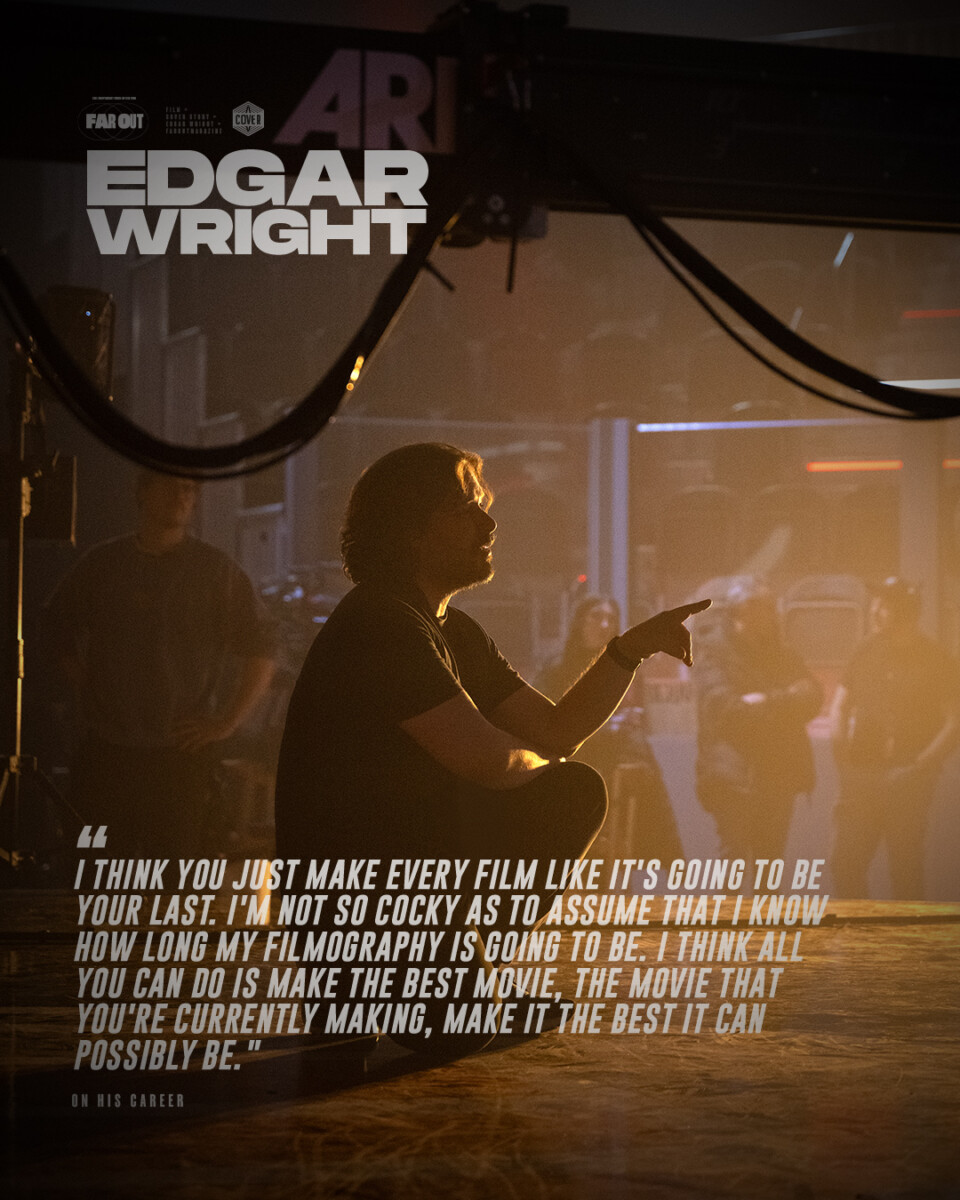
“I don’t know,” comes the honest answer, before he muses, “I think the business is so fickle, and nobody really knows what’s going to happen at any time in any industry in it, especially film. I think you just make every film like it’s going to be your last. I’m not so cocky as to assume that I know how long my filmography is going to be. I think all you can do is make the best movie, the movie that you’re currently making, make it the best it can possibly be.”
Earlier this year, reports emerged suggesting that Wright was in the mix to direct the next James Bond movie before Denis Villeneuve was hired, and almost a decade and a half ago, similar rumours were floating around that touted him as a potential candidate to helm the fourth Mission: Impossible flick, which eventually became Brad Bird’s Ghost Protocol.
Despite his adverse Ant-Man experience, Wright isn’t ruling out the possibility of boarding an existing franchise that’s well established, but it needs to meet a certain number of parameters, including how much of his own imprint he could leave on it. “I guess that’s part of it,” he said, “You want to, in some way, come in on the ground floor of something”.
“And unless it’s a franchise that, for some reason, is established that you can do whatever you want with each instalment, but that doesn’t seem to really be the case anymore. I don’t know. I mean, it would really depend on what the actual situation is. There have been times when I’ve been asked to do that, and I feel like what they really want to do is just continue the franchise as it is.”
“So if you don’t think you can add anything to it, then it’s probably not good to get involved,” he surmised, “If it’s something where they actively want you to do something different, then that’s a different matter.” A committedly non-committal response, but an accurate assessment of where franchise filmmaking is these days, and an apt summary of why Wright has yet to take the reins on an existing property.
What about full-blown horror, then? The Don’t trailer from Tarantino and Robert Rodriguez’s Grindhouse and Last Night in Soho saw him dip his toes into the genre-infested waters, and since it’s no secret that An American Werewolf in London had a massive impact on him, could Wright ever envision himself making a blood-and-entrails horror like the kind he grew up watching?
“I mean, Shaun of the Dead has a lot of entrails in it, doesn’t it?” It does, but technically, it’s a zombie movie, which is a subgenre unto itself. “Are you saying, would I make a werewolf movie?” Not specifically, but more of a classic, ’70s style, exploitation-inspired spectacular? “Well, isn’t that what Don’t is?” Again, technically, but it’s short-form, so it doesn’t really count. “I think… who knows?”
Wright is keeping his cards close to his chest on whether he fancies a tilt at making the type of horror movie that played such a huge part in his filmic upbringing, but with next year marking the 25th anniversary of Spaced‘s final episode, and with the filmmaker having never returned to the small screen as a director since, it was worth gauging if he could ever see himself taking his talents back to television.
“I don’t think it’s something where you ever think, ‘Oh, I must do a TV show,'” which is fair enough. “I think it’s just got to be on what the subject matter is. If it’s something that I think is a great idea, and it could only be done in long form, or the start of a series or something, for sure.”
“The thing I do think sometimes is that there are shows where it feels like a ten-hour show could have been done better as a two-hour movie,” he added, which is a feeling we’ve all felt at least once. “Sometimes you get remakes of classic movies, and they say, ‘You liked this in 1987, now here it is, ten hours long’, and I’m like, ‘I’m good with the two-hour version’. But that’s not to say that I wouldn’t, it would totally depend on what the story was.”
Bringing our chat full circle and returning to The Running Man, since the concept revolves around one man’s desperate battle to stay alive long enough to emerge victorious and receive a life-changing reward, removing Powell’s Richards from the equation for obvious reasons, which Edgar Wright character does Edgar Wright think stands the best chance of winning the show?
“I guess, probably Nicholas Angel would seem the most capable, I think,” with the Hot Fuzz frontman getting the nod, “Because he’s a pretty sensible guy, and a pretty practical guy, and pretty attuned to what’s going on around him. So I would say probably Nicholas Angel. I certainly bet on him over Shaun and Gary King!”
With that, Far Out bids farewell to the filmmaker, but not without an unnecessary apology: “I’m sorry for ragging on Glasgow. I did love shooting there. I want to make that very clear. I loved it, it was great.” There’s no need to apologise, because it really is cold as fuck during the winter.
