


‘Prelude’: an early gothic short film about the fear of being buried alive

Sometimes, our biggest fears are those that are most unlikely to happen, such as being eaten by a killer shark, being haunted by ghosts or being buried alive. Yet, in 1927, a British filmmaker named Castleton Knight translated this fear into the visual medium with the silent horror short Prelude.
It’s a unique piece of early cinema, made before the term ‘horror’ had even been used to describe scary movies. While the first horror movie, Le Manoir du Diable, was made in 1896, the genre didn’t start to flourish until the 1920s and ‘30s. Most filmmakers used Gothic fiction as inspiration, adapting stories such as Dracula and Strange Case of Dr Jekyll and Mr Hyde for the big screen.
Knight’s film uses Edgar Allan Poe’s The Premature Burial, a short story published in 1844, as a starting point. It was the first adaptation of the Gothic master’s story, which was later made into movies like 1935’s The Crime of Dr. Crespi and 1962’s The Premature Burial. In the story, a man is so scared of being buried alive that he does all he can to ensure that such a terrifying thought never becomes his reality.
He designs a coffin that would allow for an easy exit if he suddenly woke up buried alive. He writes, “There was suspended from the roof of the tomb, a large bell, the rope of which, it was designed, should extend through a hole in the coffin, and so be fastened to one of the hands of the corpse.”
Besides The Premature Burial, Knight also used Rachmaninoff’s ‘Prelude in C Sharp Minor (Op. 3, No. 2)’ from 1892 as another key source of inspiration, a piece that listeners often associate with fears of being buried alive. The Victorian era was a period steeped in a morbid fascination with death, and many artists, such as writers and musicians, tapped into the very real fears facing many people living during this time. When Knight made Prelude several decades later, these fears weren’t as widespread, but the concept remained the perfect material for a piece of horror entertainment.
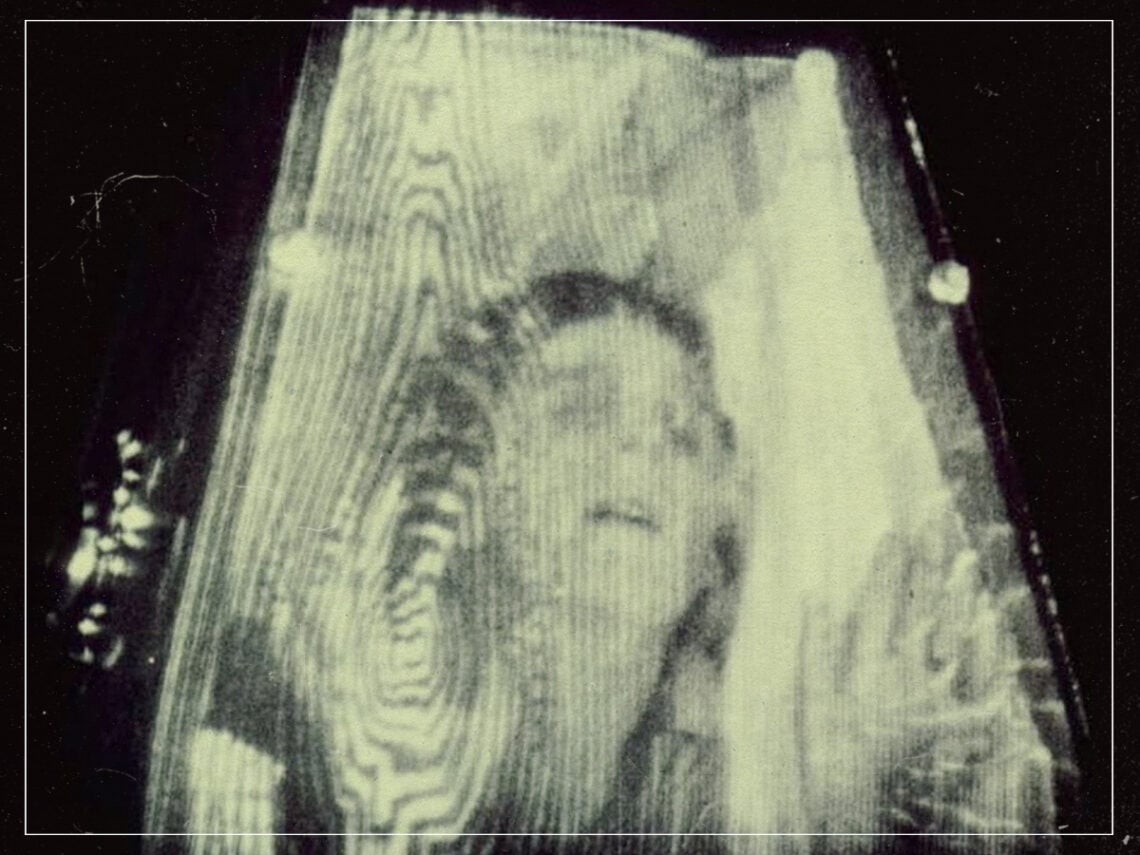
Knight’s film is an experimental work of cinema, drawing on these two pieces of popular media to imagine being buried alive through a new medium. It appears as though this was the first time that such a horrifying phenomenon was imagined for the screen, with Knight using clever editing techniques to show himself trapped inside a coffin—layering two shots at once.
We begin, however, with Knight reading Poe’s story, getting increasingly anxious and fixating on a small statue on the mantelpiece that appears to represent Death. As the clock ticks and the image of a chiming bell appears, Knight then enters a dreamlike state where he is being buried.
Several images of people shovelling dirt over the coffin are interspersed with Knight trapped inside, screaming and recoiling in fear as he realises that he cannot get out. We then see close-ups of each of his eyes, with one showing scenes of Hell and the other depicting a journey towards Heaven. Once the nightmare is over, Knight is still taunted by the Death-like figure, suggesting that our lives are fragile and death will come for all, one day or another.
