


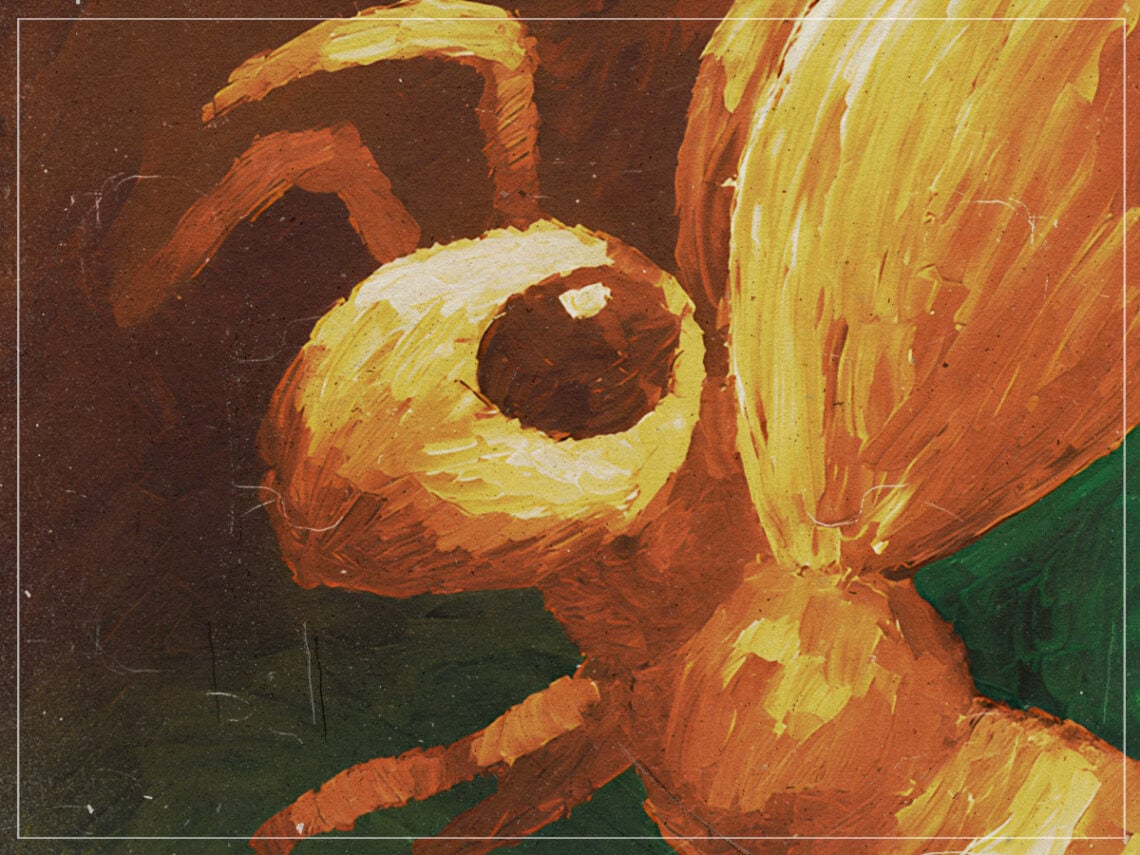
Dvar: the strange case of an anonymous Russian band channelling their overlord, a giant bee God

Dvar are an impossible band to get a hold of. Sadly, I’ve learnt that it is hard to contact any Russian artist right now, but Dvar are certainly the hardest. That is mostly because nobody knows who they are. However, this is not because they have chosen to remain anonymous to avoid the Sauron-like scowl of governmental censors but rather because they do not want to detract from the work of their overlord, a giant bee named Dvar, as mere messengers themselves.
Their first album was released in 1995, and shortly after that came the first snippet of information about the members: General Bee, Bee Warrior, Bee Girl, Bee Jag and Bee Svizzl. This five-piece behind the darkwave sound were not traditional musicians, rather they were anonymous channellers of the overlord Dvar, a giant bee who visits them in their dreams and gifts them with honeyed music of the most bittersweet, nightmarish variety.
This bee of unknown intent had selected the hitherto un-inclined messengers to form a band. Therein, they would extoll Dvar’s word to the masses, which, according to the brief lyrics we can occasionally grasp, is in Enochian – an occult constructed language deciphered from the journals of the 16th-century English mystics John Dee and Edward Kelley, who believed they were transposing the voices of angels. This rendered resultant band performances equal parts musical recital and spiritual practice.
However, this Enochian language is atypical, meaning that Dvar is merely angelic-adjacent, I suppose? While all this might sound up in the air, perhaps the strangest element of all is how serious the project seems to be. Since 1995, the band have consistently released new music on a range of labels exploring various themes, all of which remain centred around Dvar, and the mask of the messengers has never slipped. So, it is safe to assume that General Bee and Co remain as devout to their dream dementor as ever.
This comes with one notable exception: a nine-year hiatus that was broken in 2021. This lengthy departure both began and ended without announcement. Was it simply that Dvar failed to visit them? Or had the bumbling overlord himself encountered writer’s block? As ever with this mystic band, these questions remain unanswered.
But Dvar do illuminate one thing: Russia’s so-called ‘dark scene’. This is the avant-garde underworld of Russian music that has, in truth, existed since the revolution. Like rolling over a stone, the dark scene is the various critters that scurry underneath, a world too impenetrable and perturbing for censors to even bother with. They simply roll the stone back over, and the musicians continue scurrying.
So, although Dvar might seem weird on the surface when you delve into the history of alternative music in Russia, they make a lot more sense. Even the poppy beginnings of rock ‘n’ roll made their way to Russia in mysterious circumstances after being banned at the height of the Cold War. Some clever folks in St Petersburg and other port towns realised that you could press the vinyl onto X-ray film, making a discreet, smuggleable primitive flexi-disc rather than a bulky vinyl. The other benefit to this bounteous practice was that it was cheaper and even more discreet to press it onto used X-ray film sheets. Thus, the Chuck Berry records or whatever else had been smuggled into the country were etched onto sheets of cracked ribs and shattered shin bones.
This sort of subversive underground energy continued to build. Perhaps the band that epitomised it most was the early 1980s emergence of Vova Blue & The Brothers of the Mind. They were a band that made the New York punk club, the CBGB, seem about as overground as the Space Station. They lived in a town that didn’t even appear on maps. Like something from Stranger Things, the two brothers were residents of a rural village centred around making A-bombs and seemingly underground New Order-esque music. Their home recordings were placed on cassettes, and these small reel-to-reel tapes spread through the country, with a legion of other bands following suit.
Then, when Mikhail Gorbachev took control in 1985, a new age began. The underground became the mainstream. Thus, the underground itself just got deeper and darker. In recent times, the relevance of that has, tragically, re-emerged. So, while Dvar might be daft on the surface, the mysticism and darkness of their ethereal electronic sound remain decidedly subversive even if the music can’t be understood by mere mortals.
