


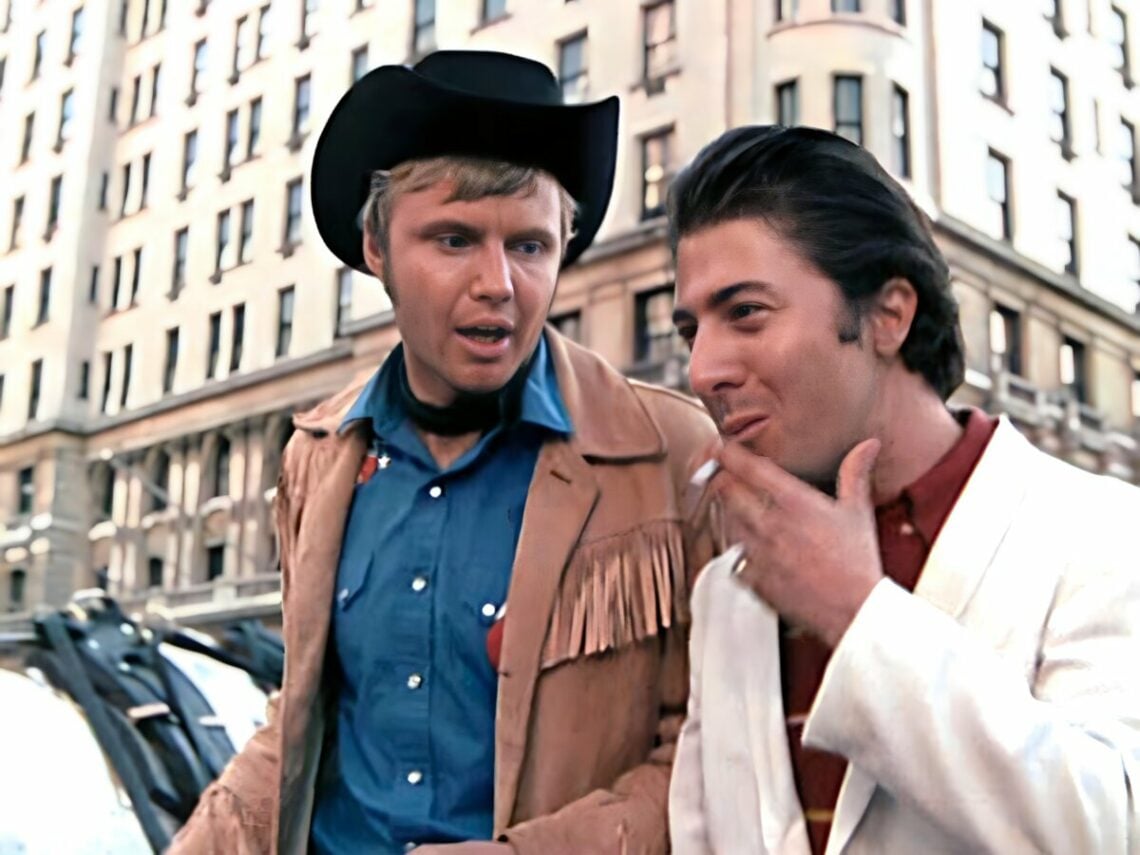
Does Jon Voight know he’s a queer cinema icon?

It’s gay, but it’s not. Nothing about Midnight Cowboy is explicitly homoerotic; in fact, throughout the film, the protagonist, Joe Buck, has one rule for his new career as a gigolo—no men. But there is a palpable queerness that runs through the film as the tender relationship between Buck, and his friend Ratso, has become a truly iconic and beloved queer cinematic pairing. Although Jon Voight himself doesn’t seem to know that, or, at least, would hate it.
In the final, devastating moments of the 1969 movie Midnight Cowboy, Jon Voight wraps his arms around Dustin Hoffman. Playing Joe Buck and Ratso, respectively, the two are a pair brought together by the mean streets of Manhattan. Buck is new in town, a naive southern boy who we learn is running from intense sexual trauma, hoping to use his body to make a living as a sex worker. Ratso is a con-man who, after at first exploiting Buck, becomes his best friend.
There is one scene where Buck first finds Ratso again after he stole $20 from him and sent him off to meet a dangerous pimp. Spotting him through the window of a dinner, the pair first smile at each other. The scene moves in almost slow motion, flashing between them as their faces light up and then falter. It’s like their true feelings come first, showing a second of the odd sense of care they’ve fostered between them, the strange infatuation that immediately connected them, or perhaps just their mutual desire to know someone, feel recognised by someone or have any level of relationship amidst the poverty they’re both suffering. Even when that gives way to a brawl, they resolve it by sticking to each other; Buck moves in with Ratso, and then suddenly, they’re cohabiting like partners, sharing food, shelter and a life.
From then on, all money is shared between them. The drive to survive is a mutual one, and eventually, as Ratso falls ill, Buck’s entire life plan is put to one side in favour of his partner’s dream. In a gorgeous sequence revealing his ultimate fantasy, Ratso wants to be in Florida, in the warmth with a tan, living it up at a nice resort—and he wants Buck there, too. That fantasy becomes mutual as the desire to be together overtakes any desire to stick to their individual plans; the movie ends on a bus with the duo going off to live that life together. It ends with Ratso in Buck’s arms.
You can ignore the contemplations of Buck’s sexuality; you can also ignore the scene of him having his first gay sexual experience and the whole consideration of the character’s feelings towards that. You can even ignore how Ratso’s death, though decades pre-dating the first case or cinematic depiction of Aids, feels poignant and prophetic of the incoming crisis. The simple fact of Buck and Ratso’s relationship, their concern for each other, their physical tenderness, their dedication to one another, their shared life, and their joint future makes Midnight Cowboy at least feel like a piece of queer cinema, as many audiences have come to consider it.
Does Jon Voight know that? Since playing the role and skyrocketing to notoriety off the back of that beautifully nuanced performance, the world has watched Voight dramatically slide into staunchly right-wing politics. Perhaps he knew it for a while. In the early days, when Voight was a new darling of the cinematic countercultural set, he was liberal. He stood shoulder to shoulder with the likes of Jane Fonda, fighting the same social and political fights that rallied for equality and global peace, protesting against the Vietnam War and working towards better voter registration efforts to engage people with politics.
But soon, as we see with many celebrities tripping down the same path, money and fame made him switch sides. Later on, he’d write that he actively regrets all of that, especially his anti-war youth. In an op-ed for The Washington Times in 2008, he’d essentially slash through his entire liberal, open-minded reputation. He was now a staunch Republican criticising the Democrats, claiming Obama wanted a “socialist America”. Over the years, it got worse and worse as Voight slipped further right. Now, he’s a huge Trump supporter, standing behind him at both elections and, as we now know, Trump has no care towards the queer community given that he’s busy actively trying to strip their rights and protections.
We shouldn’t be surprised. By now, the world is well versed in star letdowns, but there’s something especially devastating about Joe Buck, a gorgeously three-dimensional, empathetic, and caring character, who we last see wrapped around his friend or partner, being impacted by the legacy the man who played him would come to have.
