


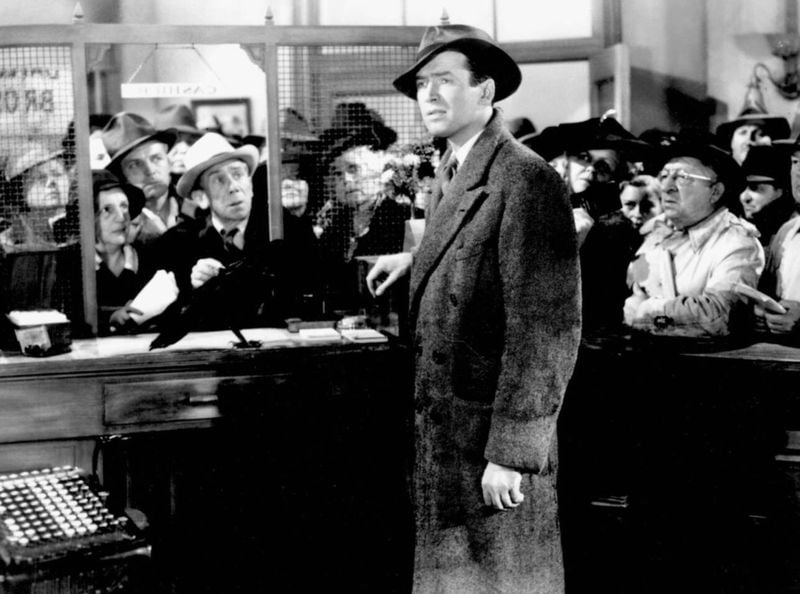
Does ‘It’s A Wonderful Life’ still hold up to today’s cultural zeitgeist?

It’s A Wonderful Life originated from a Christmas card. The film was adapted from a short story titled The Greatest Gift, written by Philip Van Doren Stern. In 1943, Stern couldn’t find a publisher for his story, so he printed 200 copies of it as a 24-page Christmas card and sent it out to friends and family.
The story tells the tale of a man named George Pratt who, feeling despondent and contemplating suicide, meets a stranger who grants his wish to have never been born. The reality which the stranger shows George teaches him a lesson about what life would have been like if he had never existed, illustrating the positive impact he has had on the lives of others.
Of course, in Frank Capra’s film, George Pratt is reimagined as George Bailey, played wonderfully by James Stewart. The stranger is instead portrayed as an angel called Clarence, and, in the alternate reality where George never existed, Mary remains unmarried in the film, while in the original story, she ties the knot with a man named Art Jenkins.
Though subtle discrepancies exist, both renditions convey a shared message: honouring the significance and worth of each individual’s life and their constructive influence within their community. Of course, the film delves into numerous other themes, but that generally encapsulates its overarching perspective. Considering its release in 1946, you might think that some of its ideas and scenes appear outdated, but somehow, it remains timeless.
Set in Bedford Falls, the movie captures the importance of the collective efforts of its residents from the beginning. George’s impact on the town becomes evident as the story unfolds, showcasing how his absence in an alternate reality significantly alters the lives of those he touches. The film also challenges conventional notions of success and wealth, showcased within his journey to understanding the true meaning of riches.
Amid all of these challenges, George displays immense resilience. He experiences various personal setbacks but discovers hope and redemption through self-reflection, demonstrating the power of perseverance and the human capacity to overcome obstacles. On Christmas, a lot of people evaluate their trials and tribulations over the past year, often adopting rose-tinted glasses and experiencing newfound hope for the future. This is captured within George’s essence, who ultimately realises the importance of cherishing family.
This also plays into our natural inclination for idealising second chances — Clarence effectively anchors this notion, guiding George along his journey of self-discovery. Much of the film relies on Stewart’s portrayal of experiencing confusion, despair, and grief, but Clarence’s presence makes these moments feel significantly less heavy. Ultimately, It’s A Wonderful Life is a beautiful allegory for challenging capitalist society and applying human nature where it counts.
The film, despite being released decades ago, still resonates with our innate desire to fight the good fight, no matter how many hurdles we may encounter. Its enduring legacy lies in its ability to reaffirm the importance of kindness, community, and the profound impact of every individual on the world around them, making it a perennial favourite and a holiday classic for generations to come.
