


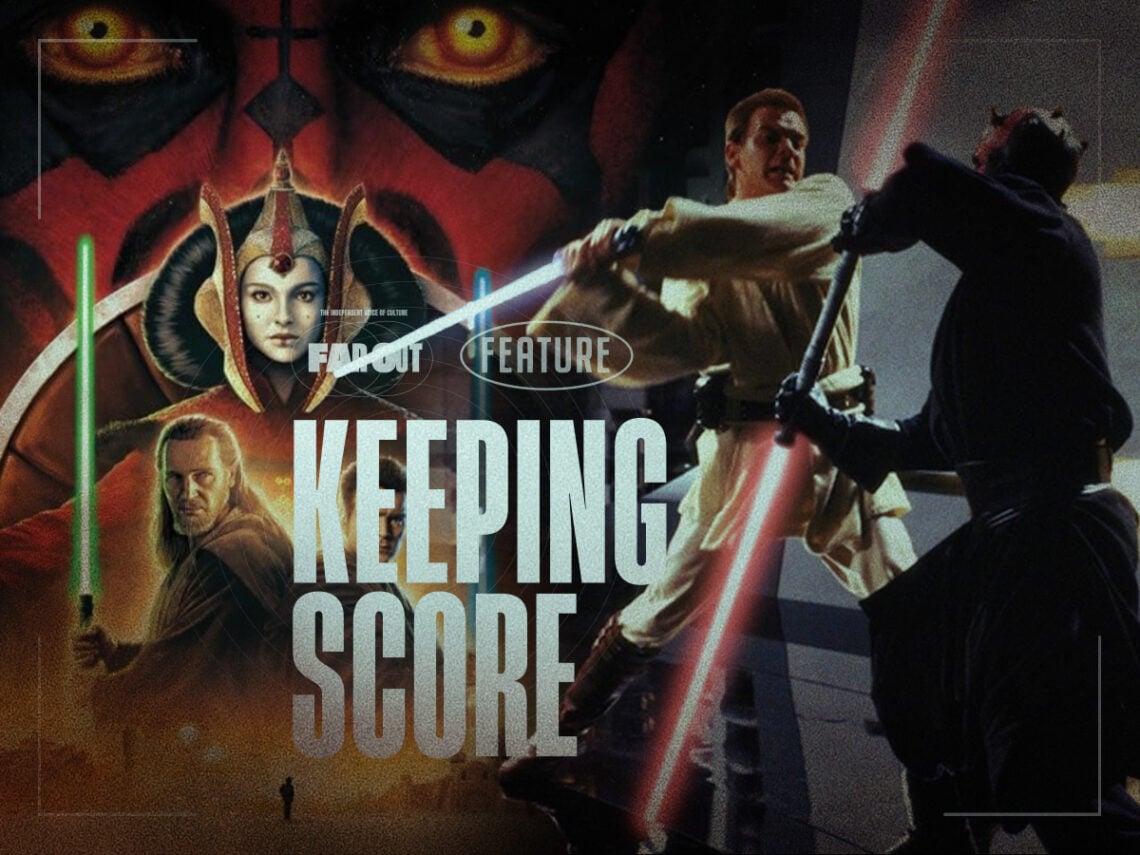
Keeping Score: Does ‘Duel of the Fates’ redeem the ‘Star Wars’ prequels?

The Star Wars prequels are rubbish.
I know it’s fashionable to speak more positively about them these days, but there is so much wrong with them, from the glacial pace to the uninspired performances to some of the worst dialogue ever committed to the big screen. George Lucas’ attempt to revitalise his beloved franchise ended up doing much more harm than good, but to paraphrase the series, “always two old men, there are”. Luckily for us, that second old man was John Williams.
As he’d done for the original trilogy, Williams was brought in to sprinkle his trademark magic over Lucas’ work. This started with the first new Star Wars movie in over a decade and a half, 1999’s The Phantom Menace. The Oscar-winning icon contributed a number of new themes, including one for a young Anakin Skywalker, but his most famous piece from this movie has nothing to do with Tatooine’s favourite son.
One of the best sequences in Phantom Menace (and the entire prequel trilogy) is the climactic two-on-one battle between Jedi Knights Qui-Gon Jinn and Obi-Wan Kenobi and the Sith Lord Darth Maul, which, as well as introducing the world to the double-ended lightsaber, is notable for its incredible soundtrack.
Once Williams had seen the film’s climactic battle, he knew he wanted its soundtrack to invoke feelings of religion. This was the Jedi order in its prime, up against a reemerging Sith threat, a literal war of ideologies, set in a cavernous space not unlike a great temple. In order to fully capture this church-like atmosphere, the great composer did something he never normally does and got himself some singers; hence, as the three fighters battle it out, viewers are treated to one of the most epic pieces of film music ever recorded in the form of the ‘Duel of the Fates’.
As viewers watched Liam Neeson and Ewan McGregor attempt to subdue Ray Park, they were treated to a glorious performance from both the London Symphony Orchestra and the London Voices choir. Most of Williams’ pieces don’t feature vocals, but he felt they were essential to capturing the ritualistic sentiment he wanted for ‘Duel of the Fates’.
The lyrics come from a fragment of a Welsh poem called ‘Cad Goddeu’, which means ‘The Battle of the Trees’ in English, which Williams translated into Sanskrit, but only very loosely. Don’t attempt to translate them back into English, because you’ll just get a load of gibberish.
Audiences certainly didn’t think the finished product was gibberish, though, and ‘Duel of the Fates’ was by far and away the breakout hit of The Phantom Menace’s score. It was so popular that its music video entered regular rotation on MTV’s Total Request Live show, the only time a classical piece ever did so. The theme has cropped up time and time again throughout the Star Wars franchise and in wider culture.
Without ‘Duel of the Fates’, the incredible finale to The Phantom Menace wouldn’t hit nearly as hard, and through this divine creation, John Williams proved that he is just as vital to the success of Star Wars as anyone else.
