


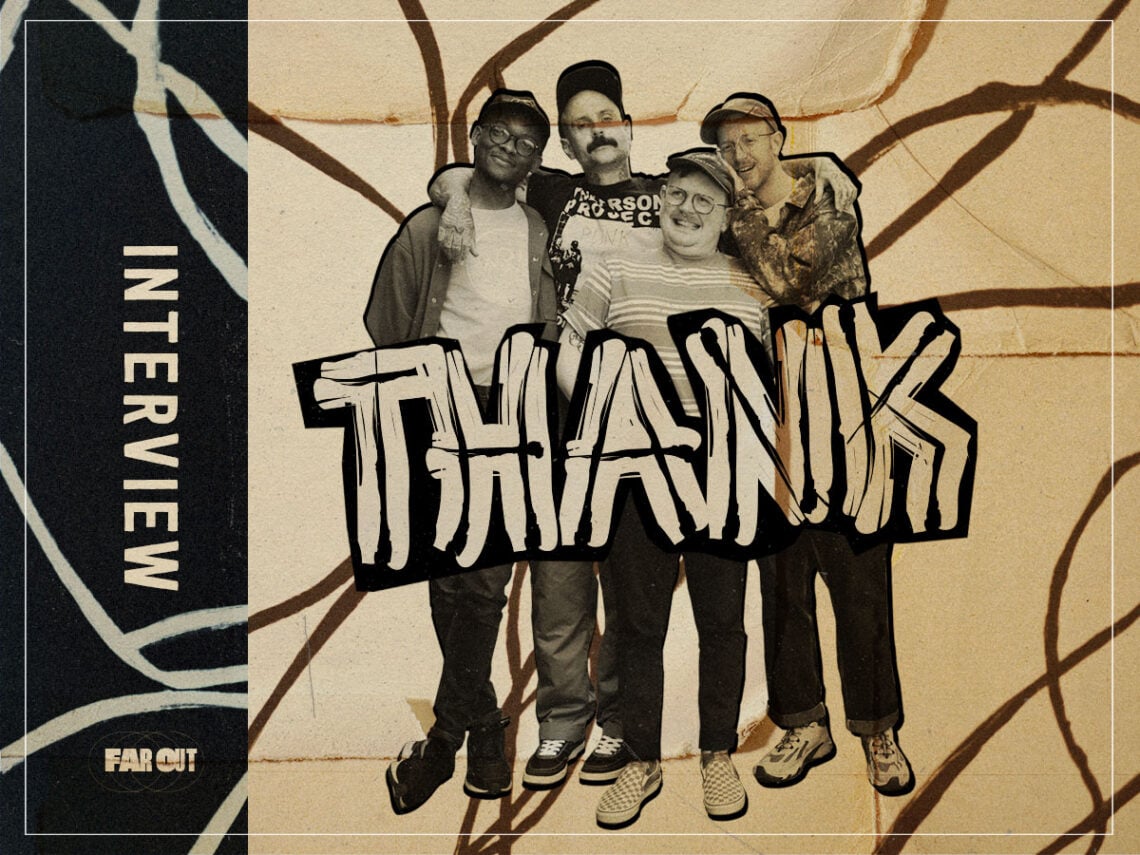
Do it badly: Discussing DIY scenes with Freddy from Thank

If you’ve been around the Leeds music scene for long enough, you’ll have heard whispers of Chunk. If you’ve been around a little longer, you might be lucky enough to be a part of the space, to have attended one of their club nights or, if you’re Freddy from Thank, to have whiteyed for the first time ever in that hallowed venue. Sitting in the suburbs of Leeds, the music cooperative was once a haven for local bands and creatives, serving as a practice space, a venue, and, perhaps most importantly, a site for DIY collaboration and community.
Chunk claimed to run on love and noise, and though neither of those factors ever ran dry, money eventually did. Like many similar spaces, the cooperative was forced out of its building due to the pandemic, but remnants of the community fostered on Meanwood Road still exist across the city’s music scene. And if you’ve heard of Chunk, you’ve probably heard of one of the space’s sonic offshoots, the rock band Thank from Leeds.
Fronted by Freddy Vinehill-Cliffe, Thank are as ingrained into Leeds’ DIY scene as the legacy of Chunk is. They’re also on the cusp of releasing a new album, another torrent of noise that shows off Vinehill-Cliffe’s playful lyrical prowess as well as their punky spirit. I Have a Physical Body That Can Be Harmed is set for release on Friday, November 8th, and it’s another product of the beloved DIY scene in Leeds and beyond, an album forged in dingy practice spaces and anarchist squat venues.
Freddy meets me outside of one of Leeds’ newer practice spaces, juggling two coffees and the keys to the building before showing me around. “It’s kind of convoluted,” he tells me when I inquire about his first steps into the DIY scene, “Which I suppose it is for so many people. It’s not like you turn up one day and you’re like, ‘Hello, can I have some punk music please?’”
Before he became an integral part of the DIY scene in Leeds, Freddy cut his teeth in his hometown of Halifax, renting out pub back rooms and scrounging music gear together to put on shows as a teen. At first, he thought that this DIY approach was out of small-town necessity, believing that promoters in bigger cities didn’t have to take the same route, but he has since grown to love it. “That’s part of the joy of it,” he states, “It being this muddled together community thing.”

The Thank frontman had read about 1980s punk and considered Michael Azerrad’s Our Band Could Be Your Life to be a “sacred text”, but it wasn’t until he stumbled upon a Pulled Apart By Horses demo on MySpace that he realised there were similar scenes so close to home. “The idea that the same stuff was happening half an hour down the road in Leeds,” Freddy remembered, “That was really exciting.”
While at university in Scarborough, Freddy began making connections within the Leeds scene, playing DIY shows put on by the likes of James Smith of Yard Act fame. Eventually, he and his bandmates opted to move back to West Yorkshire, where they began hearing those whispers of Chunk. “It seemed like most of the bands we were most excited about in Leeds were rehearing at Chunk,” he remembered, “We were like, ‘We want a piece of that.’”
The space was only in its infancy when Freddy’s old band, Pink Rick, inquired about joining, a request he believed he had butchered when he attended his very first lowkey gig at the venue. “The first time I ever went to Chunk is genuinely the only time in my life that I’ve ever whitied,” he remembers, part sheepishly and part fondly, “And I was so embarrassed. I’d had two pints and half of a joint.”
“There was signage everywhere, all over the building saying, ‘Chunk has a zero-tolerance policy for drugs’,” he remembered, “And I was just like, ‘Oh my God. They’re not gonna let us join. They’re gonna think I’m some kind of troublemaker, party animal who’s always on drugs.’” Fortunately, Freddy’s fears were soothed when Chunk allowed them to join the practice space, whitey and all.
“I guess, in a way, if you want to crystallize it to one moment, that was my introduction to Leeds DIY,” he jokes, “Turning up at Chunk to see Irk, Clenstch and Magnapinna and whiteying for the first and only time in my life, and then being convinced I was gonna be banned from the space. That was my real introduction.” Far from being banned, he soon became a vital figure in the scene surrounding Chunk.
Pink Rick didn’t last long, but it didn’t matter. “With Chunk, once you were in, you were in,” Freddy explains. The organisation and approach of the space, which he described as a sort of “melting pot”, was a breeding ground for creative cross-pollination. Practice rooms were unassigned, which meant members of all different bands could come together at the same time. And somewhere in between those practice sessions, Thank was born.
“The original Thank lineup happened because of Chunk,” Freddy recalls, “It was a band that started as a hybrid of two bands that rehearsed at Chunk. Steve, who now plays drums, we probably wouldn’t have gotten to know if not for the involvement in Chunk.” Although the space that spawned them no longer exists, Thank have taken up residence in a new DIY home on the outskirts of Leeds, largely made up of the same community that surrounded Chunk.
Learning from the chaos of their old space, which was run by around 35-40 members who all had equal say and equal responsibility — it took “fucking ages to get anything done,” Freddy quips — their new home has benefitted from the greater experience of those running it. “Because everyone’s a bit older, people have skills,” he explains, “Henry from Tormented Imp is a plumber. Ben from Votiv is a joiner. There’s all this stuff that, maybe ten years ago, when Chunk was first being set up a lot of people didn’t know what the fuck they were doing.”
“People have learned from what was good at Chunk and what was bad at Chunk,” Freddy acknowledges, “It’s a little bit of a passing of the torch in a way.” It’s also provided an opportunity for those who put in the graft at their old space to take a step back. Running a DIY space isn’t an easy task, in fact, it’s “really fucking exhausting” according to Freddy, but it’s also entirely worth the stress and sleepless nights.
“I’m sure it’s true for pretty much everyone involved in these kind of spaces,” he comments, “you wouldn’t do it if you didn’t love it.” There are many moments that have provided the Thank frontman with reminders of those driving principles of love and noise, including a packed out fundraiser for a new ventilation system, thriving regular club nights at Chunk, and even morning afters spent picking up rubbish from the night before.

“Often, the day after a big event, people would come down to help clean up,” Freddy remembered, “There’d be 20 people mopping the floors and picking up all the empty cans and bottles, rearranging the building back to how it needed to be for people to start practicing again. It was often a slog, but that was a beautiful thing. It was purely people just coming down for the good of the space. ‘Oh yeah, I’m really hungover, but I’ll come down for a few hours and tidy up.’”
“The joy of it absolutely does outweigh the exhaustion,” Freddy affirms, “It’s just hanging out with extra steps.” It’s hanging out with extra benefits for noise fans, too. Thank wrote their first album during the pandemic, which meant they couldn’t be in the same space. Plus, after the loss of Chunk, they didn’t have a space to go to. This time around, the noise-rock outfit had secured their place in a new DIY space, which Freddy believes was integral to the creation of I Have a Physical Body.
It’s not just the chance to work together in person that has informed the direction of their new record. It’s also the element of community, the presence of other artists around them. Although they have their own room in the space, there would be bands practicing around them while they were writing, from grindcore projects to hardcore. “You pick up on some of that via osmosis,” Freddy suggests.
Lyrics about woke Frasier and pushing through imposter syndrome collide with Dead Kennedys-inspired riffs, groovy drums and punchy synths, and it almost feels like you’re right there with Thank, rehearsing your own project in the room next to them as they forge punk and noise music out of love. “Being around people making all different iterations of punk music really did influence it,” Freddy acknowledges, “I would say that the new record feels a lot more like a punk record, and that’s probably because of where we’ve written it.”
Leeds isn’t the only DIY scene with some bearing on the new album. Touring and testing out new material on the road was also essential to the writing of I Have a Physical Body, particularly gigs played in spaces like those they’re so familiar with. The band played shows on the squat circuit in France, which Freddy believes was particularly influential on the new record. “To me, at least compared to the first record, it feels like it’s got an anarcho-punk vibe,” he shrugs, “Whether it does, I don’t know.”
After they penned the album in their new, permanent practice room, they took it over to Scarborough to record with close collaborator Rob Slater, who plays in Carpet and previously took up drums for the band. The studio they recorded in was run by an old tutor from university and held much of the same gear as Greenmount in Leeds, so they felt right at home — and not just because they were living in the flat above.
“It was a nice combination of being in this new space and really living inside the record because we were all just there living in the flat above for a week,” Freddy remembers, “But at the same time, the familiarity of working with Chris and with the same gear, just in a bigger space and slightly better maintained.” The result is an album that sounds bigger and more band-like than their previous record but still contains that intrinsic Thank quality.

It also feels like a record that could transcend the cult following that Thank have built around Leeds, pushing them further into noise rock renown. The scene has produced some of the most exciting rising stars in guitar music over the last few years, including post-punk outfit Yard Act and Mercury Prize-winning art-rock aficionados English Teacher, both of which Freddy proclaims to be a fan of.
“Post War Glamour Girls, the band [Smith] was in before Yard Act, were not a grimy, anarcho-punk band playing this in squats and stuff, but they were pretty DIY,” the Thank frontman remembered, “He was very much like part of the community coming up. When I was still in Scarborough, he booked DIY shows for my band and brought us over a couple of times. He’s put in his time; he’s paid his dues.”
“I think like DIY or die is a fun slogan,” he continues, “And in some ways, I agree with it. There’s some stuff that I would only ever want to do DIY, and I’m very suspicious of certain aspects of the more corporate side of the music scene. But at the same time, who am I to criticise someone for making a living off of it? I would, if I could. I’d love to not have a day job.”
As far as up-and-coming Leeds bands go, Freddy shares his excitement about The Oidz, an egg-punk band whose frantic Google Drive link of demos has been circulating around the scene, as well as Cobblestoning, a concept project about the artist’s experience of Crohn’s disease. “What else do I like?” Freddy asks himself, “Just like music, man. I just like music.”
As our conversation comes to a close, I ask Freddy if he has any advice for kids hoping to take their own first steps into the DIY scene, whether it’s setting up a practice space, a venue, or just attending gigs. “Start going to stuff,” he shrugs, “If you want to get involved in your local DIY scene, start going to local DIY shows. It can feel intimidating at first, but you will find nine times out of ten that everyone is really friendly and welcoming.”
And if there isn’t a scene that already exists in your city, the Thank frontman echoes the ethos of Death By Audio, imploring you to start one. “Get a shit PA, book out the back room of a pub, invite all your mates, and then you’re doing it. You’re doing DIY,” he states, “And that might balloon into something bigger. It might pollinate into a scene. You might also find that no one is interested. If that’s the case, then tough shit.” In other words, do it badly.
