


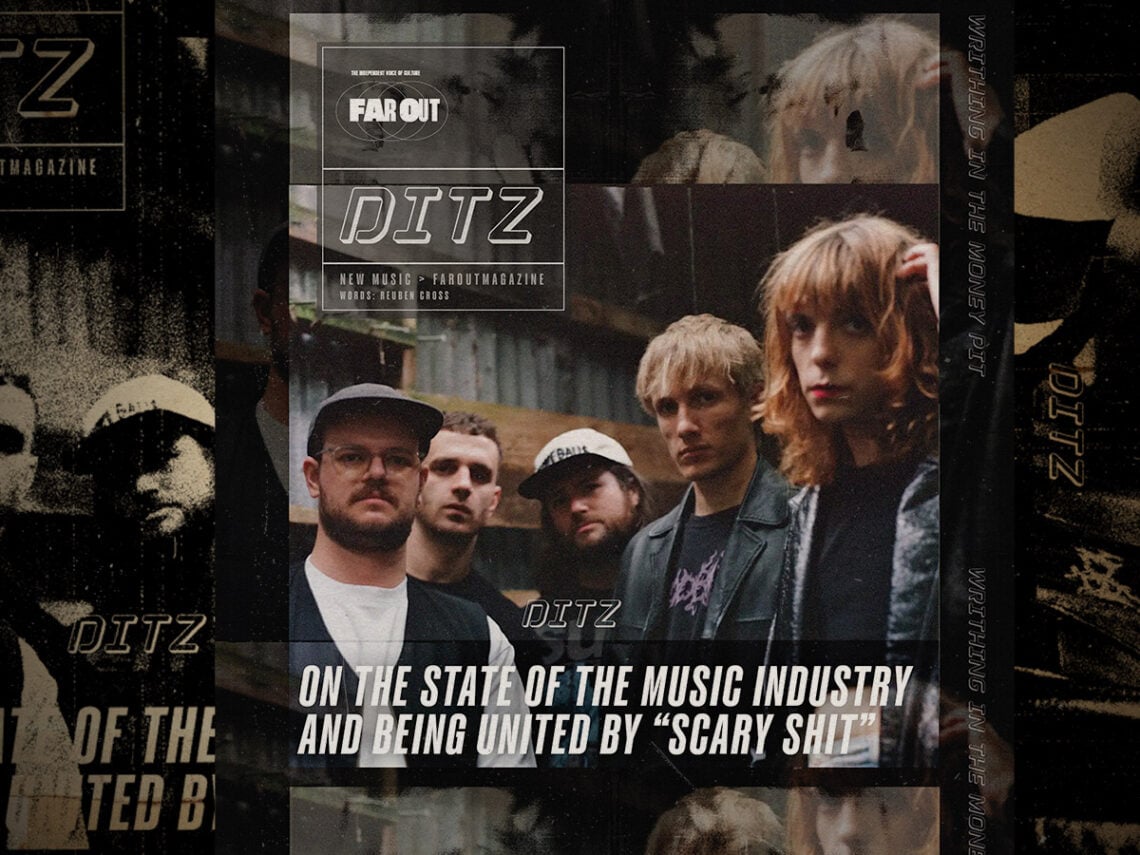
Writhing in the money pit: DITZ on the state of the music industry and being united by “scary shit”

“I’m afraid it’s a bit of a shitter. It’s freezing cold, and the wi-fi doesn’t work very well,” DITZ guitarist Jack Looker informs me as we exchange pleasantries over Zoom. The conditions he describes don’t exactly paint the most welcoming picture of the venue they’ve just arrived at in Stockholm, Sweden, but after explaining to me that they’re situated in a warehouse adjacent to a former abattoir that still reeks of pig skin, his complaints seem a little easier to understand.
Nobody told Brighton noise-rockers DITZ that the rigorous touring schedule that they signed up for would be more glamorous than this, but their description of the less-than-charming environment they called to chat from is something that all touring acts of a certain stature can relate to. If we’re to look at the positive side, they were gearing up to perform at an 800-capacity venue outside of their home country as part of a lengthy European tour, but the underlying takeaway of this opening exchange is that being in a band isn’t all as alluring as some make it out to be.
Still, DITZ have carved out a reputation as one of the most formidable bands in their niche over the past few years, largely thanks to their relentless commitment to life on the road. Despite their growing profile, they remain one of thousands of acts who can’t yet call this their full-time job. Balancing the band around other necessary income is a constant challenge. Drummer Sam Evans admits that the fact their second album, Never Exhale, even came together under these circumstances was staggering—even to them.
“It’s a bit of a miracle that we were able to get that down whilst doing these crazy tour schedules and working,” Evans claims. “But I think because we were touring so much, it was easier to be away with each other with all our instruments. For instance, if we had a day off, it’s a bit easier in that sense.” Looker also hails the fact that having friends dotted around the continent has helped in this sense, informing me that the song ‘Taxi Man’ was written in Cologne at a rehearsal space recommended to them by friends.
This network that they’ve established has ultimately been a saviour for the band, but the music industry turbulence that is being felt around the globe, especially in the UK, is still another major stumbling block that troubles them on a regular basis. The conversation rapidly moves onto the recent comments made by Kate Nash in a bid to reinvigorate the grassroots music scene in the country, which Evans is quick to praise.
Explaining, “A lot of the things that Kate Nash is saying at the minute about the music industry, I feel like it’s true down the line. It doesn’t matter what sort of band you are or what level, there’s still no money in music for UK bands, and there’s no support for it, so it’s hard to do creative things when we have to work and we are paying stuff ourselves a lot of the time.” Speaking on a more personal level, he referred back to the issue of having to balance his life outside of the project with that of the band, saying that “a lot of the difficulties came with having to ram a work schedule as busy as you can, and then take time off work to do that.”

With expenses piling up for the band in all regards, this meant that the recording process for Never Exhale felt dramatically different to that of their first album, The Great Regression, which was done during the easing of lockdown restrictions. “It felt like recording was the most expensive rehearsal session we’ve ever done,” Looker recalled of the sessions. “The first album was a lot easier because we could sit down and rehearse together when we were allowed to, and there were no gigs, so we weren’t touring our asses off. This one, it was like, tour, learn the songs playing on the road, and then come back. Some of the songs we’d not even played together before – they were only semi-learned.”
Since the band spends a large amount of its time touring in Europe, a number of the solutions that it offers are taken from initiatives that it’s witnessed on the continent to help independent bands earn a worthwhile wage from their artistic endeavours. Looker’s first suggestion is to look at the efforts of countries like France for inspiration on how to mitigate this crisis through state funding.
“Some bands get paid a salary just to be in a band,” he says, bewildered by the lack of support coming from our own government. “We got PRS Foundation funding for the first album which helps, but we still had to sink a grand each from our own pockets into it. It is just a money pit. It always seems to be at the detriment of the person creating the art.” Evans notes the knock-on effect of constantly working and touring to make ends meet, contributing to an additional crisis in mental health. “It’s easy to see why so many bands split up if they’re working and why you see so many bands do well if they’re in a position where they have money and time to create.”
On a more positive note, the tone shifts towards how the band have managed to have a positive impact on the continent and has made an impression on fans in neighbouring countries. Evans tells us about Nico, a friend of theirs from France, who was inspired to make a dramatic career change from software engineering to music due to having witnessed DITZ play some of their first Paris shows. Looker still can’t believe that his band have managed to stir something in an individual to the point that they abandon the safety of a career to pursue the arts, but is thrilled by it nonetheless.
“That was the first moment for me when I realised that maybe we’re not just a bunch of idiots in a band,” he recalls of their first encounter with Nico. “He had a really good job getting paid loads of money and decided that he didn’t want to do that anymore and wanted to be in a band or work in music, which I think we told him was a stupid idea.” As a Frenchman with access to far more support than a British band is able to get, it has luckily ended up paying off for him, and he’s now enjoying life working at Supersonic, a venue in Paris, while also performing in his own band.
Nico’s origin story has a number of parallels to the tale of how DITZ formed, experiencing their own eureka moment at a gig featuring both METZ and Lightning Bolt way back in 2015. Still seeing some of the bands that they formed over a love of while on the road is something that they collectively see as a full-circle moment, and Evans points out that Nico will be having a full-circle moment of his own during this touring cycle. “He’ll be there at our Paris show,” he informs me, “And his band will be supporting.”
Aside from the doom and gloom of being an act struggling to ascend the ladder in the music industry, it felt wrong not to be asking about DITZ’s triumphant new album, Never Exhale, in more detail. While the band admit that the music was a continuation of what they’d done on their previous release, the visceral lyrical themes delivered by vocalist CA Francis were one of the most entrancing elements of the record. Sliding into view having spent the majority of the interview off-camera, they were willing to dive further into what prompts their emotional dives into the darkness.

“I write a lot, and then these guys write something, and then I have to find something from what I’ve written that matches the music,” Francis explains, favouring the stream-of-consciousness approach to express their stark imagery. “I really like writers that just fucking flow on,” they tell me in an effort to justify this approach.
While the surrealness of the lyrics matches up brilliantly with the abrasion that the rest of the band delivers, they were keen to inform me that not everything emerges from the depths of despair. “You don’t see all the romance novels that I’ve written, they just didn’t fit to a Jack Looker riff.”
However, the pursuit of generating the most vivid imagery is what fits a Jack Looker riff and is what DITZ is applauded for delivering. “The strong physical metaphor is most striking way you can interpret any sort of emotion,” Francis proclaims. “Each line is part of a collage that is the whole picture of the song, and it’s just trying to come up with the strong physicality of whatever it is that’s trying to be illustrated.”
The one downside to Francis’ methods is that they’re often left with a surplus of material that it isn’t possible to work with, and combing through reams of block text for the perfect line leads to there being an inevitable cull that they have to confront. “There’s probably a thousand other DITZ songs that haven’t got any music to them,” they insist, “And there’s also probably a thousand that have been binned in the process.”
The surreal, cerebral and challenging elements of DITZ as a group are ultimately what have kept them together as a unit for a decade, and the thought of the alternative option of being in a band is simply not worth considering as far as they’re concerned. “We like weird shit, we like scary shit, we like to feel a little bit uncomfortable, and I guess we just like transgressive art,” Francis believes. “We’re a pretty diverse group of people, and that’s sort of the one thing we all definitely have together. That and a beer.”
Plenty of scary shit and beer is high on the agenda of a DITZ tour, and no matter how difficult things get for artists at the base of the ladder, you kind of expect an act like DITZ to still be here after another decade, no matter how things fare for them in the meantime. “If we packed it all in and got normal jobs,” Evans staunchly remarks, “That’s so much more depressing for me. The state of the world is a shit show, and to work and not be creative while that’s going on is way worse. We do this because we love it.”
