


“Distorted and vulgarised”: when Alfred Hitchcock substituted California for Cornwall

These days, it’s common for British actors and directors to make it big in the United States, but it hasn’t always been the case, with it being quite difficult for talented Britons to make it across the pond.
Of course, the changing nature of the world has helped break down the barriers, but there are also a number of individuals we have to thank for paving the way, and one of the earliest examples of this sort of transatlantic success comes from none other than Alfred Hitchcock.
Born and raised in Leytonstone, now in east London, Hitchcock broke into British cinema as a title card designer, achieving his destiny with the release of his first feature film, 1926’s The Pleasure Garden. His revolutionary approach to filmmaking ushered in all sorts of conventions, including the first use of synchronised sound in a European picture, and it was only a matter of time before Hollywood caught wind of what he was doing, finally calling him up in 1939.
The first movie he made following his move to America was Rebecca, adapted from the Daphne du Maurier novel of the same name, starring Joan Fontaine as the wife of Maxim de Winter, a wealthy landowner played by Laurence Olivier; actually, read that as ‘the second wife’, for the spectre of the first Mrs de Winter (the eponymous Rebecca) haunts this new union, with the second Mrs de Winter, who is never referred to by name, living in the shadow of her perfect predecessor, which drives her into a state of madness.
Rebecca was produced by the great David O Selznick, who had been the one to sign Hitchcock to his first Hollywood contract. You’d think he’d trust his new hire to make a movie on his own, but you thought wrong, as according to the producer, Hitchcock’s first draft of the movie was “a distorted and vulgarised version of a provenly successful work” in which “old-fashioned movie scenes have been substituted for the captivatingly charming du Maurier scenes” (according to du Maurier’s official website).
Selznick reportedly told his director, “We bought Rebecca, and we intend to make Rebecca,” which the great man didn’t take well.
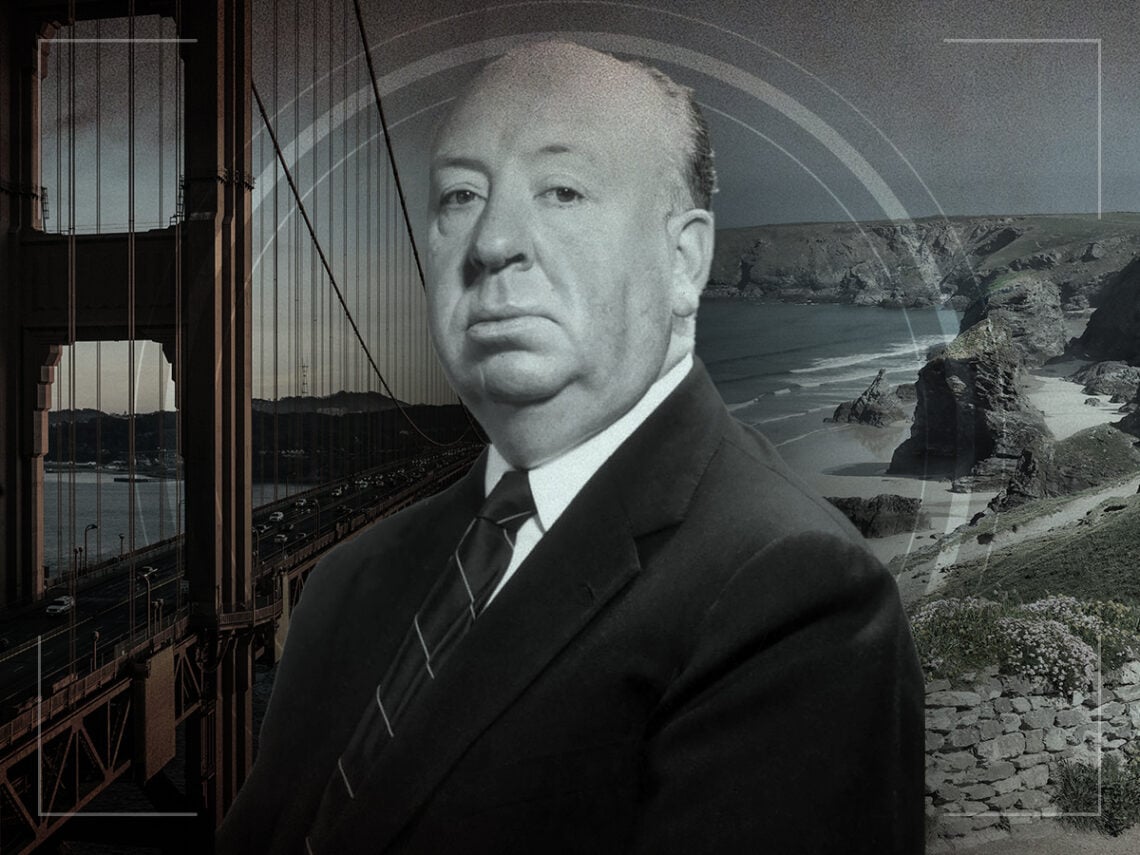
The story is set on the grounds of de Winter’s estate, Manderlay, a grand mansion on the Cornish coast. However, as Hitchcock was now based stateside, he had to find a suitable substitute, and while most of the interior shots were filmed in a studio (the same studio in which Gone with the Wind was filmed, no less), most of the exterior action was filmed in California. The director replaced the British beaches with ones just outside of Los Angeles, while the Del Monte region of the ‘Golden State’ made up the grounds of Manderlay.
Hitchcock might not have liked all of this meddling, but it paid off in the end, as Rebecca was a huge hit both financially and critically, earning ‘Hitch’ his first of five ‘Best Director’ nominations at the Oscars, while Selznick walked away with the statuette for ‘Best Picture’.
The ‘Master of Suspense’ remained in the US for the next several decades, eventually returning to the UK for the last eight-or-so years of his life.
