


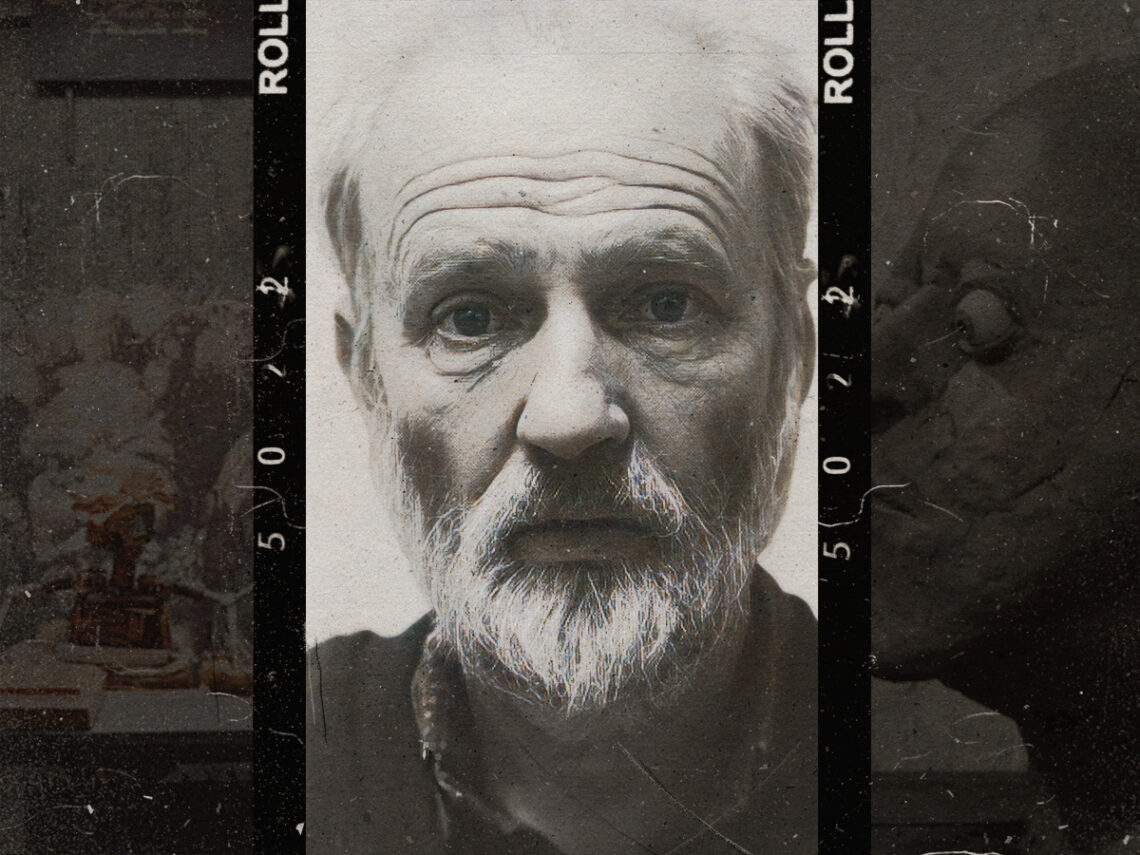
Dissecting the meaning behind the stop-motion oddities of Jan Švankmajer

The stop-motion cinema of Czech innovator Jan Švankmajer is unlike any other. Stiff and robotic, yet free and liberating, his short films and feature-length projects breathe with unfettered originality, where clay heads are smushed to a rough paste, infant tree roots wail with deafening cries and surrealism is extracted from the nonsense of everyday existence.
Such an interest was sparked at an early age, when Švankmajer was gifted a puppet theatre during a cold Christmas in Prague, kick-starting his love for practical stop-motion movies. This would lead him to study in the Department of Puppetry at the Prague Academy of Performing Arts, where he would work with the acclaimed animator Emil Radok on the 1958 film Johanes doctor Faust.
Such theatricality was displayed in his own short film debut, 1964’s The Last Trick, as well as the 1966 stop-motion oddity Punch and Judy, which brought his early passion for puppets to cinematic life. Almost inevitably, due to the creative flair he was already injecting into his projects, these theatrical shorts soon became increasingly more surreal, with 1968’s The Garden sharing more similarities with Švankmajer’s wonderfully bizarre classics.
Bringing meaning to the banal moments of life, Švankmajer thrives when making use of the domestic setting, with random objects from around the house being used as key parts of his own shorts, making magic from everyday life where each item becomes infused with its own unique meaning. Surreal, terrifying yet also undeniably comical, Švankmajer’s films move with an over-exaggerated rhythm, feeling like a gift from another realm of existence entirely.
As his form continued to grow and his films began to grow ever more complex, Švankmajer’s interests somewhat switched, with his movies in the early 1990s holding an innately political edge.
“I would like to say that I consider all of my films to be very politically engaged,” the director stated in an interview with Animation World Magazine in regards to his 1991 film The Death of Stalinism in Bohemia made whilst Czechoslovakia was attempting to break away from the USSR.
Continuing, he added: “I never narrowed it down to a totalitarian system, the way, for example, the artist dissident would. Because I realize that civilization does allow for the creation or existence of something as sick as Fascism or Stalinism, then the entire civilization itself is very ill, something is wrong. I always wanted to penetrate the core of this problem. Not to just concentrate on the very surface of political activity”.
Švankmajer followed this up with the short film Food, a more commercially enjoyable movie that still maintained a political energy, discussing the monotony of the workforce and the unjust social order that keeps society in order.
Speaking about the relatability of his films, he adds: My films are universal, they can communicate with audiences outside of the Czech Republic. So, just because the political situation changed in Czechoslovakia, doesn’t mean that the universe or the civilization changed at the same time. As far as I was concerned, there was no reason to change my enemy. It will always be the same”.
