


The five most disastrous expeditions into the unknown

History is littered with examples of catastrophic expeditions. For as long as humanity has sought to map the earth, it has been venturing into the unknown. Some have sought knowledge; others have been driven by a desire to prove their mettle. Almost always, however, these expeditions have served to benefit that most potent of historical motivators: imperial expansion.
Alas, even the most powerful Empires are no match for the frozen arctic winds or the Atlantic Ocean’s tumultuous churn. In environments like these, a single mistake can cost the lives of an entire crew. Time and time again, a combination of poor planning, poor supplies and poor leadership has made meat of men.
Here, we’ve bought you a list of some of the most disastrous expeditions throughout history. While the sad fates of many of the adventurers on this list were the result of hubris, that in no way diminishes their bravery or the scale of their undertaking. That being said, there are numerous lessons we can learn from the stories below, the most obvious being: never take a hot air balloon to the Antarctic. I mean, duh.
The five most disastrous expeditions
The Abubakari Expedition (c. 1311 CE)
Our first entry takes us back to fourteenth-century Mali, where Mansa Musa the ruler of the Mali Empire, is preparing 200 ships for a voyage to discover the furthest limits of the Atlantic Ocean. 100 of these are carrying his man, with another 100 carrying gold, water and supplies.
All but one of the 200 ships disappeared without a trace. When asked what news they brought, the captain of the surviving ship is said to have told Mansa’s successor: “O Sultan, we travelled for a long time until there appeared in the open sea [as it were] a river with a powerful current. Mine was the last of those ships. The [other] ships went on ahead but when they reached that place they did not return and no more was seen of them, and we do not know what became of them. As for me, I went about at once and did not enter that river.”
Rather than accepting defeat, the Sultan prepared 2,000 ships: 1,000 for himself and his men and another 1,000 for water and provisions. What became of that vast fleet is unknown, though some have argued that the expedition may have been successful and led to the discovery of the Americas centuries before Columbus.
The Australasian Antarctic Expedition (1911)
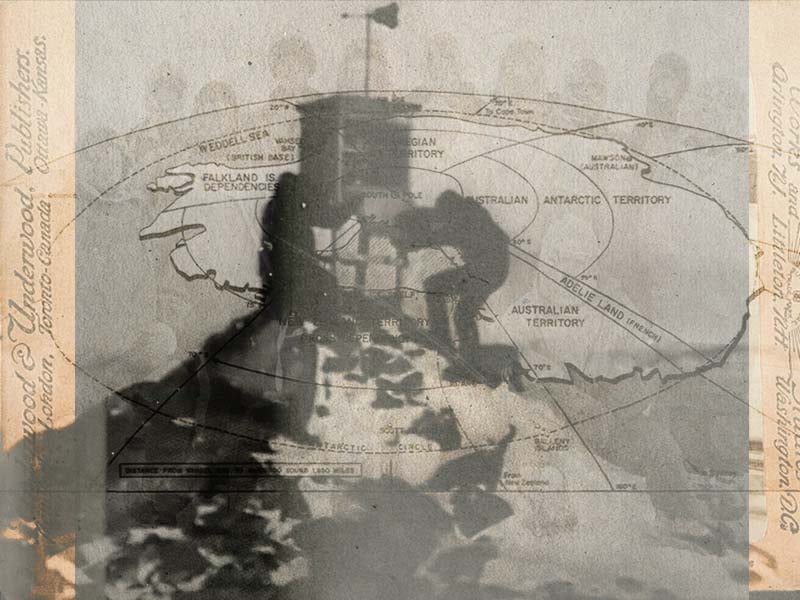
Most of you will have heard of Captain Scott’s failed mission to the South Pole, an expedition made all the more tragic by the success of his rival, Roald Amundsen. Less of you, however, will have heard about the third polar expedition going on at the same time.
By 1910, Douglas Mawson, an esteemed Australian academic, had developed such a fearsome reputation as an explorer that he was invited to join Scott’s Terra Nova expedition. Possibly spotting something rotten in the heart of Scott’s plan, he turned down the offer – embarking on his own trip to a remote portion of Antarctica in 1911. On arrival, he and his team mapped the land and conducted various scientific studies. However, when Mawson led a small party away on a trip away from base camp, things took a turn for the worse.
With a pack of 16 dogs and two companions (Xavier Mertz and Belgrave Ninnis) for company, Mawson set off on November 10th, 1912. After weeks of walking through snow and ice, Ninnis fell into a crevasse and was killed, taking most of the group’s supplies with him. Mawson and Mertz were forced to eat their dogs to survive, though Mertz didn’t last long. After walking over 100 miles across Antarctic wilderness, Mawson arrived back at base camp having ripped away the soles of his feet.
Franklin’s Lost Expedition (1845)
In the 19th century, European explorers were racing to discover the Northwest passage, a route which theoretically ran between the Atlantic and Pacific Oceans – passing through the Arctic Ocean and Canada on the way. The most legendary (or all the wrong reasons) of these explorers was Sir John Franklin, who, in May 1845, set out with a fleet of two vessels, the HMS Terror and the HMS Erebus, to locate the foretold passage. Neither of the ships nor the 129 men aboard them survived.
Franklin was one of the first to die, possibly succumbing to pneumonia in June 1847. Most of the crew remained alive until the Spring of 1848. Shortly after, a search party sent to retrieve the ships found three of Franklin’s men on Beechey Island. In 1859, further remains were found on King William Island.
Scurvy, malnutrition and lack of medical supplies all played a part in the expedition’s tragic outcome, though later analysis of bones revealed evidence of cannibalism. That’s right: they ate each other to survive. The ships remained lost until 2014, when the HMS Erebus was discovered in Queen Maud Gulf in Canada. The Terror was found in the same waters in 2016.
The Percy Fawcett Expedition (1925)
Those of you who have watched James Gray’s brilliant film The Lost City of Z will know all about Percy Fawcett’s tragic final expedition. Unlike most of the entries on this list, Fawcett’s trip was not a failure because of poor planning or lack of expertise. To give you an impression of just how dangerous his journey was, it’s estimated that over 100 people have died attempting to find out what became of him.
After many trips to Brazil, both for the National Geographic Society and independently, Fawcett developed a theory about a lost city that he called “Z”. After serving in Flanders during the First World War, he returned with his eldest son, Jack, for another exploratory expedition. Joined by Percy’s friend Raliegh, the trio travelled to the Mato Gross region where they believed the city would be located. Sadly they did not return.
Most people believe they were killed by one of the hostile tribes in the area. In 2005, a New York Times writer visited the Kalapalo tribe and learned that Fawcett had been the first white man the tribe had ever seen and that an oral account of the meeting had been passed down from generation to generation. Apparently, they told him to avoid a certain area where a fierce rival tribe were said to dwell, but he insisted on going anyway – driven by an unflinching need to locate Z once and for all.
Solomon Andrée’s Arctic balloon expedition (1897)
If you’re looking for the real-life Phileas Fogg, look no further than Swedish aeronaut Solomon August Andrée. In 1897, he set off on a trip to the North Pole from the Svalbard archipelago in – wait for it – a hot air balloon. Though Solomon’s ambitions were lofty, his ballon, sadly, was not. It remained in the air for just ten hours before suffering a number of collisions with the arctic surface. After piloting the craft for 41 sleepless hours, Solomon landed safely, at which point he and his team began to make the return journey – on foot.
Andrée had put so much emphasis on the balloon’s success that he was very ill-prepared for a journey across Arctic terrain. Not only was his sledge completely useless, but his food supplies were minimal and his clothing ill-suited to the freezing temperatures.
After two months of traipsing across the ice, he and his two companions somehow made it to a remote island called Kvitoya in the east of Svalbard. Two weeks later, all three men were dead – having ingested parasites from the polar bears they’d been shooting and eating to survive. Their bodies weren’t found for another 30 years.
