


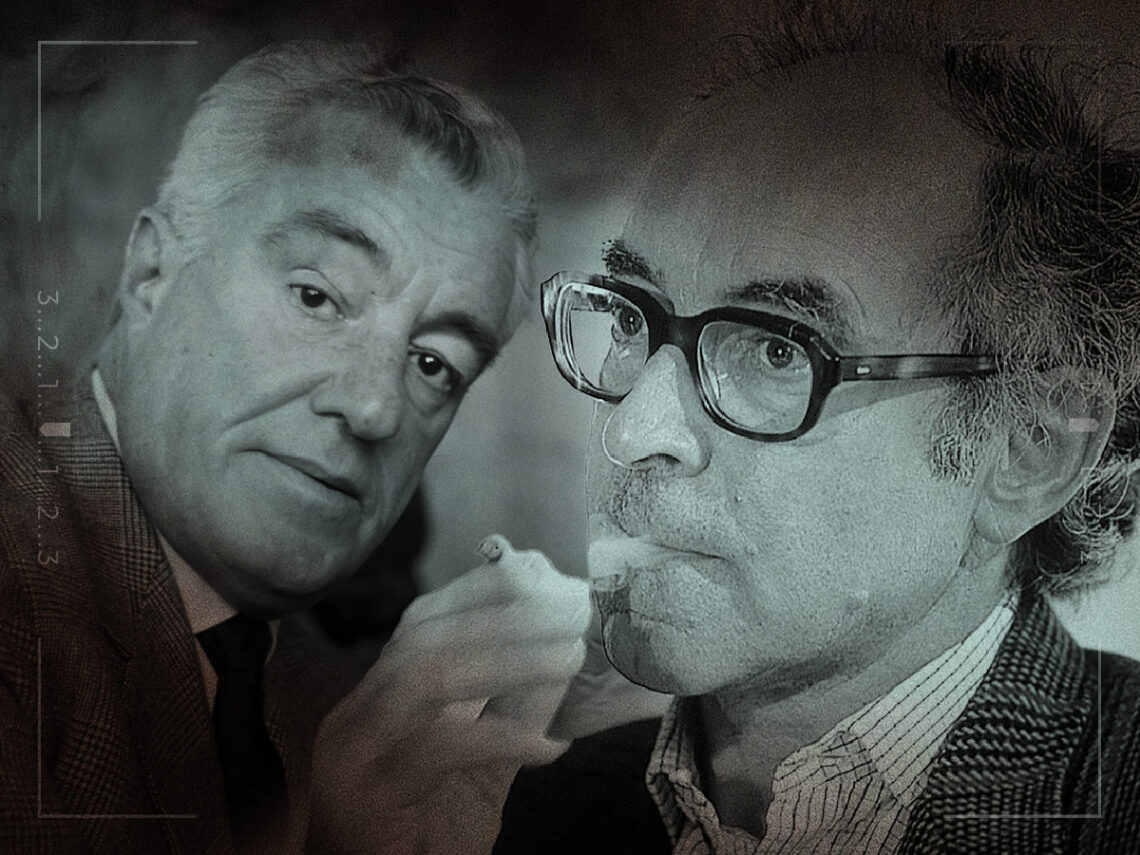
Why Vittorio De Sica accused Jean-Luc Godard of accidentally ruining cinema: “Imitation is deplorable”

When you think of who could be accused of ruining cinema, especially by one of the medium’s greatest masters, a few names come to mind.
Michael Bay is uniquely bad for the art form. Stan Lee inadvertently contributed to the downfall of Hollywood the moment he put pen to paper. And Ted Sarandos has done more to butcher the big screen experience than just about anyone.
But in the eyes of Vittorio De Sica, the Italian neorealist pioneer who gave us such landmark films as Bicycle Thieves and Yesterday, Today and Tomorrow, the guilty party has nothing to do with cars turning into robots, comic books, or streaming (he died in 1974, after all). Instead, the object of his displeasure was a fellow European arthouse darling.
In the book Encountering Directors, journalist Charles Thomas Samuels included a conversation he had with De Sica in which the director opined about the unintended consequences of originality. “Godard is a master, a totally personal artist, but the inventor of the New Wave,” he said. “He created followers, imitators, and imitation is always deplorable.”
There is no question that Jean-Luc Godard influenced generations of filmmakers, because his films, including À bout de souffle, Bande à part, and Pierrot le Fou, created a new kind of cinema – one that could feel spontaneous and unconstrained by plot or form.
He used editing as another channel of creative expression – jump cuts kept audiences on their toes, while the use of handheld cameras made viewers feel as if they were out in the streets of Paris with his characters, watching the world unfold without a destination.
Not surprisingly, this revolutionary take on the medium inspired other filmmakers, and whether or not they are trying to make explicit parallels between themselves and the French master, countless directors have referenced his work over the decades – everyone from Martin Scorsese to Kelly Reichardt has drawn on his work, demonstrating just how completely he unlocked cinema and demonstrated its possibilities.
That said, he was not a truly original filmmaker. No one is. In fact, he made many direct references to other movies, including the Humphrey Bogart noir The Harder They Fall, Nicholas Ray’s western Johnny Guitar, and Sam Fuller’s western Forty Guns. He even explicitly stated that imitation was something to be celebrated, not deplored. “It’s very good to steal things,” he said once. “Bertolt Brecht said art is made from plagiarism.”
It’s highly likely that he would have disagreed with De Sica, even though he would no doubt have been flattered by the Italian director’s praise. Godard was more than happy to admit that cinema is about iteration and transformation rather than invention. Orson Welles was a devout follower of John Ford and DW Griffith, after all, and John Ford was in turn inspired by the western painter Charles M Russell.
No art is original. Even De Sica’s work was arguably just copying real life, because he made his films feel so hyper-real that they struck a chord with viewers from all swathes of life, not just the ones he depicted – perhaps he should have been more specific by condemning filmmakers who imitate Godard without layering their own creativity on top. He would have had many examples at his disposal.
