


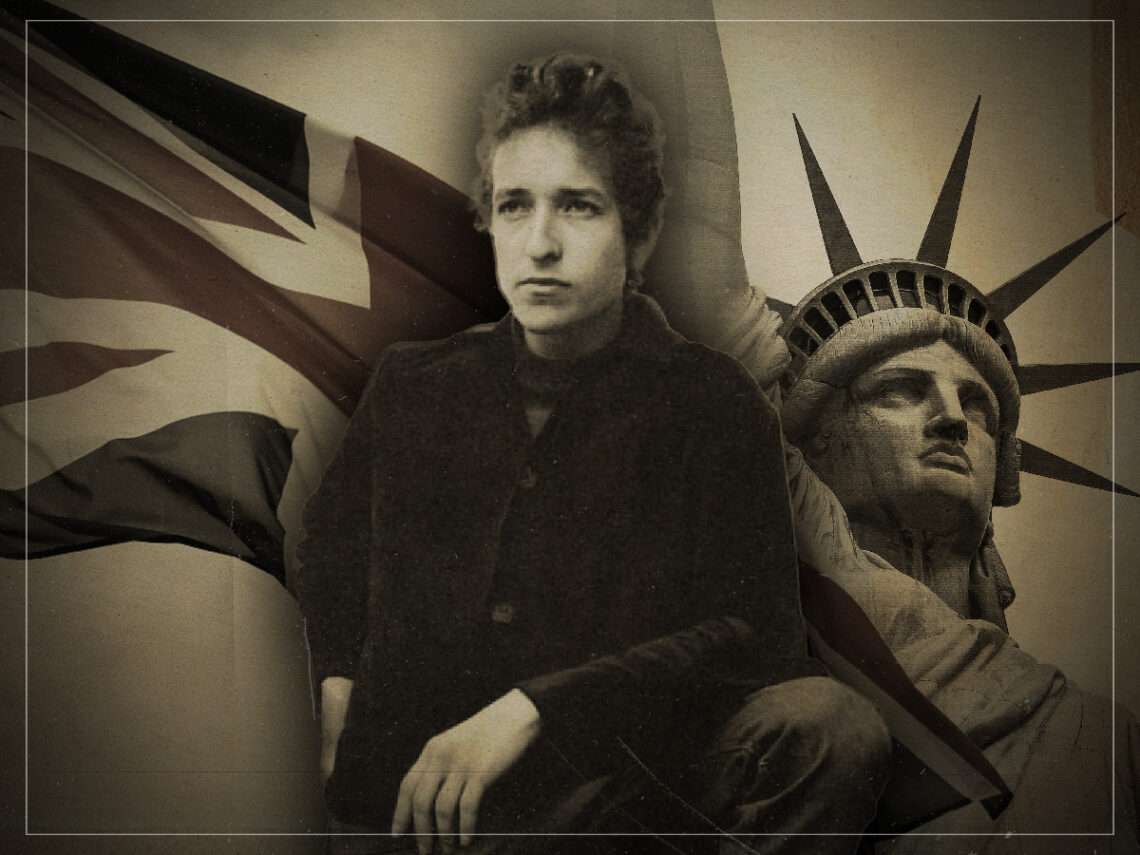
“I shall be free”: Did the British invasion help Bob Dylan navigate US politics?

Regardless of the legacy Bob Dylan has crafted over the years, the artist maintains that he isn’t and never will be the voice of his generation.
It’s one of the things that makes his music so compelling. As someone who is too often hailed as his generation’s mouthpiece, Dylan frequently calls out the absurdity of such a claim and pokes fun at those who position him as someone who is above everyone else, not just musically but in terms of his own sociopolitical views, too.
This was especially prominent in Dylan’s early years – many of those songs that set him apart from his peers blended real-world issues with his own personal experiences and musings, giving him a unique voice that saw the world and all its faults through an endearing lens of whimsy, and quite a few of his best songs ultimately became anthems, capturing the spirit of an entire era with their cultural resonance, allowing people to place themselves into his stories.
This is also one of the reasons why Dylan’s songs became anthems in the first place – he never intended them to become as such; he simply reflected his own personal afflictions during a time of great change. And many of the industry’s greatest voices at the time knew that attempting to create something greater than themselves at the time was one sure way to complete failure.
As Joan Baez once said, it’s “impossible” to write an anthem because it’s all to do with the “universality of time and space”, and achieving such a feat is usually more organic than actively trying to pander to all its requirements. As such, many of Dylan’s songs simply became anthems because they were real and unique at the time, reflecting Dylan’s own trials and tribulations as he navigated the political landscape around him.
Much of this, as we’ve established, was navigated by making light of his own reputation. In ‘I Shall Be Free No 10’, for instance, Dylan starts by joking about those who see him as some sort of all-powerful force of music and unity, claiming that he is “average” and “common”, just like everybody else. “I ain’t different from anyone,” he sings.
“It ain’t no use a-talking to me / It’s just the same as talking to you.”
His tongue-in-cheek self-deprecation continues as he talks about being a “poet” but hopes he doesn’t “blow it” – an awareness he’s never displayed anywhere else – and reveals facets of his political positioning by saying he is “liberal to a degree” and that he wanted “everybody to be free”. Other political and cultural references in the song include Muhammad Ali, Conservative Senator Barry Goldwater, and the space race between the US and “the Russians”.
This stream-of-consciousness sees Dylan trying to figure himself out while attempting to make sense of the world around him, while his playful, comedic remarks signal someone who isn’t so much interested in finding out the answer as pointing out how silly it all is to ponder. And by the end, he seemingly brushes the entire piece off by highlighting its own lack of meaning with a nod to the ripples of the British invasion over in America.
“Well, you’re probably wondering by now / Just what this song is all about,” Dylan sings. “What’s probably got you baffled more is what this thing here is for / It’s nothin’, it’s somethin’ I learned over in England”.
By this point, Dylan makes it clear that he’s not trying to say that much. But that acculturation, including that caused by the rising British invasion, made him rethink parts of his own cultural identity and what it meant for the American landscape, even if none of it means anything at all.

Never Miss A Tale
The Far Out Bob Dylan Newsletter
All the latest stories about Bob Dylan from the independent voice of culture.
Straight to your inbox.