


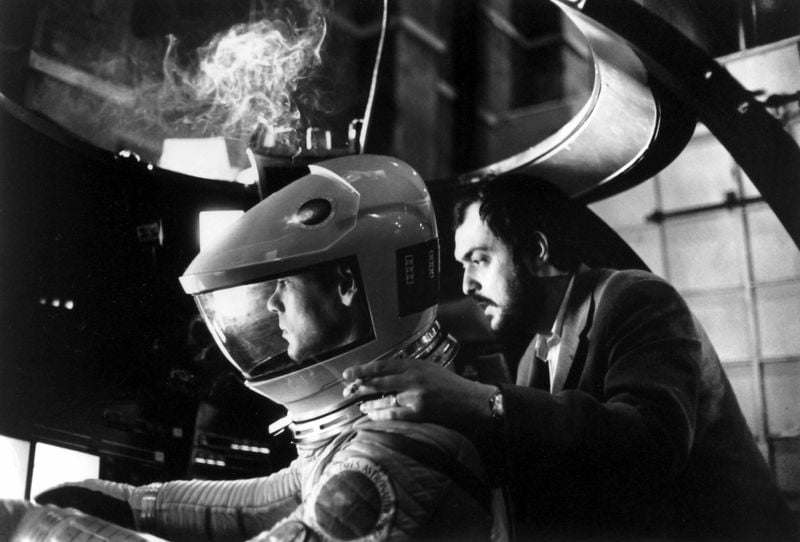
Did Stanley Kubrick fake the moon landing?

The American visionary Stanley Kubrick was such a staggering innovator that many die-hard fans put the filmmaker on an incomparable pedestal. Moreso than the likes of Martin Scorsese, Quentin Tarantino and Paul Thomas Anderson, Kubrick was a remarkable artist whose eye for detail went unmatched for several decades, creating multiple classics from 1953 till his untimely death in 1999.
Shortly after the release of his third feature film, and the first to get considerable critical praise, 1956’s The Killing, Kubrick began to gain traction as one of America’s most promising filmmakers. Releasing the WWI drama Paths of Glory to cap off his 1950s movies, Kubrick followed this up with a trio of classics in the following decade, Spartacus in 1960, Dr. Strangelove in 1964 and 2001: A Space Odyssey in 1969.
Released the same year as astronauts landed on the moon for the very first time in 1969, many questioned just how Kubrick was able to re-create such realistic images for his sci-fi masterpiece 2001: A Space Odyssey. Since people love a conspiracy, the idea that Kubrick may have worked alongside NASA and the CIA to fake the moon landings so that the USA would win the space race against the USSR started to snowball.
Whether he was playing up to these rumours or was just planting subliminal clues, Kubrick left a trail of strange space-based imagery in his 1980 horror film The Shining, starring Jack Nicholson, and fans consumed it with an eager appetite.
Kubrick’s cheeky winks to the Apollo 11 mission were littered throughout the movies and were later popularised by the 2012 documentary Room 237, directed by Rodney Ascher. One such enigmatic clue is the setting of the Overlook Hotel, a grand structure that stands on an Indian Burial Ground. Towards the start of the film, the manager meets Jack (Nicholson) in his office, with his desk being notable for its mini American flag and overbearing eagle statue – apparently a nod to the name of the Apollo 11 lunar landing module, ‘Eagle’.
More clues come in the form of the pattern of the hotel’s carpet, with a birds-eye view of the floor looking surprisingly similar to the Apollo 11 launch pad. Jack’s son Danny also wears a knitted jumper that depicts the Apollo rocket mission, and even comes into contact with a set of terrifying twins, with Kubrick doubling the singular girl of the book allegedly to signify the failed Gemini mission by NASA.
The documentary presents even more clues, both significant and absurd, though ultimately, all signs point to the fact that Kubrick indeed did not fake the moon landings, with no evidence to say that he did at all.
Contrary to popular opinion, the American filmmaker had a cheeky sense of humour, often pranking actors on set, as well as planting intricate gags into some of his most straight-faced movies, even in A Space Odyssey. As a result, we think Kubrick knew exactly what he was doing, planting so many clues to the moon landings in The Shining, leaving fans down a fabricated rabbit hole to keep them scratching their heads for decades.
Looks like his prank worked perfectly.
