


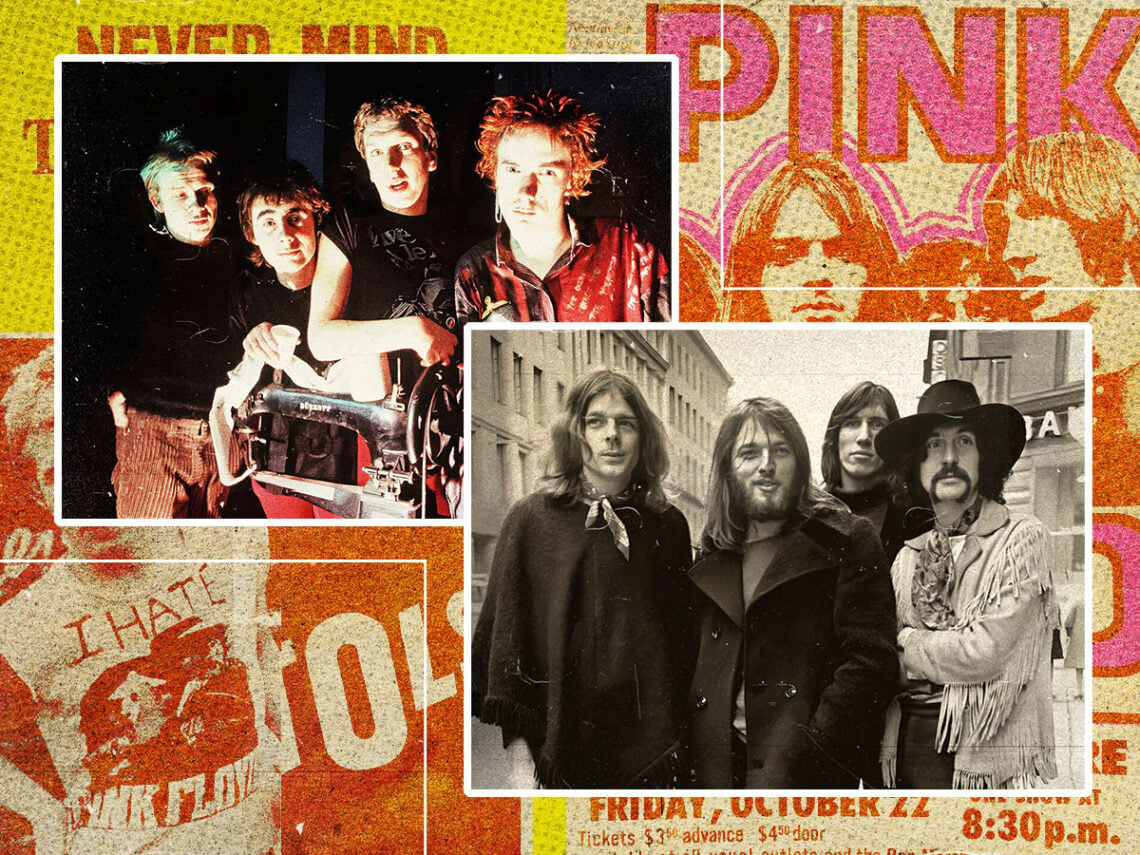
Did Sex Pistols and Pink Floyd really hate each other?

Since their heyday in the mid-late 1970s, Sex Pistols have been closely tied to Pink Floyd. As is well known, the former was at the forefront of the British punk insurrection against the establishment, which allegedly included the latter. Yet, much of this connection is attributed to the legend about a young John Lydon being hired after he was spotted walking down London’s King’s Road in a ragged Pink Floyd shirt with “I Hate” scrawled across it. This T-shirt would become even more iconic when Rotten took to the stage with the band donning it, with each member then taking turns to wear it in public.
Whilst the two groups seemed antithetical, the situation wasn’t exactly black and white. Years after the Pistols broke out, Lydon would clarify his position on Pink Floyd and concede that he had a soft spot for their 1973 masterpiece, The Dark Side of the Moon. Fans of Rotten shouldn’t be too surprised, of course, given that there’s a famous picture of him in circulation sporting long hair in his pre-punk days. Hippies are punks, as they say.
This revelation emerged during a 2010 interview with The Quietus, a conversation in which Lydon revealed he’d turned down an offer to perform with Pink Floyd in Los Angeles. Regarding the infamous T-shirt, he said: “I’ve no idea where I got it from, it being green, which was an oddity . . . not my colour. It might have been something I nicked off a stall”.
Moving onto Pink Floyd’s music, he added: “Listen, you’d have to be daft as a brush to say you didn’t like Pink Floyd. They’ve done great stuff. They’ve done rubbish too. Dark Side of the Moon, I love. But I go right back to when they were with Syd Barrett. But I grew up with all kinds of music.”
Lydon then explained why he didn’t like their “pretentiousness” and argued that Floyd were misrepresented in the press. He said: “What I didn’t like about them was the pretentiousness. There was an aura of ‘Oh, we’re so great there’s no room for anybody else.’ But you know, I’ve met members of the band, and I get on alright with them because they’re not like that at all. There was kind of a misreading and a misrepresentation in the press, and they’re not holier than thou. In fact, they are just like thee and thou.”
Lydon added: “Dave Gilmour I’ve met a few times, and I just think he’s an alright bloke.”
Speaking to Phil Singleton in 2000, former Sex Pistols bassist Glen Matlock, who is credited as a songwriter on ten of the 12 songs on the punk band’s only studio album, Never Mind the Bollocks, also shared some respect for Pink Floyd. Whilst Matlock differed from Lydon in categorically saying, “I don’t like Pink Floyd”, he maintained that their first record, 1967’s The Piper at the Gates of Dawn, is excellent. In fact, taking things a step further, he described it as “the first punk rock record ever”.
Matlock said: “I don’t like Pink Floyd, but I like their first album; it’s like a punk album. I can imagine it in all those swinging Sixties clubs. The Piper at the Gates of Dawn, it’s great; it’s the first punk rock record ever. There’s a spirit and intensity there. It was only recorded in an afternoon, but it’s great.”
Whilst Lydon shared his respect for Pink Floyd, with Matlock also minorly doing so despite maintaining he doesn’t like them, former Pink Floyd leader Roger Waters was less diplomatic in his account of the punk quartet. He was never a fan, and he made that clear. “The Sex Pistols were just trying to make noise,” he told Rolling Stone. “It was so clearly contrived. You know, they were managed by a bloke who ran a shop selling silly clothes!”
Waters somewhat coldly moved on to the death of late Sex Pistols bassist Sid Vicious and the immortalising impact such a young death can have, regardless of the opaque nature of his demise. “And then one of them died, so you got that iconic thing that lives on. If somebody dies, that’s always good. Except for him, obviously, and his mom and dad, and [his girlfriend] Nancy, but for everybody else, it’s brilliant,” he said.
As expected, Gilmour has been a little more balanced than Waters in his account of Sex Pistols. When speaking to Q Magazine in 1999, John Lydon’s infamous T-shirt was mentioned again. Asked if he “hated” the punk band, Gilmour asserted: “No, I thought the Sex Pistols were rather good. I’ve been on a show with Johnny Rotten – it was at Sadler’s Wells – and he said he never really hated Pink Floyd, and actually, he was a bit of a fan. I confess to not having entirely believed it in the first place. I mean, who could hate us?”
Touching on how Pink Floyd reacted to punk’s ascendence, Gilmour said in another conversation: “I don’t think we felt alienated by punk, we just didn’t feel it was particularly relevant to us. We weren’t frightened by it.”
He added: “A lot of good things came out of punk, but there were an awful lot of people leaping on it as a bandwagon, who leapt off when they’d got to the top.”
Interestingly, Pink Floyd drummer Nick Mason also provided a mindful account of Sex Pistols when discussing the age-old tale that their dark 1977 album Animals was partly a response to punk. Speaking to Ultimate Classic Rock in 2022, he explained that if punk influenced the album, it was subliminal. He also said that even if he didn’t necessarily enjoy punk music, it was fascinating how it galvanised the youth.
Mason said: “I think whatever influence punk brought to Animals or, indeed, music at the time, it was subliminal rather than being obvious. It was an influence, but I think for me, I don’t think there was a lot of it that I thought, ‘This is great.’ It was more, well, it’s interesting because it’s returning to the sort of rock ‘n’ roll where teenagers can get together and do this and actually have an audience and do it. It was strange in that respect.”
Surprisingly, the drummer praised punk for killing off prog rock, the genre to which Pink Floyd are often tied. Seemingly agreeing with the above comments from the Sex Pistols members, he said the genre had become “so pompous” at the time of punk’s arrival.
The drummer explained: “I think it was a good thing in terms of dealing with prog rock – which had become so pompous, really – but it wasn’t obvious. I mean, apart from Johnny Rotten having the T-shirt that said ‘I Hate Pink Floyd’. [Laughs.] It’s almost as though they were such separate camps that it would be hard to see quite how the influence of one might influence another.”
