


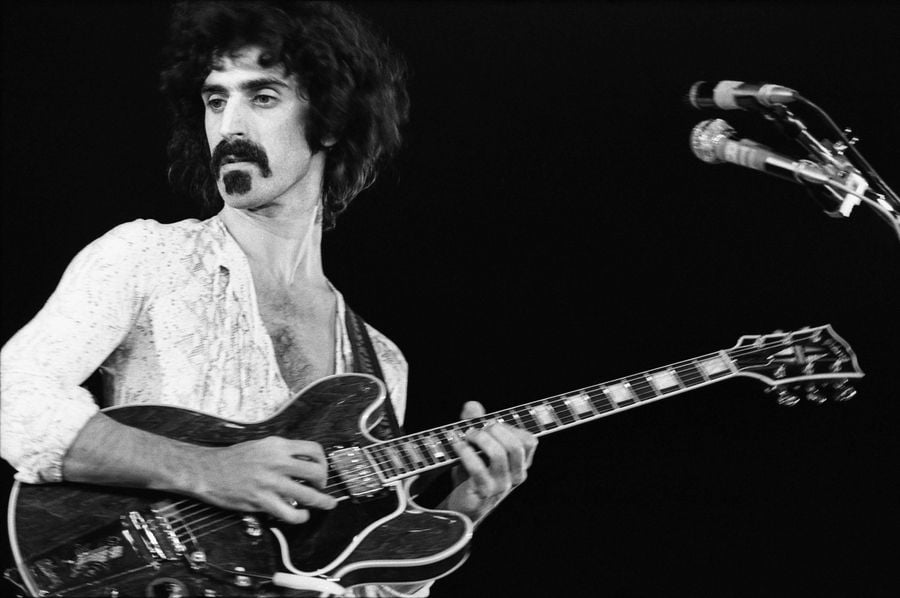
Did Frank Zappa invent ‘The Wave’ back in 1969?

As a good old-fashioned, red-blooded American, I am fascinated by the unwritten codes, secret handshakes, and dark underbelly that exist within our most popular sports. Just as all 50 states act both in tandem and completely separate from the others, American sports have shared traditions that nonetheless are distinct from each other. Some stadiums and teams have codes that no other team has, while pretty much everyone knows you can get a crowd going with ‘Seven Nation Army’.
Take, for instance, the high five. The now-ubiquitous celebratory greeting used by sports figures and everyday Joe’s alike, the high five has a wonderfully convoluted and strangely disputed origin. It would seem as though humans would have been giving out high fives to each other for centuries, but the most accurate origins we can trace back actually come from the late 1970s, when either professional baseball players Dusty Baker and Glenn Burke or college basketball players Wiley Brown and Derek Smith traded high fives for the first time. Since both baseball and college basketball are essential to the fabric of American sport, each has the desire to claim the iconic gesture as its own.
The commonly-believed origin of the wave also usually gets traced back to American sports. This time, it comes from the National Hockey League, when professional cheerleader “Krazy” George Henderson accidentally invented the crowd activity at a Colorado Rockies (now the New Jersey Devils franchise) game in 1980. The stadium activity wasn’t fully popularized until the 1986 FIFA World Cup, when most foreign viewers began associating it with Mexican fans, so interest in where the wave first appeared has remained high.
So is there a chance that the wave didn’t actually come from sports stadiums at all? Perhaps it was at another venue where audience participation has a great effect. That’s where legendary experimental rock icon Frank Zappa comes into the story.
As legend has it, Zappa and the Mothers of Invention were playing at the Denver Pop Festival on June 27th, 1969, when Zappa turned his attention to the audience. The Denver Pop Festival wound up being a watershed moment in rock history, largely because it was the final performance of The Jimi Hendrix Experience before Noel Redding left the band. But it was also perhaps the sight of the first wave ever brought to fruition.
After ‘Some Ballet Music’, Zappa began to conduct the audience instead of his band. On bootlegs of the performance, Zappa can clearly be heard getting his audience to clap in time with his hand movements. Zappa refers to the phenomenon as creating “teenage stereo”, but the roots of the wave can clearly be heard in the rolling bunches of sounds that Zappa gets out of the audience.
It’s when Zappa gets the audience to sing the highest note they can for a brief second that the first remnants of the wave can most clearly be distinguished. Zappa never instructs the audience to do the specific motions associated with the wave, but his desire to get the same action to happen across the rows of audience members is a clear precedent for what the wave would become. Maybe Zappa needs to be remembered as a sports icon all his own.
Check out the phenomenon of Zappa conducting his audience down below.
