


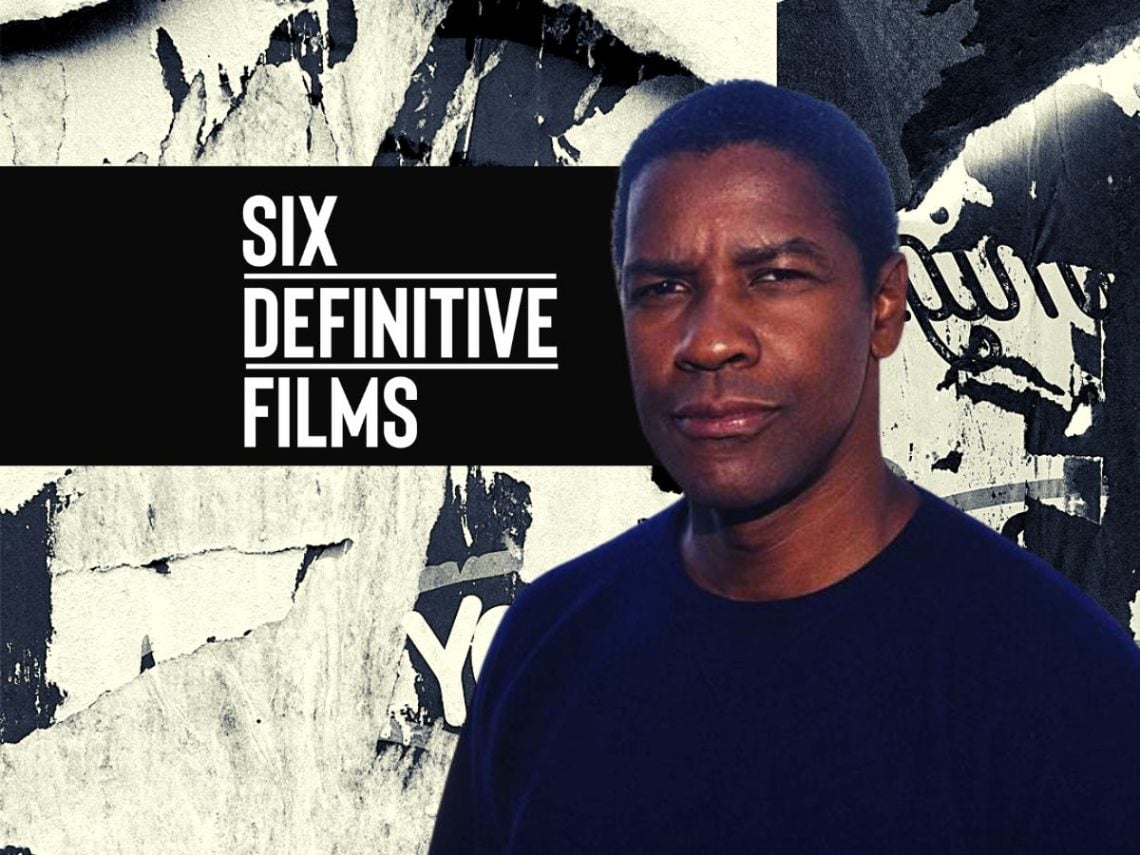
Six Definitive Films: The ultimate beginner’s guide to Denzel Washington

Recognised in critical and commercial circles as one the most influential actors of all time, Denzel Washington Jr. is a contemporary movie star who has changed the definition of what it means to be a Hollywood actor. A true icon of American cinema, Washington has proved himself in collaborations with the likes of Spike Lee, Robert Zemeckis, Ridley Scott and Jonathan Demme.
Starring his career in theatre, starring in an off-Broadway performance of William Shakespeare’s Coriolanus in 1979, Washington first came to industry prominence in the early 1980s when he featured in the medical drama St. Elsewhere with Howie Mandel, Ed Flanders and William Daniels. Before this time, he had only tussled with middling TV roles, and as the small screen began to dominate American homes, Washington became a household name.
The actor unusually attributes his early success to the divorce of his parents when he was just 14 years old. Sending him to the private preparatory school Oakland Military Academy in New Windsor, New York, Washinton would later tell Parade magazine, “That decision changed my life, because I wouldn’t have survived in the direction I was going. The guys I was hanging out with at the time, my running buddies, have now done maybe 40 years combined in the penitentiary. They were nice guys, but the streets got them”.
Instead, Washington pursued a life on the silver screen, becoming one of the most iconic Hollywood stars of the 21st century as a result.
Denzel Washington’s six definitive films
Glory (Edward Zwick, 1989)
After taking bit-parts in several minor movies of the early 1980s, Washington’s first glimpse of success came in the aforementioned TV series St. Elsewhere. It was here that industry experts would scout his name for future projects, casting him in the 1989 war film Glory, directed by Edward Zwick. Playing Pvt. Trip, a volunteer for the US army’s first all-black company, Washington delivered an astonishing performance.
So significant was his first major role that Washington received an Academy Award for his performance in the war drama, outshining his fellow screen stars, Matthew Broderick, Morgan Freeman, Andre Braugher and Cary Elwes.
Malcolm X (Spike Lee, 1992)
Having emerged from relative obscurity at the turn of the 1990s, Washington’s rise through the Hollywood ranks came with considerable pace, appearing in the Spike Lee romance Mo’ Better Blues in 1990. Forming a strong bond, Lee would later call upon the actor’s expertise for his biopic of the life of civil rights campaigner Malcolm X, with Washington dedicating an emotional performance to the 20th-century icon.
Nominated for an Oscar for his remarkable leading role, Lee’s 1992 biopic might just be the most important movie from Washington’s filmography, with the movie demonstrating to Hollywood that he was capable of being a powerful leading man.
Philadelphia (Jonathan Demme, 1993)
After two turns in supporting roles, featuring in both Much Ado About Nothing and The Pelican Brief in 1993, Washington returned to being a glittering Hollywood lead when he co-starred with Tom Hanks in the influential drama Philadelphia. Helmed by Jonathan Demme, the same mind behind the iconic horror flick The Silence of the Lambs, the seminal movie tells the story of Andrew Beckett (Hanks), a man with HIV who is fired from his law firm because of his condition.
Washington’s Joe Miller is the homophobic lawyer hired to defend the man, taking on a new perspective of the world as he grows a stronger emotional connection to his client. The actor’s appearance in the celebrated movie consolidated his name in contemporary cinema.
Training Day (Antoine Fuqua, 2001)
By the turn of the new millennium, Washington had already been established as one of the finest actors of modern Hollywood, with his 1998 collaboration with Spike Lee for He Got Game further proving this. Having largely starred in dramatic roles, in the 2001 movie Training Day directed by Antoine Fuqua, Washington broke into significant new ground, appearing as a gruff action star and bent copper Alonzo.
Earning another Academy Award for his efforts in the movie, Washington drags the film into commercial relevance, elevating David Ayer’s script as well as the performance of his supporting actors, Ethan Hawke, Eva Mendes and Snoop Dogg.
Flight (Robert Zemeckis, 2012)
Between the release of Training Day in 2001 and the 2010s, Washington’s career morphed into something altogether more generic. Taking on an influx of action roles in Tony Scott’s Deja Vu in 2006 and The Taking of Pelham 123 in 2009 before appearing in the apocalyptic action movie The Book of Eli in 2010 and Safe House in 2012, Washington’s career arguably became tainted with far more ‘misses’ than ‘hits’.
His fortunes changed when he switched back to the realm of Hollywood drama, collaborating with Robert Zemeckis for the dramatic thriller Flight, where the actor starred as Whip Whitaker, an airline pilot who saves almost all his passengers on a plane despite being under the influence of alcohol. Rightfully being nominated for an Academy Award for his efforts, Washington shined in an ensemble cast that included Don Cheadle, John Goodman and Kelly Reilly.
The Tragedy of Macbeth (Joel Coen, 2021)
Realising that he was significantly more successful whilst starring in dramatic roles, as the 2010s came to a close, Washington’s action movie projects began to ebb away. Sure, he still found moderate success with The Equalizer in 2014 and its sequel in 2018, but the actor was never cut out for the action genre, as his directorial debut, the emotionally-wrought drama, Fences, proved in 2017.
More recently, Washington’s career came full circle after he took the starring role in Joel Coen’s adaptation of Shakespeare’s The Tragedy of Macbeth with Frances McDormand and Brendan Gleeson. 42 years after he starred in the stage adaptation of Coriolanus, Washington returned to the work of the iconic British playwright and proved why he was born to deliver the material, speaking each line like he lived and breathed the material.
Though he was nominated for an Academy Award, Washington was unlucky enough not to claim his third Oscar, losing out to Will Smith in King Richard. Still, Academy Awards do little to demonstrate the true significance of Denzel Washinton’s staggering career.
