


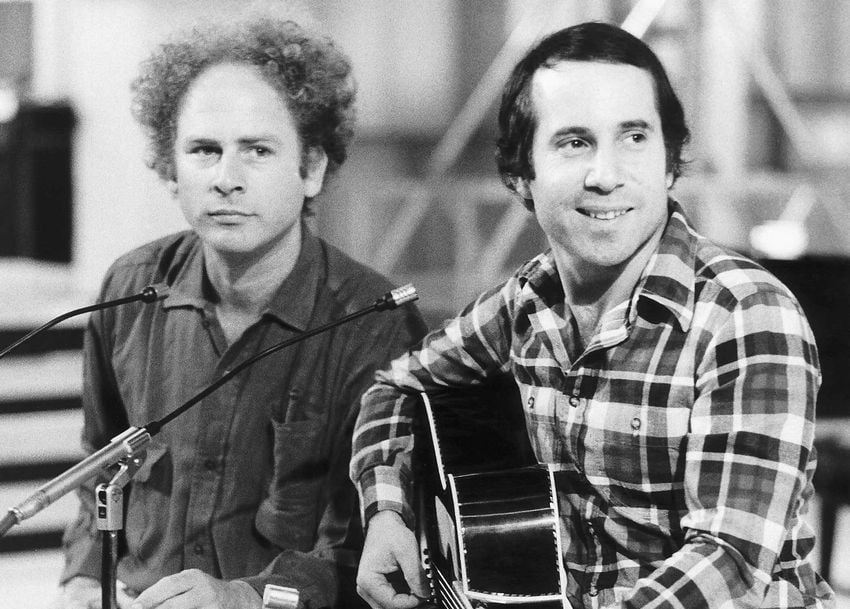
Debunking the myth around Simon & Garfunkel’s ‘Bridge Over Troubled Waters’

There’s nothing like an excellent musical tale to enliven your local history. In fact, from where I sit writing this piece, in South London, there are several unremarkable pieces of musical history. About 200 yards south is one of the first pubs that Kate bush and her band ever performed live, and about 500 yds further south is a bus stop from which David Bowie would often disembark. However, a spot in East Devon has long since claimed one landmark to be inextricably linked to the Simon & Garfunkel song ‘Bridge Over Troubled Water’.
Hitting number one in 1970, the song is one of the duo’s finest moments. A combination of hymnal hyperbole and the kind of melodic practises that made Paul McCartney wince in jealousy, the song has gone on to define the duo that spawned it as well as a generation of music listeners. It, alongside other greats from the folk era, has become anthemic in its purity and archetypes of its genre. It cannot be understated how foundational the song is. However, what can be contemplated and, unfortunately for those in Devon, completely dispelled, is that the song was written about a bridge near Bickleigh.
However, there is good cause for thinking so. Paul Simon and Art Garfunkel spent a lot of time in England during the end of the 1960s when the song was written. They also happened to find themselves in Devon for a large chunk of their time here. The duo also visited the site of Bickleigh Bridge, a picturesque spot in East Devon. However, on a promotional tour in 2003, Garfunkel confirmed the song was inspired by sources closer to their home: “No – I’m sorry about that! ‘Bridge Over Troubled Water’ is a gospel phrase which Paul took from a gospel group. It was in a Baptist church hymn. He liked the phrase, and he used it.”
In truth, things were far deeper. The final song that Simon & Garfunkel ever recorded together, ‘Bridge Over Troubled Water’, ranks as one of the best tracks in musical history. An iconic folk tale steeped in the personal problems of its writer Paul Simon and his professional partner Art Garfunkel. While the track will forever be attached to both the legendary singers’ Paul Simon and Art Garfunkel, the song is deeply rooted both in Simon’s past and his then-present. While the material dealt with artistic and professional issues he was having with Art; the song was also rendered with the spiritual sounds of his teenage years.
Simon had always harboured an interest in gospel since hearing Sonny Til and the Orioles’ epic recording of ‘Crying in the Chapel’ as an adolescent. He told CBSN: “I loved the emotion of the singers and the songs, and there was something mysterious just about the word chapel because I didn’t know, at twelve or thirteen, what a chapel was or looked like. It probably would have been different if they had sung, ‘Cryin’ in the Synagogue.'”
One particular track on the Silvertones’ album, ‘Oh Mary Don’t You Weep’, is a deeply spiritual song from darker days before the Civil War. Reverend Claude Jeter, the band’s lead singer, added a phrase which could be traced back to the church: “I’ll be a bridge over deep water if you trust in my name”. It was here that something sparked in Paul Simon. Simon, speaking to the CBSN, said of writing the now-iconic melody: “It was just like that. The essence of the song took maybe twenty minutes; the first two verses were done in two hours. And the melody was something like fifteen notes, which is long. I thought, ‘This is better than I usually write.'”
So, while the song’s inspirations are purely hymnal and removed from a quaint bridge in Devon, during his conversation in 2003, Garfunkel did confirm that the county was included in the duo’s discography. In Simon’s classic song ‘Homeward Bound’, he begins by singing, “I’m sitting in a railway station…” a line Garfunkel confirmed was penned in Widnes station. Now, that’s a win for Devon if ever I saw one.
