


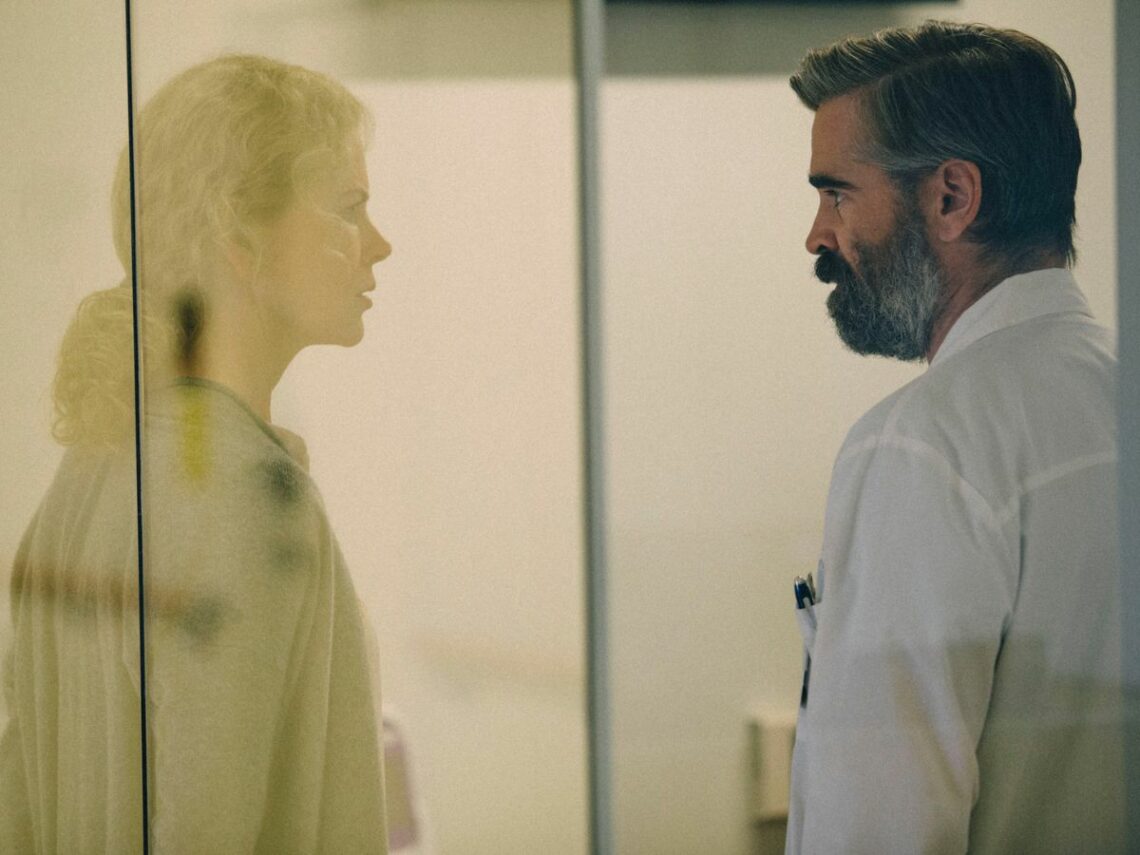
Understanding the strangely deadpan performances of ‘The Killing of a Sacred Deer’

Yorgos Lanthimos‘ horror thriller The Killing of a Sacred Deer has everything you might expect from the director: deadpan acting, strange dialogue, and themes that delve into pessimistic worldviews or the deep realm of Greek tragedy. Inspired by Iphigenia in Aulis by Euripides, The Killing of a Sacred Deer perpetuates Lanthimos’ unwaveringly idiosyncratic style, delivering performances poised to either elevate or challenge the viewer’s cinematic experience.
Amid the Hollywood cycle, Lanthimos’ talent is one not to be reckoned with. With the Emma Stone-fronted Poor Things set for imminent release and Barry Koeghan’s skyrocket to fame following movies like Saltburn and The Banshees of Inisherin, The Killing of a Sacred Deer is having a popularity resurgence.
The film follows Colin Farrell’s Dr Steven Murphy, a heart surgeon leading an idyllic existence with his wife and two children. However, the tranquil setting takes a dark turn when Koeghan’s Martin, the teenage son of Steven’s former patient, gradually integrates himself into his world. As Martin’s involvement escalates and crosses boundaries with Steven’s family, the decision to expel him comes at a heartbreaking cost for the surgeon.
Seeking revenge for his father’s death on Steven’s operating table, Martin’s vendetta takes a horrifying turn when Steven’s young son, Bob, mysteriously falls ill, followed by his daughter, Kim. Steven is then faced with a grim choice — killing one or letting them all die. The film does well to embody typical emotional family drama while elevating it to an unconventional horror experience through its peculiar dialogue.
This stylistic choice offers a simple yet impactful addition to the film that infuses profound meaning into how the characters communicate. According to Lanthimos, every choice was made to create a world filled with ambiguity, particularly in relation to Martin. “We’re trying to create a balance, which you don’t find every day in life,” he explained, “We didn’t want him to appear as evil or naïve.”
When asked about the rhythm of the film’s dialogue, Lanthimos explains how different actors approach his meticulously crafted settings, with some already possessing an understanding of how to deliver the lines. “All the talented and smart actors, they get it; as soon as it comes out of their mouth, they know if it’s right or wrong,” he says. “If the writing has a particular voice, they get it, and they can hit it.”
Therefore, the unsettling, blunt and matter-of-fact dialogue served to accompany the narrative and overarching aesthetic. Across many of his films, like The Lobster and Dogtooth, the dialogue perfectly matches the atmosphere that Lanthimos creates. As he put it: “Weirdly enough a lot of it comes logically for us,” he told Cine-Vue. “When you create a certain set-up and situation, it leads you to a certain way of solving problems.”
Continuing, the director adds: “This kind of extreme and strange situation, you have to solve these problems with logic, so it ends up being absurd but at the same time it’s because it starts from one thing and logically ends up there.”
